




Clashes erupt at JNU during march over UGC rules, several injured and 14 arrested
- In Reports
- 02:50 PM, Feb 27, 2026
- Myind Staff
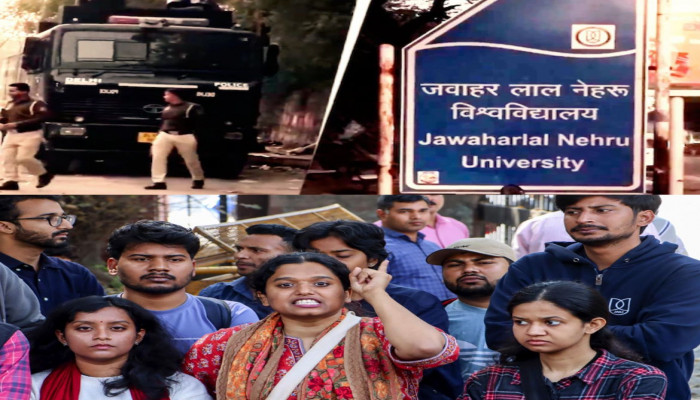
Violence broke out at Jawaharlal Nehru University (JNU) in Delhi after students attempted to march towards the Ministry of Education as part of a protest against University Grants Commission (UGC) norms and other demands. The protest, called a “Long March” by the Jawaharlal Nehru University Students’ Union (JNUSU), led to clashes between students and the police, leaving both sides injured. While police accused students of assaulting officers, throwing objects and even biting them, the students alleged that they were manhandled and taken to “undisclosed locations.”
The protest was organised to highlight several demands, including opposition to the recent rustication of student leaders, implementation of UGC regulations, and support for the proposed Rohith Act. Police had issued an advisory stating that permission had not been granted for any march outside the campus. Despite this, around 400 to 500 students gathered and began marching from the campus towards the Ministry of Education. At around 3:20 pm, the group moved toward the University’s main gate to march further. In response, police set up barricades outside the campus to stop them.
As the protesters reached the gate around 4 pm, tensions rose, and a clash began at about 4:15 pm. According to videos accessed from the protest site, some students allegedly associated with JNUSU were seen slapping police personnel, abusing security staff, and throwing sticks. In one of the videos, a PhD student named Nitish was seen climbing a wall inside the campus and allegedly provoking students while speaking about teaching the police a lesson. Another video showed a student identified as Shrey allegedly slapping a police officer. A third clip reportedly showed students abusing security personnel deployed outside the campus and throwing a stick at a Rapid Action Force (RAF) jawan.
Police said that barricades placed outside the campus were damaged as the situation escalated. A senior police officer told news agency PTI, “Barricades placed outside the campus were damaged as the situation escalated. The protesters pelted banners and sticks, threw shoes and resorted to physical assault. Some police personnel were bitten during the scuffle, resulting in injuries to several officers deployed at the spot.” Around 25 police personnel, including senior officers, were reported injured. Police also said that they pushed the protesters back inside the campus grounds.
On the other hand, students claimed that the police used excessive force. During a court hearing, a female student said that four to five men in plain clothes dragged her away from the crowd, which caused blood clots and an injury on her arm. Another accused student said that the claim that they were marching toward India Gate was wrong and clarified that they were heading to the Ministry of Education. The prosecution argued in court that the protest was not peaceful and that violence had been used. It stated that students had scuffled with police officers, who also suffered injuries. The prosecution also said that the accused had protested earlier as well and had used force in the past. Four different FIRs had been registered previously.
The court observed that the police had submitted that around 300 people were marching toward India Gate without permission when barricades were installed. The court said, “Assault on police officials is serious and cannot be permitted under the garb of a peaceful protest.” By the end of the day, more than 51 people had been detained, and 14 were formally arrested. On Friday morning at 7:30 am, the police made official arrests of 14 protesters. At 9:30 am, they were produced before the Patiala House Court, where judicial custody was sought.
JNUSU president Aditi Mishra and former president Nitish Kumar were among those detained after they tried to leave the campus. Police said they detained some protesters to maintain law and order at the university gates. However, several students claimed that after detention, some protesters were taken to “unconfirmed locations.” The JNU Teachers’ Association (JNUTA) also raised concern about this and expressed worry for the safety of the detained students.
JNUSU further alleged that a portrait of BR Ambedkar was damaged during the police action. Videos claiming to show this incident circulated on social media, though their authenticity could not be independently verified.
In an official statement, the university administration said, “JNUSU protestors are demanding UGC regulations to be implemented. This is in violation of the Honourable Supreme Court, which issued a stay on the regulations. JNU Vice Chancellor or Registrar have no powers over the regulations.” The administration also said that students had “refused to address the core issue of students who were rusticated for ‘vandalism and violence’ unleashed inside the campus.” It added that disciplinary action had been taken after a proctorial inquiry as per proper procedure.
The university further stated, “JNU is a public university, hence accountable to the government, the Parliament and the Indian taxpayers. It is deplorable that a woman OBC Vice Chancellor is instead attacked on false allegations, only to divert from the issue of violence and vandalism of public property.” Meanwhile, police rejected allegations of manhandling.
Speaking to PTI, police said, “We have detained some of the protestors. Some protestors are levelling allegations that police manhandled them which are completely baseless. Every single officer deputed there was maintaining law and order.”
According to the protest timeline, JNUSU claimed that RAF personnel were deployed inside the campus at 11 am. At 12 noon, the students’ union gave a call for a protest. The march began at 3 pm, and protesters reached the main gate at 4 pm. The clash started at 4:15 pm, and detentions began by 4:30 pm. At 6:30 pm, JNUSU issued an SOS call asking students to gather at the protest site. At 10:30 pm, police registered an FIR under non-bailable sections. At 11 pm, JNUSU announced a protest march to Vasant Kunj North police station demanding the release of detained protesters, but they were stopped inside the campus.
The students’ demand charter included enacting UGC regulations along with the Rohith Act, the resignation and apology of the JNU Vice-Chancellor, and strengthening funding for public institutions. The protest has taken place amid continuing disagreements at JNU over administrative authority, student discipline and the implementation of education policies. Both the administration and student groups continue to blame each other for the violence and unrest on campus.



 Loading...please wait
Comments