




CJI Suryakant forms four special benches to fast track Supreme Court's oldest pending cases
- In Reports
- 12:55 PM, Jul 13, 2026
- Myind Staff
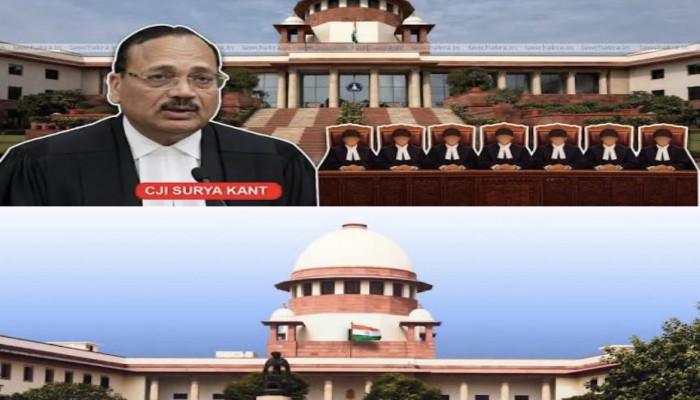
Chief Justice of India (CJI) Surya Kant has launched a major initiative to speed up the disposal of the Supreme Court’s oldest pending cases. Under a new roster that came into effect on July 13, four special division benches will exclusively hear long-pending civil and criminal matters. The move marks the Supreme Court’s first structured docket-management exercise in recent years and aims to ensure that old cases receive continuous judicial attention instead of getting delayed further.
The initiative comes as the Supreme Court resumes its regular functioning after the partial working schedule during the peak summer months. Court officials have identified around 800 of the oldest pending matters for faster disposal in the first phase. These cases will now receive focused hearings through dedicated benches instead of being mixed with the court’s regular workload.
Speaking to Hindustan Times, CJI Surya Kant said the decision reflects the judiciary’s commitment to restoring public confidence in the justice delivery system. He said the Supreme Court wants to ensure that people waiting for justice for several years receive timely attention.
“The judiciary’s foremost obligation is not merely to decide cases, but to decide them within a timeframe that preserves the faith of citizens in the rule of law. Every old pending matter represents a litigant who has waited years, and sometimes decades, for closure. The age of a case cannot become the reason for its continued neglect. By constituting dedicated benches to exclusively hear the oldest civil and criminal matters, the Supreme Court seeks to institutionalise a culture where long-pending litigation receives sustained and uninterrupted judicial attention,” the CJI said on Sunday.
Justice Kant further said, “Every old case that reaches its logical conclusion reinforces the credibility of the justice delivery system and reaffirms the constitutional promise that justice shall not be defeated by the passage of time.”
According to the new roster notification, two division benches will deal exclusively with the oldest civil cases on non-miscellaneous days, which include Tuesday, Wednesday and Thursday. These benches will function under Justices PK Mishra and SVN Bhatti. Two other division benches, led by Justices Manoj Misra and Ujjal Bhuyan, will hear the oldest criminal matters on the same working days.
The roster notification states, “Two Division Benches, headed respectively by Hon’ble Mr Justice PK Mishra and Hon’ble Mr Justice SVN Bhatti, shall exclusively deal with the oldest Civil Matters on Non-Miscellaneous days...Two Division Benches, headed respectively by Hon’ble Mr Justice Manoj Misra and Hon’ble Mr Justice Ujjal Bhuyan, shall exclusively deal with the oldest Criminal Matters on Non-Miscellaneous days...”
People familiar with the development told Hindustan Times that each of the four benches will initially hear nearly 200 of the oldest pending cases. This brings the total number of identified cases to around 800. The Supreme Court plans to give these matters uninterrupted attention so that hearings move forward without frequent delays.
The decision is one of the first major administrative reforms introduced by CJI Surya Kant after taking office. It reflects his approach of reducing pendency through planned judicial management instead of short-term disposal drives. The initiative seeks to create a long-term system that regularly addresses old cases and prevents them from remaining pending for years.
The scale of the pendency challenge remains significant. According to the National Judicial Data Grid (NJDG), the Supreme Court currently has 95,911 pending cases. This includes 74,145 civil matters and 21,766 criminal matters. Among these, 37,826 cases, or around 39.4 per cent, are less than one year old. This shows that a large number of older cases still await final hearings.
The four special benches will spend three working days every week hearing only these legacy cases. This arrangement will keep them free from the routine burden of miscellaneous matters and allow them to focus entirely on long-pending litigation.
The reform also follows Justice Kant’s recent remarks on the growing pendency of cases across the country. While inaugurating the Silver Jubilee celebrations of the Indian Institute of Arbitration and Mediation (IIAM), he said that reducing the massive backlog requires more than regular court proceedings.
“Indian courts currently carry more than five crore (50 million) cases...No adjudicatory model, however well-resourced, resolves a backlog of that scale on its own. It has to be met partly outside the courtroom, not as a matter of convenience, but as a matter of arithmetic,” he had said, stressing that arbitration, mediation and online dispute resolution must function as complementary pillars of the justice delivery system.
His remarks highlighted the need to strengthen alternative dispute resolution methods to reduce the number of new cases entering courts. The latest roster notification shows that the Supreme Court is also introducing internal reforms to improve its own case management and reduce its pending workload.
The dedicated benches are expected to ensure that older cases receive regular hearings without interruptions caused by changing rosters or urgent matters listed before the court. The initiative also reflects the Chief Justice’s broader administrative focus on improving judicial efficiency through structured docket management while delivering faster justice to litigants who have waited for years for their cases to reach a conclusion.



 Loading...please wait
Comments