



CJI slams NCERT over a section on ‘Judicial Corruption’, says action will be taken
- In Reports
- 04:19 PM, Feb 25, 2026
- Myind Staff
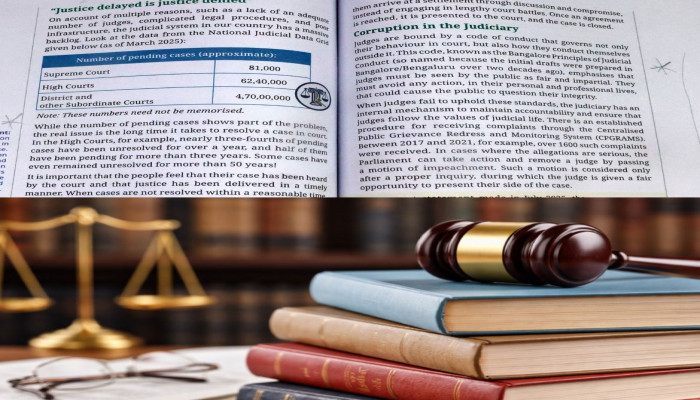
The Supreme Court on Tuesday expressed serious concern over a new Class 8 NCERT Social Science textbook that contains a section on “corruption in the judiciary.” Chief Justice of India (CJI) Surya Kant said the court would take action in the matter and made it clear that the judiciary’s integrity cannot be questioned.
Taking note of the issue on his own, the CJI said he had been receiving many calls and messages about the textbook, including from judges of various High Courts. The matter was raised in court by senior advocate Kapil Sibal, who said that members of the legal community were deeply disturbed by the inclusion of the topic in a school book.
“We as senior members of this institution are very disturbed at ‘judicial corruption’ being part of the Class 8 books,” Sibal told the court.
Responding to this, the CJI said he was already aware of the issue. “I’m getting a lot of calls and messages about this, also from judges of the HCs,” he said.
He then made a strong statement defending the institution. “I will not allow anyone to defame and question the integrity of the judiciary,” CJI Surya Kant said. He added that the matter appeared serious and that the court would not hesitate to act. “It seems to be a calculated and deep-rooted attack on the judiciary. We will not allow anyone to target the judicial institution,” he further said.
The Chief Justice also made it clear that action would be taken regardless of how high the matter reached. He stressed that the court would not permit any attack on the judicial institution.
Another senior advocate present in court, Abhishek Singhvi, also shared his concerns. He argued that the way the issue was presented in the textbook appeared selective. “It’s as if corruption exists only in the judiciary. There is no word about politicians, ministers, bureaucrats or anyone else,” Singhvi told the bench.
He further said, “The selectivity, my Lord. The selectivity... It is there in other areas also but judicial corruption.”
At this point, Justice Joymalya Bagchi also made an observation. He said, “Constitutional integrity to the basic structure is missing in the structure of the book.”
The controversy is related to a revised NCERT Social Science textbook for Class 8 students. The book includes a chapter titled ‘The Role of the Judiciary in Our Society’. In this chapter, there is a section that discusses corruption in the judiciary and the issue of pending cases in courts across the country.
The textbook explains that the Supreme Court is currently burdened with around 81,000 pending cases. It lists several reasons for this backlog, including a shortage of judges, complicated legal procedures, and a lack of proper infrastructure.
According to the revised text, High Courts across India have more than 6 million pending cases. It also mentions that lower courts are dealing with over 40 million pending cases.
While the chapter talks about the challenges faced by the judiciary, its focus on how corruption affects the credibility of courts has led to strong reactions. Critics argue that highlighting judicial corruption in a school textbook without discussing corruption in other institutions creates an unfair impression.
The revised textbook is expected to be released in the market soon.
The NCERT textbook issue has emerged at a time when relations between the judiciary and the government have already been tense over other matters. One major point of disagreement has been the system of appointing judges to the Supreme Court and High Courts.
In 2015, the Supreme Court struck down the National Judicial Appointments Commission (NJAC) Act. The Act had been passed by Parliament to replace the existing collegium system of judicial appointments.
Under the collegium system, senior judges of the Supreme Court recommend names for appointment and transfer of judges. The NJAC, on the other hand, had proposed a different system. It suggested that appointments should be made by a commission that included the Chief Justice of India, the law minister, two senior judges, and two eminent persons.
The government had supported the NJAC as a more balanced and transparent system. However, the Supreme Court ruled it unconstitutional and restored the collegium system.
In recent times, former Law Minister Kiren Rijiju and former Rajya Sabha Chairman Jagdeep Dhankhar have raised concerns about the current system. They have argued that the judiciary should not have the final say in appointments.
During his time as Law Minister, Rijiju had said that the collegium system places an additional burden on judges. According to him, judges are required to appoint other judges while also handling a large number of pending cases.
Speaking at the 2022 India Today Conclave in Mumbai, Rijiju strongly criticised the Supreme Court’s decision to strike down the NJAC Act. He said the court should have suggested an alternative system if it found NJAC unsuitable.
“It is not only the government or the judiciary that would decide. This is what the National Judicial Appointment Commission suggested. It would be the combined efforts of the CJI, the law minister, two senior judges, and two eminent personalities that would choose the names for elevation,” he said.
He also added, “Nowhere else in the world exists a system in which judges appoint judges.”
The latest controversy over the NCERT textbook has now added another flashpoint between the judiciary and the executive. With the Supreme Court taking strong note of the issue and the CJI assuring action, the matter is expected to see further developments in the coming days.



 Loading...please wait
Comments