




Civilisational Definition of Real Intelligence
- In History & Culture
- 10:55 AM, Apr 28, 2026
- Gargi Joshi
What is intelligence? Who do we call intelligent? How do we develop it in our children, in the next generation of Bharat?
I have been thinking about this a lot, not as an academic question, but as a mother.
We all use the word “intelligent” very casually. A child who scores well is called intelligent. A child who remembers quickly is called intelligent. A child who speaks smartly is called intelligent. But somewhere, I kept feeling this cannot be the full picture.
Then I came across this beautiful shloka in Ami Ganatra’s book Why Are We This Way? I paused at it because it seemed to define intelligence in such a different and much deeper way. I wanted to understand it simply. But as I looked into it more, I realised this one shloka contains an entire philosophy of learning, education, and even parenting.
And while trying to understand it better, I also looked up what Sadhguru says about education and intelligence. That made the whole picture even clearer.
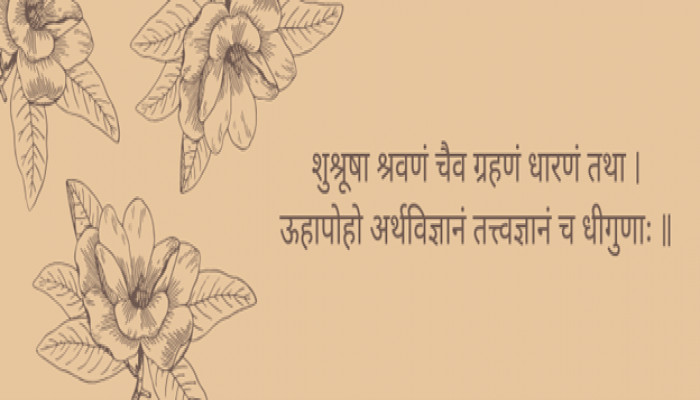
The shloka is this:
शुश्रूषा श्रवणं चैव ग्रहणं धारणं तथा ।
ऊहापोहो अर्थविज्ञानं तत्त्वज्ञानं च धीगुणाः ॥
Transliteration:
śuśrūṣā śravaṇaṃ caiva grahaṇaṃ dhāraṇaṃ tathā |
ūhāpoho arthavijñānaṃ tattvajñānaṃ ca dhīguṇāḥ ||
Its simple meaning is:
These are the qualities of intelligence: desire to learn, listening, grasping, retention, reasoning, understanding meaning, and knowledge of truth.
Just look at how profound that is.
This shloka does not say intelligence is marks.
It does not say intelligence is memory alone.
It does not even say intelligence is reasoning alone.
It says intelligence is a journey.
That was my first big takeaway.
So, who is truly intelligent?
According to this shloka, an intelligent person is not just someone who knows a lot. Not just someone who can argue. Not just someone who performs well in exams.
A truly intelligent person is someone who: wants to learn, listens properly, grasps what is taught,
retains it, thinks through it, understands its meaning and finally sees the truth or principle behind it.
When I read that, it felt like such a complete answer.
And honestly, it also exposed the gap in how we usually think about education.
Today, we often focus on information, syllabus, marks, and competition. Sadhguru has also said something similar - that modern education has become too informative and not inspirational enough. It fills children with content, but does not always kindle the thirst to know. That line stayed with me.
Because that is exactly where the problem begins.
Let us understand this with a simple student example
Suppose a child is learning a simple equation:
2x + 3 = 11
The teacher says:
“To solve this, subtract 3 from both sides first. Then divide by 2.”
Now, let us see how this shloka explains the whole process of learning.
1. शुश्रूषा - the desire to learn
This is the starting point.
Before learning begins, the child must actually want to know.
This is not knowledge yet. It is the inner attitude:
“I want to understand.”
“Teach me.”
“I am open.”
“There is something here worth learning.”
Two children may sit in the same classroom. One is curious and eager. The other is bored and just waiting for class to end. The first child has already shown the first sign of intelligence.
This is such an important insight for parents and teachers.
We often jump straight to teaching. But the shloka tells us that before teaching, there has to be readiness.
Sadhguru says the role of a teacher is to kindle the thirst for knowledge. I found that line so powerful. Because if that spark is alive, the child will learn. If it is dead, even the best textbook will not help much.
So, the first duty of pedagogy is not pressure. It is awakening interest.
2. श्रवणम् - listening
Then comes listening.
Not just hearing sounds. Not just sitting in class. But attentive listening.
The teacher says:
“An equation stays balanced if you do the same thing to both sides.”
A distracted student hears noise.
An attentive student actually listens.
This seems so simple, but it is not.
In today’s world, children are surrounded by constant distractions. So much is said, shown, sent, and taught - but how much is actually heard deeply?
The Vedic tradition gives a central place to श्रवण for this very reason. Knowledge has to be properly received.
For me, this was another big reminder: if we want intelligent children, we must create spaces for attention. Too much stimulation, too much hurry, too much noise - all this weakens learning.
3. ग्रहणम् - grasping
Now comes grasping.
The student understands what the teacher is saying:
“To solve 2x + 3 = 11, subtract 3 from both sides first, then divide by 2.”
At this stage, the student may not know algebra deeply. But the student gets the method.
They can say:
“Okay, I see what the teacher is doing.”
That is ग्रहणम्.
This is basic comprehension.
And this is where a lot of teaching quietly fails. We often assume that because we explained, the child understood. But understanding cannot be assumed. It has to be checked, supported, and built carefully.
4. धारणम् - retention
Then comes retention.
What was grasped should not disappear immediately.
After class, the student should still remember:
what the teacher explained,
the steps of the method,
the example used.
If the child says, “Yes, yes, I understood,” and forgets it all in five minutes, then retention is weak.
What I loved here is the balance of the shloka. It does not dismiss memory. It simply refuses to reduce intelligence to memory.
Memory matters. But memory alone is not intelligence.
So, pedagogy must support retention properly - through revision, repetition, recall, practice, and stability.
Sadhguru says education should not just make children into “knowledgeable idiots” - full of information but lacking perception. That is a harsh phrase, but it hits home. Retention must support deeper understanding, not become the end goal.
5. ऊहापोहः - reasoning and testing
Now comes reasoning.
This is the stage where the child starts thinking actively.
The student asks:
Why does this work?
What if the numbers change?
Would this method work elsewhere?
What is correct and what is wrong?
Then the child notices:
“If I subtract from only one side, the equation becomes unbalanced.”
“So this is not random.”
“There is logic behind it.”
This is beautiful because now the child is no longer just repeating. The child is examining.
This is where passive learning becomes active learning.
Sadhguru says the intellect is like a scalpel - it cuts, analyzes, discriminates. That image fits perfectly here. Reasoning is necessary. But the shloka is careful: it includes reasoning, but it does not stop there.
That is very important.
Because today, many people think a sharp argument itself is intelligence. This shloka says no - reasoning is one stage, not the final stage.
6. अर्थविज्ञानम् - understanding meaning
Now we go deeper.
Earlier, the student knew:
“Subtract 3 from both sides.”
Now the student understands:
“The point is to isolate the variable while preserving equality. That is why the same operation must be done to both sides.”
Now the student understands not just the step, but the meaning.
This is a huge shift.
This is where knowledge becomes alive.
I found this especially useful because it helped me see the difference between a child who can “do” something and a child who actually “understands” it.
That difference matters in every subject - maths, science, language, scripture, life.
7. तत्त्वज्ञानम् - knowledge of truth
Finally comes तत्त्वज्ञानम्.
This is the deepest stage.
Now the student no longer knows only this one example. The student sees the underlying principle:
“Solving equations is about preserving relationships while uncovering the unknown.”
Now the child can solve fresh problems independently.
This is the essence. This is the truth. This is a principle.
And in spiritual learning, this becomes even more profound. It means not just knowing the words, but seeing the truth the words point to.
Sadhguru often says education should build capability, not just a qualification. I felt that fits beautifully here. When the principle is seen, the child becomes capable.
What does this mean for us?
As parents, teachers, professors, and policy makers, this shloka gives us a very clear framework.
If we define intelligence wrongly, our whole education system will go wrong.
If we think intelligence means marks, we will build exam factories.
If we think intelligence means memory, we will build repeaters.
If we think intelligence means argument, we will build debaters.
But if we understand intelligence as this shloka defines it, we will build human beings.
This is the progression:
interest → listening → grasping → retention → reasoning → meaning → truth
What a complete framework for pedagogy.
This means:
Parents must awaken curiosity, teachers must inspire attention, schools must teach for understanding, professors must go beyond information, and policy makers must design systems that build capability, not just credentials.
To me, this shloka from the Jñāna Sukta of the Rig Veda is not just a definition of intelligence. It is a civilisational answer to a very modern problem.
And the more I sat with it, the more I felt: this is exactly the kind of clarity we need if we want to raise a generation in Bharat that is not just successful, but truly intelligent, deeply rooted, and wise.
Disclaimer: The opinions expressed within this article are the personal opinions of the author. MyIndMakers is not responsible for the accuracy, completeness, suitability, or validity of any information on this article. All information is provided on an as-is basis. The information, facts or opinions appearing in the article do not reflect the views of MyindMakers and it does not assume any responsibility or liability for the same.



 Loading...please wait
Comments