




Churachandpur: North-East India’s HIV Epicentre
- In Current Affairs
- 11:54 AM, Aug 07, 2026
- Ankita Dutta
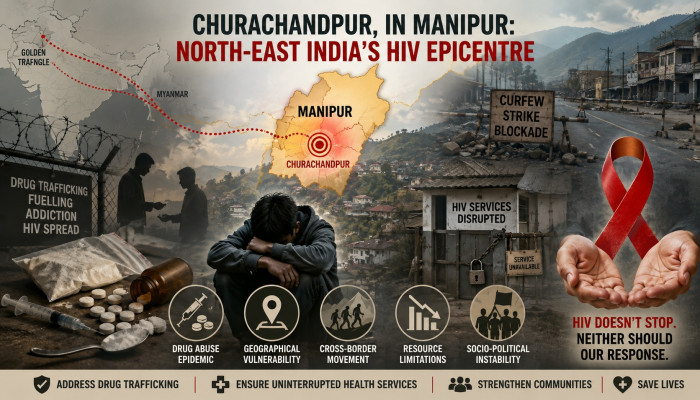
The state of Manipur is at the centre of the international drug trafficking network. The twin epidemics of drug abuse and HIV-AIDS prevailing here can be understood as a consequence of illegal drug trafficking. Quite understandably, the HIV epidemic in Manipur is much more severe and long-standing compared with the rest of the North-Eastern states. Coupled with this, the state’s unstable socio-political situation, such as the imposition of sudden curfews, strikes and blockades, etc. and complex patterns of cross-border movement of people have inhibited the timely delivery of HIV Prevention Services, including the availability of life-saving medications.
Thus, drug abuse, geographical location, resource limitation, and socio-political problems afflicting the region have acted as the major factors behind the failure of preventive programs introduced for tackling HIV.
History and Impact of the AIDS Epidemic in Churachandpur
To recall, Manipur was the first state in the North-East to have installed condom-vending machines at strategic points in the districts of Imphal West, Imphal East, Churachandpur, and Senapati, under the aegis of the Union Family Welfare Ministry,[1] with the objective of promoting safer sexual practices and as well as family planning. Since the time HIV-AIDS emerged as a major social and public health pandemic in Manipur in the mid-1990s, Churachandpur, often touted infamously as the AIDS capital of the North-East, has been among one of the worst affected districts in the state, burdened with the third highest number of HIV cases in the country.[2]
According to 2011 data, the HIV rate in the border district of Churachandpur was 48 times the national average. By 2017, it was 38 times the national average in the entire state of Manipur. It would be wrong to understand this phenomenon as simply a ‘medical problem’. It is a public health emergency and seems like an almost impossible task to halt the ever-increasing rates of the life-threatening, deadly disease. Drugs and addiction have been intimately linked with HIV-AIDS since the beginning of the epidemic in Churachandpur. Besides AIDS, alcoholism-related heart ailments and psychological distress, gynaecological problems, malaria, diarrhoea, and chronic liver disease are also reported to have a high frequency of occurrence in the district.[3]
However, among all other diseases, AIDS has assumed monstrous dimensions in Churachandpur, the increasing numbers of HIV-infected married women, divorcees, widows, maidservants, and orphans being a case in point.
Initially, not many were aware of the problem. In a radio announcement made in 1996 at the village of Pangei in Imphal East district of Manipur, the State Government had announced the discovery of a deadly disease in the state of which there was no cure. However, it was only from the late 1990s onwards occurrence of a series of HIV-AIDS related deaths in Churachandpur led people to take serious note of it. Back then, “Gallery Shooting” was a common practice in the region, where people used the same syringe on multiple individuals in a group when syringes were not readily available for sale. The operation of cross-border prostitution rackets was another dominant issue.

(Source: https://edukemy.com/upsc-current-affairs/daily-current-affairs/12-Jul-2023/12-07-2023)
Owing to its proximity to the ‘Golden Triangle’ notorious for the production of opium and heroin, Churachandpur is a hotbed of Intensive Drug Users or IDUs (mostly in the age group of 21-30 years across both genders) who are often initiated into drugs by another person (most commonly a friend or neighbour, who helps in injecting the drug). The IDU being the chief transmission route of HIV in Manipur, the vulnerability of co-infection is predominant. Notably, the mode of transmission varies from person to person and also from one place to another in the same district, with blood transfusion and infection from mother-to-child being two of the most common routes, besides sharing of needles by IDUs. Sharing of injecting equipment and containers is associated with many risk factors, including the type of drug being injected, place of injection, availability of clean injecting equipment, and awareness of the risks of sharing.
Besides drugs, Churachandpur is also a hub of Myanmar-origin alcoholic drinks such as Jockey Gold liquor and Juntus beer. News reports of security forces seizing large quantities of these smuggled drinks from different places of the district have become quite common.[4] Alcoholic drinks, which are increasingly available and being sold in Myanmar’s Chin State and Kalay Township of Sagaing Division without being medically tested, easily find their way into the bustling liquor shops of Churachandpur. Most of these drinks are not processed in accordance with the prescribed medical standards, and once consumed, they have a detrimental effect upon the health and character of the youth, resulting in unexpected bouts of anger and violent behaviour.
Why Churachandpur?
Churachandpur town, along with Ukhrul and Chandel districts, is reported to have the highest number of IDUs in Manipur – the majority of the first-time drug users generally reported to be adolescents, mostly under 25 years of age.[5] A study titled HIV-AIDS in Manipur, India: An Annotated Bibliography (December, 2005) under Project Parivartan conducted in Churachandpur among IDUs revealed that heroin was used by all of them, the majority of whom were males between the ages of 15 and 35 years. Teenagers and middle-aged people from rich families initially used the drug as a kind of fashion. Youth from economically poorer families soon followed the trend. To afford these drugs, the addicted youths often resort to stealing or extorting small and valuable goods from others or their own houses.
The presence of a significant chunk of HIV infected persons roaming around freely in the streets of Churachandpur has been suspected for a long time. Lack of adequate socio-economic development in the border regions of Manipur, including Churachandpur and their proximity to the drug trafficking routes from Myanmar have made the problem worse for youngsters, especially the unemployed. Once they fall into the drug trap, any return to a healthy, normal life is rendered extremely difficult thereafter, if not virtually impossible, unless more well-thought-out, systematic measures are devised and put into effect. There are several hangout zones (locally known as hotspots) in Churachandpur where IDUs indulge in drugs, gambling and lotteries. Local people here believe that these places see a lot of sexual activity.
A significant proportion of IDUs are known to engage in casual, unsafe sex and have multiple sexual partners. Sometimes, minor boys and girls living in and around these hotspots are suspected to be drugged by the addicts themselves to stimulate them for fulfilling their animalistic carnal pleasures.[6] It needs to be understood that the sexual transmission route of HIV in Churachandpur lies at the intersection of pornography, the overwhelming impact of an alien, Western culture inspired by a Christian worldview, drug trafficking, thriving sex trade, and cross-border arms smuggling. The numerous tribal Christian communities in the district have a long tradition of nightlife featuring community songs and dances, including condolence meetings that routinely run late into the night – sometimes even throughout the night.
Impact of Christianity
Noteworthy of mentioning here that the traditional harvest festivals of these tribes (e.g. Kut, Thabal Chongba dance festival during Yaoshang, Zomi Nam, etc.) have undergone profound change over at least the past three decades as a result of the increasing intervention of the Church and other voluntary organisations. As a result, the original Dharmic essence of these festivals that celebrated love and nature has been lost. Several local traditions of Manipur are in the continuous process of being transformed beyond recognition or wiped out completely. Traditional songs and dances of the tribes have been replaced by Western pop songs and dances. The Church has made use of similar techniques in other states of the North-East too, such as Meghalaya, i.e. cutting off a large section of the youth from their native cultures and traditional societal values which are crucial for a healthy and harmonious society.
In a society where a woman was earlier honoured for her modesty, cheap beauty contests have become a common affair. Incidents of tribal boys raping tribal girls are on the rise, where previously it rarely happened. Events such as Youth Club Days, etc., frequently organised by the Church involve public partying and extend well beyond midnight, with cigarettes, wine and alcohol easily available to all, both young and old. Such events, exclusively meant for only Christians, increase the ease of access to multiple sexual partners of the opposite sex and the consequent risk of HIV and other Sexually-Transmitted Diseases (STDs) such as Syphilis, Gonorrhoea, Chlamydia, Cancroids, etc. through unprotected heterosexual intercourse. Persons already infected with STDs are physically more likely to be infected with HIV and transmit the virus to others.
Earlier, the various tribal festivals used to serve as important events of social and community get-together. However, it gradually began to be subverted by the Church via the penetration of Western cultural values into tribal societies. It is interesting to note that abortion rates, which never previously used to be an issue in the tribal societies of the North-East, shoot up exponentially in the months of January and February, immediately after the annual Christmas and New Year parties. Unfortunately, such news from the North-East hardly ever find their way to the media. In earlier times, the punishment for illicit sex was extremely strict and severe in these societies, sometimes even leading to social boycott and complete expulsion of the family from the village; or, at least having the boy and the girl being made to marry each other.
But, the traditional laws of the ancestral religion of the tribes and its associated penalties are no longer applicable for Christians, especially the newly-converted ones. Thus, the Church has further accelerated the breakdown of the native family structure of the tribal societies of the North-East. While simultaneously discouraging early marriage, the Church has virtually done nothing about the burgeoning problem of teenage sex and teenage pregnancies in these societies. It believes that children are the “Blessings of God” that one shouldn’t stop receiving. Societal acceptance of cohabitation from a younger age combined with the religious discouragement of contraception and abortion has led to increasing sexual promiscuity, besides the prevalence of a looming healthcare crisis among teenagers who lack comprehensive knowledge on the subjects of protection and contraception.
High incidence of teenage pregnancies and increasing numbers of unmarried, teenage mothers are one of the major reasons for the high rates of infant and maternal mortality in many of the North-Eastern states. Another dangerous consequence has been that of philandering husbands and their increasing numbers of polygamous relationships. A consequence of this is the rise of single mothers in places like Churachandpur and other North-Eastern states such as Meghalaya, where Christianity and its opposition to family planning on “religious” grounds has snowballed into a full-blown fertility crisis.
In the Manipur of the 1980s and the 1990s, insurgency and Christianity worked in tandem to disconnect the region, culturally and civilisationally, from not only other parts of Bharat but also the so-called “mainstream” media, especially Hindi cinema. While a section of the youth who had resources left for the metropolitan cities seeking better educational and employment prospects, those from economically deprived backgrounds who stayed back with their families had limited entertainment options in the region. They often fell prey to expensive drugs and narcotics, most often under the influence of peer pressure. In places like Churachandpur, the mushrooming of local video parlours screening pornographic movies increased the risk of sexual promiscuity among the youth who began seeking their own pleasure outside of parental control.
The cadres of various militant groups, well-aware of the situation, neither sought to regulate the small screen nor did they voice any word of protest against the declining standards of ethics and morality and the resultant lawlessness in these societies. In this regard, the role of the militants as possible carriers of the AIDS virus certainly cannot be ruled out. Churches too, hardly ever opposed these activities through campaigns or anything significant; their actions are merely a facade. In reality, they silently promoted them. Many times in the past, fatwas have been issued by the Church offering rewards to people for killing security personnel who acted against drug peddlers and suppliers.[7] Once trapped in the den of drugs and pornography, the youth could hardly ever come out.
Thus, the vicious cycle continued, beginning from anti-social activities to insurgencies. Hence, insurgency and drug trafficking should not be seen as two different and separate phenomena, requiring different solutions. Especially in a border state like Manipur where the presence of drug traffickers and insurgents coincides, there has been a convergence of interests between both for the purpose of confronting a common enemy, i.e. the Indian State. There are several indicative parameters to prove how insurgency and poor governance in places like Churachandpur are directly correlated to drug abuse and other consequential problems thereof. For a terror-struck people living in a militancy-infested zone day in and day out, drugs became one of the best means of escape, especially the younger lot of boys and girls.
Also, there has been a drastic and remarkable change in the form of narcotics consumed in the North-East and the categories of people being impacted by their abuse in recent times. In Manipur, and Churachandpur in particular, the abuse of heroin has outstripped all other drugs and narcotic substances. In fact, Churachandpur was the first district in Manipur to have been affected by heroin. Due to its high purity content, the heroin produced in the ‘Golden Triangle’ is more preferred to that of the ‘Golden Crescent’. It is cheap and easily available. Earlier, drug abuse, which used to be the bane of the urban middle-class and affluent sections of society, has now moved beyond the urban rich to the poor and rural youth across the region. Taking into account under-diagnosis/under-reporting/delays in reporting, AIDS cases were thought to have occurred mostly in urban Churachandpur till a few years back.
The Silent Pandemic Spreading its Tentacles
It is true that in the past few decades, HIV-AIDS was limited to only certain sections of society or high-risk groups in Churachandpur such as IDUs, commercial sex workers, prostitutes, call girls, immigrants, etc. However, low-risk groups such as housewives with single sexual partners and maidservants are no exception today. Primarily put at risk by their husbands, these monogamous women have become the new face of the epidemic in Churachandpur. During our studies on Manipur and its bordering areas, we noted the prevalence of several wrong notions regarding the disease among people in the district, which might have also contributed to its spread. For instance, a commonly-held view among HIV-infected persons is that discharging the AIDS virus via masturbation and/or passing it to others might help relieve them of the disease. Other writers too have observed the same.
Encouraging HIV-infected persons to infect others with the promise of incentives has also been found to be rampant. Besides, the neglect of condom use among HIV-infected persons, driven primarily by a desire to infect others, has been noted.[8] Therefore, in order to limit the expansion of more complex forms of the virus, it is extremely important to increase the testing coverage scale and enhance the screening and detection systems of HIV and other blood-borne viral diseases across the entire international border region of Manipur, where the HIV pandemic is much more complex than in any other region of the country. This will not only help improve the prevention of HIV in the international border region but also increase and diversify cross-border collaboration in HIV preventive measures and public health, thus leading to positive changes in Governmental policies of drug use.
The resources allocated by the Centre have not been utilised for the purposes they were initially designated for. Even if they were targeted to meet the objectives of poverty alleviation, Public Distribution System (PDS), health and education, drinking water and rural electrification, etc. the target groups were either not reached or the delivery mechanism suffered massive leakages. In fact, in the absence of any proper monitoring and evaluation of these projects and the related use of resources, leakage and diversion of funds became a regular feature in a place like Churachandpur, with inadequate international border vigilance. Gradually, it became institutionalised. Meanwhile, resources kept coming from the Centre regardless of how they were utilised. This continuous flow of resources did help to consolidate the emerging institutionalised corruption and the near-complete absence of accountability.
The issue now was how and where to use the money amassed through corruption. In North-East India, the earning of quick and easy money is reflected in the apparent consumption patterns of the people; but, more dangerously, it is reflected in the behaviour of the youth, a vast section of whom are inspired by a Western culture and Christian worldview that denigrates everything traditional, including locally-brewed alcoholic drinks as “dirty” and “unhygienic”, in the name of a flawed notion of “progress”. Although Christian pastors in many regions of the North-East have banned these local drinks in their areas, but, it is common knowledge that no pastor lives without his liquor. Isn’t it a coincidence that whenever these missionaries set foot in any border area of the country, the problem of drug abuse follows? Can there be any better example of this than Punjab?
As per independent estimates, HIV prevalence among IDUs was over 15 per cent in seven districts of the country in 2008. While Amritsar topped the list with 30.40 per cent, Churachandpur was second, with 28 per cent of IDUs suffering from HIV. A majority of the female IDUs are sex workers who peddle drugs into the state from neighbouring Myanmar. In Churachandpur, a dangerous trend can be noticed of drug addicted women and young girls looking for drugs in exchange for sex with sex dealers or clients. As such, women become slaves to both drugs and sex in this manner. Minor girls especially are exploited through drugs and eventually lured into prostitution. They become accidentally infected with HIV when sex dealers or regular clients ignore the use of contraceptives. Girls from Manipur and other North-Eastern states are regularly trafficked to countries like Thailand and forced into prostitution.
These girls, in turn, become the carriers of the deadly virus as a result of unprotected sexual intercourse. Hence, the inter-linkages between drugs and prostitution in the North-East are too telling to be ignored. As mentioned by Lalbiaklian from the excerpts of an interview conducted with the Director of SHALOM (Society for HIV/AIDS and Lifeline Operation in Manipur), an NGO in Manipur fighting against drugs and the HIV epidemic and a pioneer of the Needle and Syringe Exchange Programme in the state, unlike call girls in other districts of Manipur, a majority of the call girls in Churachandpur are not from very well-to-do family backgrounds. Born and brought up in lower middle or middle class families, these call girls operate in secret. Men in positions of power and influence are known to be their regular clients.
To reduce the looming health threat, various local NGOs in Churachandpur provide fresh needles to IDUs and counsel them on the importance of not sharing these needles. Although these institutions have been able to make some impact through the launch of awareness campaigns on de-addiction and AIDS, a systematic social intervention is the need of the hour in order to prevent the further spread of AIDS in Churachandpur that offers an easy route to North-Western Myanmar. Hence, illegal immigration from Myanmar is both directly and indirectly associated with the problem of AIDS in the district. There are several instances of Multi-Drug Resistant (MDR) tuberculosis and HIV-positive patients from Myanmar travelling for hours to reach either Moreh or Churachandpur for treatment. The long civil war has destroyed Myanmar’s healthcare system and private care is of low quality and too expensive.
Till the suspension of the Free Movement Regime (FMR) with Myanmar by the Government of India, most patients from Myanmar crossed the border to reach the clinic of the Medecins sans Frontieres (MSF) situated right on the India-Myanmar international border in Moreh, took their medication and returned the same day. Patients spent the night at any of the transitional shelter homes in Tamu before crossing the border at 7 A.M. local time. The drug-resistant TB patients stayed for at least six months to two years on the Indian side to complete the arduous treatment, consisting of very strong drugs and their innumerable side-effects.[9] In Churachandpur, the HIV-infected patients from Myanmar, including their children, stay in the shelter homes during treatment. After their parents’ death, the stranded children generally do not return to their home country and are adopted by different orphanages.
Child survival rates have also been directly affected as a result of infants being born to HIV-positive mothers who generally catch the virus from their husbands. The adverse economic impact and decreased productivity are clearly discernible. Moreover, the expenses incurred in rehabilitation of the addicts lead to heavy indebtedness, compelling families to sell their homes and lands. This is coupled with the intangible costs of emotional suffering, leading to adverse effects on human relationships. It leads to physical and mental isolation of people from their own community, friends and families, resulting in depression and sometimes even suicide. The long-term, potential impact of this phenomenon has been domestic chaos, social unrest and political instability, including destitution, street violence and other crimes, especially against women and children, that have seen a steep rise of late.
In this regard, addicts roaming unsupervised on the streets of Churachandpur is concerning. At times, some parents in the region can even be seen to be expressing the view that they would like their children to be sent to confinement and police custody for their own safety! For the affected families of Churachandpur, the problem is much more serious than decades of insurgency in Manipur. However, there is also a section of people who believe that it is no longer in their hands to protect themselves. The prevalence of HIV in Churachandpur is so high that these people have left it all to ‘God’s Will’, despite knowing that this attitude is scientifically incorrect. Hence, instead of taking precautions, they can be seen to have become increasingly careless, with well-educated girls even marrying their HIV positive boyfriends! The fear and stigma of HIV is no longer to be seen in their faces!
(My special note of thanks to Vladimir Adityanath for enlightening me on the topic and helping me to carry out my studies on the subject).
[1] Manipur stress on safe sex, family planning, The Telegraph, June 06, 2003. https://www.telegraphindia.com/north-east/manipur-stress-on-safe-sex-family-planning/cid/818959
[2] 28,500 HIV Positive Cases in Manipur, Imphal Free Press, September 1, 2022. https://www.ifp.co.in/manipur/28500-hiv-positive-cases-in-manipur
[3] Baseline Survey of Minority Concentrated Districts – District Report, Churachandpur. Study Commissioned by Ministry of Minority Affairs, Government of India. Study Conducted by Omeo Kumar Das Institute of Social Change and Development, Guwahati.
[4] Security Forces Confiscate Contraband Liquor in Churachandpur District, The North-East Affairs, November 6, 2023. https://thenortheastaffairs.com/security-forces-confiscate-contraband-liquor-in-churachandpur-district/
[5] Lives in Peril: Inside Manipur’s Drug Zone, Deccan Herald, December 13, 2011. https://www.deccanherald.com/india/lives-peril-inside-manipurs-drug-2461967
[6] Johny Lalbiaklian. (2017). “Spreading the Dreaded Virus: Social Dimension of HIV/AIDS in Churachandpur, Manipur”, Journal of North East India Studies, 7 (1): 16-32.
[7]https://organiser.org/2024/07/08/246394/bharat/not-just-homeless-but-cultureless-now-metei-hindus-share-pain-of-not-celebrating-rath-yatra-amid-kuki-terrorism/
[8] Ibid, no. 6.
[9] In Pictures: Myanmar Patients in India, AlJazeera, May 14, 2014. https://www.aljazeera.com/gallery/2014/5/14/in-pictures-myanmar-patients-in-india
Disclaimer: The opinions expressed within this article are the personal opinions of the author. MyIndMakers is not responsible for the accuracy, completeness, suitability, or validity of any information on this article. All information is provided on an as-is basis. The information, facts or opinions appearing in the article do not reflect the views of MyindMakers and it does not assume any responsibility or liability for the same.



 Loading...please wait
Comments