




China’s drone factory in Bangladesh raises new security concerns for India
- In Reports
- 02:15 PM, Jan 29, 2026
- Myind Staff
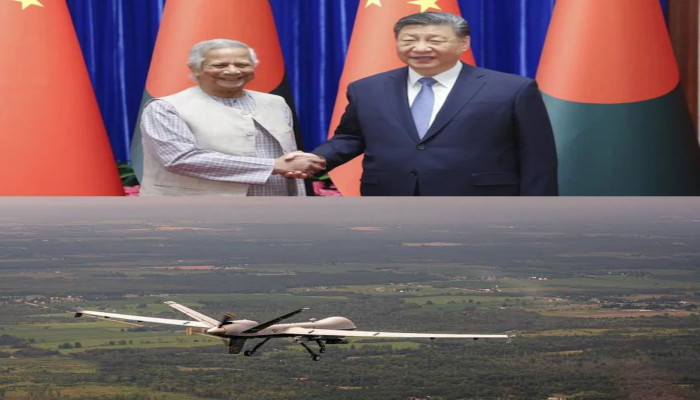
China’s growing military involvement in Bangladesh has created fresh concerns for India’s security planners. Bangladesh has decided to set up a domestic unmanned aerial vehicle (UAV) manufacturing facility with direct Chinese defence support. While Dhaka has described this move as a step toward self-reliance and modernisation, experts believe it marks a deeper military and technological presence of China in India’s neighbourhood.
Unlike ordinary arms purchases, this project establishes a long-term defence-industrial base. It includes technology transfer, infrastructure development, and ongoing operational cooperation. For India, the issue is not limited to drones alone. The larger concern is China’s expanding strategic influence in Bangladesh and its implications for regional security. The development comes at a time when Bangladesh’s interim administration is visibly strengthening ties with Beijing, raising fears of increasing militarisation near India’s eastern and northeastern borders.
The agreement was signed on January 27 between the Bangladesh Air Force (BAF) and China Electronics Technology Group Corporation International (CETC International), a Chinese state-owned defence electronics company. The signing ceremony took place at the Bangladesh Air Force headquarters in Dhaka Cantonment, showing full institutional support for the project.
According to Bangladesh’s defence ministry, “Under the agreement, BAF and CETC will jointly set up a facility to produce and assemble state-of-the-art UAVs.” The ministry further stated that the deal includes technology transfer and capacity building so that Bangladesh can manufacture drones independently in the future.
The project is officially titled “Establishment of Manufacturing Plant and Transfer of Technology (ToT) for Unmanned Aerial Vehicles (UAVs).” It received approval from the finance ministry after clearance from Chief Adviser Muhammad Yunus, who currently holds the defence portfolio. The Bangladesh Air Force will implement the project.
The total approved cost of the project is Tk 608.07 crore, which is approximately $55 million. The entire amount will be funded from the Bangladesh Air Force’s budget. Out of this, Tk 570.60 crore has been allocated for imported Chinese infrastructure and technology.
CETC International is a subsidiary of China Electronics Technology Group Corporation, a major Chinese defence conglomerate. The group is involved in advanced military technologies such as radars, electronic warfare systems, secure communication networks, UAVs, and military software. Its involvement in the project has raised concerns beyond manufacturing, especially due to its role in network-centric warfare systems.
Although Bangladesh has not officially disclosed the exact UAV model to be manufactured, reports suggest it could be the CETC-developed XY-I MALE (Medium Altitude Long Endurance) drone. This platform is designed for multiple roles, including surveillance, reconnaissance, electronic warfare, and attack missions.
CETC has claimed that the drone can carry modular payloads for communication, intelligence gathering, and combat operations. This capability allows it to be integrated into broader military networks rather than being used as a standalone system.
The drone manufacturing project fits into a broader pattern of China’s growing military presence in Bangladesh. The country already uses Chinese submarines, naval vessels, radar systems, and aircraft. Bangladesh is also reportedly in talks for a $2.2 billion deal to purchase 20 J-10C fighter jets from China.
Between 2019 and 2023, Bangladesh accounted for about 11 per cent of China’s global arms exports. The new project further deepens this relationship by embedding Chinese systems and technology into Bangladesh’s defence planning and infrastructure.
India’s concern is rooted in both geography and strategic intent. Bangladesh shares a 4,096-kilometre-long border with India, including areas close to the sensitive Siliguri Corridor. Analysts believe that MALE drones operating from bases such as the proposed Bogra airbase could significantly enhance surveillance and electronic intelligence capabilities near Indian airspace.
Indian experts warn that Chinese access to Bangladeshi military infrastructure could enable monitoring of sensitive regions. Such access could also support China’s broader regional strategy in South Asia and the Bay of Bengal.
Since 2024, Chief Adviser Muhammad Yunus has accelerated engagement with China. Major agreements were signed during his visit to Beijing in March 2025. As a result, New Delhi increasingly views Bangladesh as another key link in China’s expanding strategic network across South Asia.
For India, the issue is no longer theoretical. The establishment of a Chinese-backed drone factory in Bangladesh represents a concrete shift in the regional power balance. It highlights a growing overlap between cooperation and strategic expansion, making the situation more complex and sensitive for regional security.



 Loading...please wait
Comments