




China used Pakistan to counter India’s rise: US Commission Report
- In Reports
- 02:26 PM, Nov 21, 2026
- Myind Staff
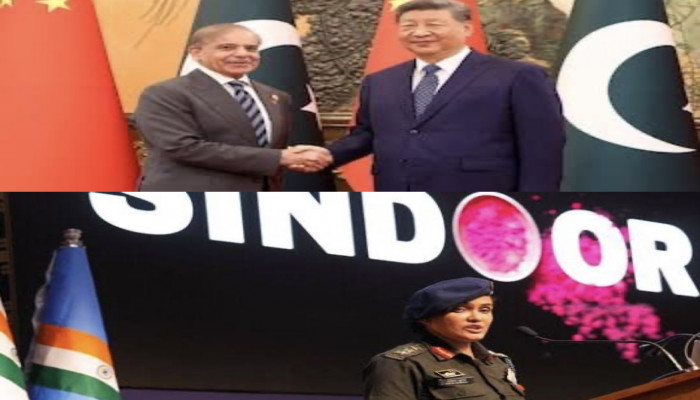
China’s support for Pakistan during India’s Operation Sindoor in May 2025 was part of a broader strategy to limit India’s rise across multiple domains, according to the 2026 Annual Report to Congress by the US-China Economic and Security Review Commission.
The report has a dedicated chapter titled ‘China’s Other Front: India and the Future of US Strategy in the Indo-Pacific’. It states that Beijing views India’s growing economic and military strength as a strategic challenge. The findings draw on a February 2026 hearing, a fact-finding visit to India and discussions with officials and business leaders.
The commission traces China’s support for Pakistan to the 1962 Sino-Indian War, describing it as a long-standing strategy to balance India. China supplied 81 per cent of Pakistan’s arms imports between 2020 and 2024, making it Islamabad’s largest defence supplier.
The report says Operation Sindoor demonstrated how Beijing could strengthen Pakistan during a crisis without directly entering the conflict. Pakistan reportedly deployed advanced Chinese weapons, while hackers attempted large-scale distributed denial-of-service attacks on Indian government IT systems, telecommunications and digital services.
The commission said it could not independently attribute the cyberattacks. However, it cited China-India military expert Sameer Lalwani, who testified that the most sophisticated attacks on Indian critical infrastructure originated from Chinese soil.
China also reportedly deployed survey vessels equipped with advanced sensors near India’s exclusive economic zone and in the Bay of Bengal. The report says these vessels could have tracked Indian military movements and shared maritime intelligence with Pakistan.
In May 2026, Chinese state broadcaster CCTV interviewed Zhang Heng, an engineer at the Chengdu Aircraft Design and Research Institute. He confirmed that he and other Aviation Industry Corporation of China personnel provided technical support in Pakistan during the conflict. Chinese-linked online actors also reportedly ran disinformation campaigns against India’s French-made Rafale jets while promoting China’s J-10 fighters.
Beyond Pakistan, the report highlights China's military infrastructure expansion along the 3,400-km disputed border. Beijing is developing airfields, railways and logistics networks across the Tibetan Plateau. It has also strengthened its claims over Arunachal Pradesh by building dual-use facilities near Tawang and using Mandarin names for locations in the state.
In the Indian Ocean, China is expanding its naval reach through ports and logistics facilities in Djibouti, Gwadar, Hambantota and Chittagong. The report also flags Beijing's growing influence in Bangladesh, Myanmar, Nepal and Bhutan.
Economically, China has restricted specialised fertilisers, tunnel boring machines and rare earth magnet approvals. Although several restrictions were lifted in August 2025, barriers to battery technology transfers continue to delay Indian production.
India has strengthened border infrastructure, naval capabilities, cyber defences and drone development. The report also mentions Prime Minister Narendra Modi’s Mission Sudarshan Chakra, which aims to establish a layered air and missile defence system by 2035.
The commission says India will protect its strategic autonomy rather than automatically align with Washington. However, it has urged the US to deepen defence cooperation with India through intelligence sharing, joint monitoring of Chinese naval activity, pharmaceutical supply partnerships and a proposed Indo-American Strategic Leadership Exchange Program.



 Loading...please wait
Comments