




China is rejecting Nvidia’s H200 AI Chips, pushing for self-reliance
- In Reports
- 02:12 PM, Dec 15, 2025
- Myind Staff
China is rejecting Nvidia’s H200 AI Chips, pushing for self-reliance
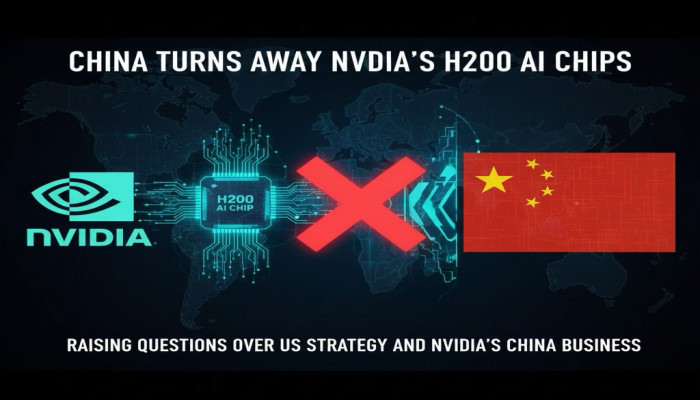
China is reportedly declining to buy Nvidia’s advanced H200 artificial intelligence chips, choosing instead to rely on domestically developed semiconductor technology, a move that could undermine a key US strategy aimed at competing with Chinese technology firms. The development was highlighted by White House AI and crypto czar David Sacks, who said Beijing appears determined to achieve semiconductor self-reliance.
Speaking in an interview on Bloomberg Tech, Sacks said China has “figured out” the US plan that allowed the country to purchase Nvidia’s H200 chips and is now deliberately rejecting them. His remarks came just days after US President Donald Trump announced that his administration would permit shipments of the H200 to China. “They’re rejecting our chips,” Sacks said, citing a news article he had seen earlier that day. “Apparently, they don’t want them, and I think the reason for that is they want semiconductor independence.”
The decision to allow exports of Nvidia’s H200 chips to China was part of a broader US strategy backed by Sacks. The goal was to introduce American competition into China’s domestic market, particularly to challenge Chinese technology leaders such as Huawei Technologies Co.
President Trump said on Monday that he would allow shipments of the H200, viewing the move as a way to counter Chinese tech firms on their own turf. However, Sacks indicated on Friday that he was no longer confident the strategy would be effective.
In a social media post on Saturday, Sacks clarified that his remarks were based on a Financial Times report. According to that report, China is preparing to restrict access to the H200 through a local approval process, under which Chinese companies would need to justify their need for the chips before being allowed to purchase them. Sacks’ comments have raised fresh doubts about Nvidia’s ability to regain revenue from China, once one of its most important data centre markets. Nvidia has already removed China entirely from its forward revenue forecasts.
Despite this, Nvidia Chief Executive Officer Jensen Huang has previously estimated that the Chinese data centre market could be worth $50 billion this year. Bloomberg Intelligence analysts have said that the H200 alone could represent a $10 billion annual revenue opportunity in China — but only if Chinese buyers accept the chip. In a statement, an Nvidia spokesperson said the company is continuing discussions with the US government regarding licenses for H200 shipments to approved customers. “While we do not yet have results to report, it’s clear that three years of overbroad export controls fuelled America’s foreign competitors and cost US taxpayers billions of dollars,” the spokesperson said.
China’s reluctance to embrace Nvidia’s H200 comes as Beijing intensifies efforts to strengthen its own semiconductor industry. According to a Bloomberg report published Friday, China is considering a support package worth up to $70 billion to boost domestic chipmaking.
This move highlights Beijing’s determination to reduce reliance on foreign chip suppliers like Nvidia. Even if the H200 is formally cleared for export, analysts say China is likely to continue backing local companies such as Huawei and Cambricon Technologies Corp.
Liu Pengyu, a spokesperson for the Chinese embassy in Washington, said cooperation between China and the US remains important. “Cooperation on technology and the economy is in the common interest of China and the US,” Liu said in a statement. “We hope the US will work with China to take concrete actions to maintain the stability and smooth functioning of global supply chains.”
The H200 chip, introduced in 2023 and shipped to customers last year, belongs to Nvidia’s Hopper generation. While powerful, it is no longer Nvidia’s most advanced offering. The H200 ranks below the newer Blackwell chips and is two generations behind Nvidia’s upcoming Rubin series. The US government has argued that this technological lag of about 18 months behind Nvidia’s cutting-edge products justified allowing exports to China, as the chips were not considered state-of-the-art.
Sacks defended the decision, describing the H200 as “lagging” technology. He also pointed to China’s desire to protect and subsidise Huawei as a major reason for its lack of interest. “What you see is China’s not taking them because they want to prop up and subsidise Huawei,” Sacks said. “That was part of our calculation, of selling not the best but lagging chips to China, is that you can take market share away from Huawei, but I think the Chinese government has figured that out, and that’s why they’re not allowing them.”
US officials believe Huawei has made significant progress in AI hardware, reducing its dependence on foreign technology. One example cited is Huawei’s Cloud Matrix 384 platform, which links hundreds of processors together to offset the lower performance of individual chips.
According to people familiar with the discussions, some US officials viewed the H200 approval as a compromise after Nvidia earlier pushed to export a version of its more advanced Blackwell chip to China. Last week, Huang told reporters in Washington that he did not know whether China would accept the H200 chips if exports were approved.
On Monday, Trump said in a Truth Social post that Chinese President Xi Jinping had responded positively to the possibility of allowing H200 exports. However, Beijing has not publicly confirmed whether it will permit imports of the chips. It has also not officially rejected them, despite the US policy shift. Earlier this year, China declined to adopt Nvidia’s H20 chip, a less powerful product that Trump had approved for export during the summer.
For now, Nvidia’s future in China remains uncertain. While the US government hoped that limited chip exports could weaken China’s reliance on domestic players like Huawei, Beijing appears increasingly focused on achieving full semiconductor independence, even if it means turning away US technology. As policymakers on both sides weigh their next steps, the fate of Nvidia’s H200 in China could become a key test of how far economic competition between the world’s two largest economies has evolved.



 Loading...please wait
Comments