




China-EU agree to reduce Chinese hybrid car imports by more than 50%
- In Reports
- 05:06 PM, Oct 10, 2026
- Myind Staff
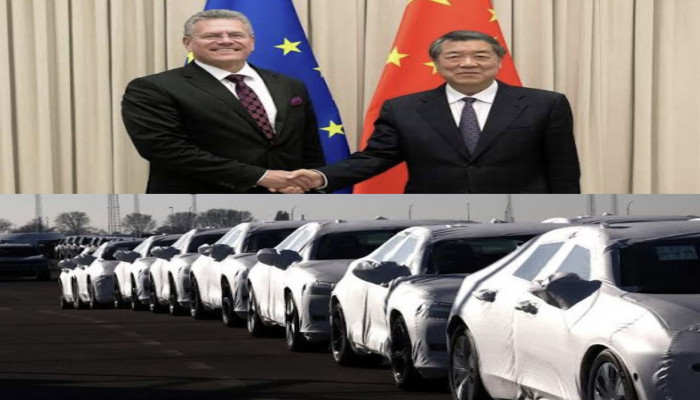
China and the European Union have reached an understanding that could reduce Chinese hybrid car exports to the bloc by more than half. European Trade Commissioner Maros Sefcovic announced the development on Friday after two days of talks in Beijing to narrow the EU’s growing trade deficit with China.
Sefcovic said the agreement would “moderate” Chinese exports of hybrid and plug-in hybrid vehicles, potentially reducing imports by several million cars over four years. However, he did not disclose how the deal would be implemented. European carmaker shares rose after the announcement, following pressure from US tariffs and rising Chinese exports.
The agreement follows three months of discussions between Sefcovic and Chinese officials, including Commerce Minister Wang Wentao. EU leaders will review the outcome at their summit in Brussels next Thursday. The bloc’s trade deficit with China has exceeded €1 billion ($1.12 billion) a day.
Sefcovic described the outcome as a positive development but cautioned against expecting an immediate resolution. “Having said that, this is far from the end. It is a crucial first step – but only a first step – in the process of rebalancing,” he told reporters in Beijing.
Bernd Lange, chair of the European Parliament’s trade committee, said the agreement should cover other sectors and called for more effective use of trade defence measures. Wang, meanwhile, said China was not the root cause of the EU’s problems but a partner in solving them, according to China’s commerce ministry.
The two sides also reached an understanding to reduce Chinese import duties on around €4 billion worth of EU exports, including car parts, olive oil and footwear. They also agreed to facilitate Chinese export licences for rare earths and permanent magnets through a “green channel” mechanism.
EU governments remain concerned about rising Chinese car imports as European manufacturers cut jobs. Plug-in hybrid imports into the EU rose 86% in the year to September, while prices fell 20%. More than half of these vehicles now come from China. In 2025, China accounted for 30% of EU plug-in hybrid imports by value.
The dispute intensified after the EU imposed tariffs on Chinese electric vehicles in 2024. It has since expanded to Chinese measures against European brandy, pork and dairy, along with restrictions on rare earths and critical minerals. France is particularly exposed in brandy exports, accounting for 90% of EU shipments to China, while Germany faces significant exposure in dairy.
Germany’s automotive industry group VDA cautiously welcomed the deal but said it was too early to assess whether it would address unfair competition. Mercedes-Benz also backed constructive dialogue, saying the agreement could improve predictability. European automotive analyst Matthias Schmidt said Germany was increasingly seeking action from Brussels and cooperation with London, given the UK’s share of Chinese new car sales in Western Europe.
China exported $560 billion worth of goods to the EU last year, up from $517 billion in 2024. Meanwhile, Chinese imports of European goods fell to $268.3 billion from $269.4 billion.
European Commission President Ursula von der Leyen has warned that the trade imbalance has reached a tipping point. Both sides will continue discussions on alternatives to tariffs and market access for medical devices. Sefcovic and Wang are scheduled to meet again in March 2027, following a video conference in January.



 Loading...please wait
Comments