




China defends its economic strategy as global trade pressure builds ahead of trade talks with EU, US
- In Reports
- 03:44 PM, Aug 03, 2026
- Myind Staff
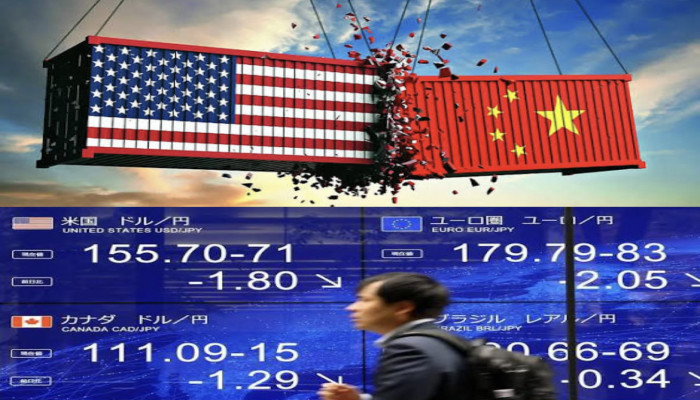
China is strongly defending its economic strategy ahead of important trade discussions with the European Union and the United States. Beijing is making it clear that it will continue to support its manufacturing and advanced industries instead of shifting its focus toward increasing household consumption. Analysts believe this reflects China's growing confidence as it prepares for negotiations with its biggest trading partners.
Chinese President Xi Jinping and U.S. President Donald Trump are expected to hold more face-to-face meetings later this year. At the same time, the European Union has set an October deadline for China to address several trade disputes. These discussions come at a time when concerns are rising over China's trade surplus, which has crossed one trillion dollars.
Many Western countries argue that China's economic policies favour manufacturers over consumers. They say this approach allows Chinese companies to produce goods at lower prices and sell them across global markets. According to these countries, such policies hurt industries in other economies that are trying to maintain balanced growth and fair competition. They also claim that China's model does not align with international trade rules.
However, recent decisions by China's top Communist Party leaders show that Beijing has no plans to make major policy changes. During a high-level meeting held on Thursday, the leadership called for targeted economic support instead of large consumer-focused stimulus measures or deep structural reforms. Western governments and many economists have repeatedly suggested such reforms, but China continues to follow its current strategy.
Earlier in the week, China's commerce ministry released a position paper on what it called "so-called industrial overcapacity." The document rejected Western criticism and described the argument as being based on "logical flaws" and "ulterior motives". The ministry also accused Western countries of adopting protectionist policies against Chinese industries.
China's ruling Communist Party also defended its economic model through an article published in its theoretical journal, Qiushi, in July. The article described China's relatively low consumer spending as a "historically justified" outcome of the country's investment-led development strategy, which helped it catch up with advanced economies.
Xu Tianchen, a senior economist at the Economist Intelligence Unit, said these public statements are not direct announcements that China will refuse any policy changes. Instead, they send two important messages to its trading partners.
"The first is about hoping others understand where it comes from. A better mutual understanding helps in negotiations," Xu said. "The second is about drawing a red line."
He also said the commerce ministry's paper "made clear that China doesn't accept discriminatory measures against its firms and products," highlighting China's position against restrictions targeting its businesses.
China argues that its development model reflects the needs of a country that is still narrowing the gap with developed economies. Beijing says its products are not only affordable but also improving in quality. It also believes its investments in technology and scientific research will benefit the global economy in the long run.
This month, Chinese Premier Li Qiang rejected warnings about a possible "China shock 2.0," a term used to describe fears that Chinese companies could dominate advanced manufacturing and push Western firms out of global markets. Instead, Li described the situation as "China opportunity 2.0" and presented it as a positive development for the world economy.
Eswar Prasad, a professor of trade policy at Cornell University and former China director at the International Monetary Fund, said this message is unlikely to convince countries facing increasing imports from China.
"This is a 'narrative that is falling flat in countries at the receiving end of those exports'," he said.
Prasad also added, "China’s heavy dependence on exports to power its own growth in light of weak domestic demand is going to make it difficult to argue that Chinese exports are a gift to consumers worldwide."
The United States had earlier tried to increase pressure on China by imposing tariffs of more than 100 per cent on Chinese goods. However, that strategy faced challenges after China used its dominant position in the production of rare earth minerals, which are essential for many global industries, to strengthen its bargaining power.
Meanwhile, the European Union has also started protecting its own industries. The bloc recorded an average daily trade deficit of around $1 billion dollars with China last year. European governments are introducing industrial policies and domestic procurement measures to reduce their dependence on Chinese products. German Chancellor Friedrich Merz also criticised China this month for keeping its currency undervalued.
Despite growing criticism from the West, China's latest statements suggest that Beijing believes it can manage trade tensions without making major policy concessions. Alicia Garcia-Herrero, chief Asia-Pacific economist at Natixis, said China appears to have gained confidence after dealing with the U.S. tariff dispute.
"The U.S. tariff episode appears to have supplied a template of managed engagement that Beijing is also applying to Europe —essentially buying time," she said.
She further added, "Beijing’s messaging on its economic model does come across as more confident and tightly framed than a year or two ago."
At the same time, China has started slowing investment growth this year. Authorities have tightened oversight of local government spending, which many economists believe contributed to excess production capacity in manufacturing and infrastructure projects.
Chinese officials have publicly acknowledged a supply-demand "contradiction" in the economy. They have also promised to stop deflationary price wars among manufacturers that compete aggressively for market share while reducing profits. The government continues to promise stronger consumer demand, although it has not announced major structural reforms.
The Qiushi article also recognised the need for future changes. It stated, "Historical justification does not mean long-term justification" and added that a change in the model was "necessary".
Analysts say these remarks show that Beijing accepts the existence of economic imbalances. However, the government wants gradual reforms instead of rapid changes that could create instability.
Several international studies have also raised concerns over China's current economic model. A recent report by the Organisation for Economic Cooperation and Development (OECD) estimated that subsidies explain the market share gains of nearly 60 per cent of Chinese firms.
Another study by the Bank of Italy found that domestic factors, including weak consumer demand and excess production capacity, accounted for around 75 per cent of China's export growth.
A report by the McKinsey Global Institute showed that China is adding productive assets at a pace three times higher than Europe and the United States combined. However, returns on that investment remain around 40 per cent lower.
Daniel Rosen, co-founder of research firm Rhodium Group, said the increasing number of official statements reflects growing international concern over China's economy.
"Chinese arguments are more frequent and formal now because the evidence of systemic domestic economic problems leading to spillovers on the rest of the world is mounting even faster," he said.



 Loading...please wait
Comments