




China admits providing technical support to Pakistan during Operation Sindoor
- In Reports
- 01:42 PM, May 09, 2026
- Myind Staff
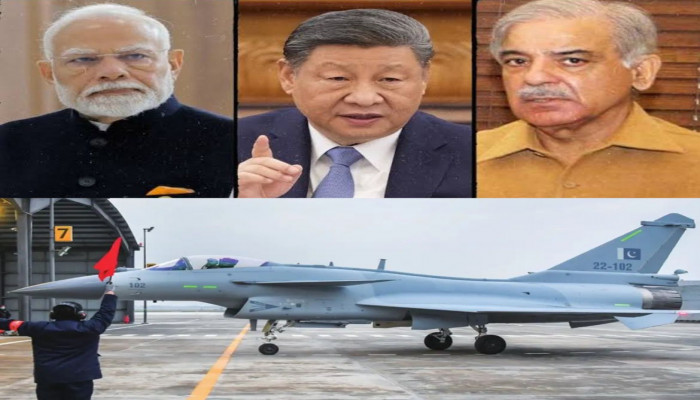
China has officially acknowledged that it provided technical assistance to Pakistan during the four-day conflict with India in 2025 following Operation Sindoor. Chinese state media reported that technical teams were sent to Pakistan during the military confrontation, where Pakistan’s air force operated Chinese-made fighter aircraft.
The revelation came through statements made by Zhang Heng, an engineer associated with the state-owned Aviation Industry Corporation of China (AVIC)’s Chengdu Aircraft Design and Research Institute. According to reports cited by the South China Morning Post, Chinese personnel were deployed on-site during the conflict to provide support related to the Chengdu J-10CE fighter jets used by Pakistan.
Pakistan’s air force operated the Chinese-made Chengdu J-10CE fighter aircraft during the conflict. The aircraft was developed by AVIC subsidiaries and is considered one of China’s advanced export fighter jets. Zhang spoke about the performance of the aircraft and the conditions faced by the Chinese support teams during the war.
“It felt inevitable. The aircraft just needed the right opportunity. And when that moment came, it delivered exactly as we knew it would,” Zhang said.
He also described the intense atmosphere at the support base during the conflict. “At the support base, we frequently heard the roar of fighter jets taking off and the constant wail of air-raid sirens,” Zhang said. “By late morning, in May, the temperature was already approaching 50 degrees Celsius (122 degrees Fahrenheit). It was a real ordeal for us, both mentally and physically.”
Zhang said his team remained focused on ensuring the fighter aircraft performed efficiently during combat operations. According to him, the team’s motivation came from the “desire to do an even better job with on-site support” and to ensure their equipment could “truly perform at its full combat potential”.
Another engineer from the same institute, Xu Da, also spoke about the emotional connection the team had with the fighter aircraft. Comparing the aircraft to a child, Xu said, “We nurtured it, cared for it, and finally handed it over to the user. And now, it was facing a major test.”
Earlier reports had claimed that a Chinese-origin fighter jet operated by Pakistan had brought down at least one French-made Indian fighter aircraft during the conflict. The aircraft mentioned in the reports was the Dassault Rafale. The Chengdu J-10CE is the export version of China’s J-10C 4.5-generation fighter aircraft. It is equipped with an AESA radar and advanced air-to-air missile systems, making it one of the more capable aircraft in China’s export market.
Pakistan remains the only known foreign operator of the J-10CE fighter jet. The country ordered 36 aircraft along with 250 PL-15 missiles from China in 2020. The aircraft has since become an important part of Pakistan’s air combat fleet.
The conflict between India and Pakistan in May 2025 began after a terror attack in Kashmir on April 22, 2025. Terrorists opened fire on tourists at Baisaran meadow near Pahalgam, killing 26 people. Most of those killed were tourists. A local pony operator also lost his life in the attack.
Indian authorities later linked the attack to cross-border terror networks based in Pakistan. In response, India carried out precision strikes on terror infrastructure located in Pakistan and Pakistan-occupied Kashmir on May 7, 2025. According to India’s defence ministry, more than 100 terrorists were killed during the operation.
Following the strikes, India also suspended the Indus Waters Treaty. Pakistan later launched attacks across the border, leading to a brief but intense military confrontation between the two countries. The fighting lasted for four days before both sides agreed to a ceasefire.
Last year, China also claimed that it played a mediating role during the conflict. Chinese Foreign Minister Wang Yi said Beijing followed a balanced approach in several international conflicts, including tensions between India and Pakistan.
Speaking at a symposium in Beijing, Wang said, “To build peace that lasts, we have taken an objective and just stance, and focused on addressing both symptoms and root causes. Following this Chinese approach to settling hotspot issues, we mediated in northern Myanmar, the Iranian nuclear issue, the tensions between Pakistan and India, the issues between Palestine and Israel, and the recent conflict between Cambodia and Thailand.”
“In our efforts, there was no interference in the internal affairs of others, no incitement, no biased manipulation, and no selfish gains. There was only sincerity and good faith. Our principles and hard work will stand the test of history.”
India has repeatedly rejected claims of outside mediation. The Indian government has maintained that the ceasefire reached after the May 2025 conflict was achieved through direct bilateral engagement between India and Pakistan.



 Loading...please wait
Comments