




Chhath Puja: From the Sacred Rivers of Bihar to Global Cultural Imagination Part II
- In Reclaim Indic Festivals
- 12:26 PM, Nov 11, 2026
- Dr. Pinku Jha
Faith and Blind Faith: The Need for a Contemporary Interpretation
One of the most important questions surrounding Chhath Puja is the distinction between faith and blind faith.
In contemporary society, religious traditions are frequently evaluated through two opposing positions. One considers every inherited practice beyond question, while the other dismisses traditional observances as irrational or incompatible with modern scientific understanding. Neither position provides an adequate framework for understanding Chhath.
Faith, when interpreted constructively, can cultivate discipline, gratitude, compassion, community participation and respect for nature. Blind faith, however, emerges when an individual is encouraged to abandon reason, disregard personal safety or attribute scientifically unsupported outcomes to ritual practices.
Chhath provides an opportunity to make this distinction particularly clear. Its central philosophy of reverence for sunlight and water has an understandable ecological and philosophical foundation. Human existence depends on solar energy, freshwater, agricultural productivity and environmental balance. The festival brings these relationships into a visible and emotionally meaningful ritual. However, this should not be confused with the claim that standing in sunlight cures blindness, leprosy or other diseases. There is no adequate scientific basis for treating Chhath rituals as medical therapies. Similarly, the belief that an individual's illness or misfortune necessarily results from failing to observe the festival can create unnecessary fear and social pressure.
The approximately 36-hour Nirjala fast deserves particular consideration. It represents an exceptional expression of religious discipline. Nevertheless, prolonged abstinence from water can cause dehydration and may be unsafe, particularly for children, older people, pregnant women and individuals with certain medical conditions. Religious commitment should never require someone to disregard serious health risks.
The distinction is therefore not between modernity and tradition. It is between meaningful tradition and uncritical acceptance. A contemporary interpretation of Chhath should preserve its essential spiritual character while encouraging scientific awareness, medical responsibility, environmental protection and voluntary participation.
This approach does not weaken faith. Rather, it allows faith to remain meaningful without becoming an instrument of fear.
Historical Memory: Bihar and the Cultural Geography of Chhath
Chhath is closely associated with the mythological narratives of the Ramayana and Mahabharata, although these narratives should be distinguished from independently established historical evidence (Singh, 2009; Chakraborty, n.d.).
One popular tradition associates Karna, the son of Surya in the Mahabharata, with solar worship and offerings while standing in water. Karna's association with the ancient kingdom of Anga also gives the tradition a geographical connection with present-day Bhagalpur and adjoining areas of Bihar.
Another narrative associates Draupadi and the Pandavas with the observance of solar worship during their period of adversity. Such stories demonstrate how the festival has been incorporated into the larger mythological imagination of Bhartiya society.
Munger offers another important geographical and cultural association. Local tradition connects Mata Sita with Sage Mudgal's ashram and the observance of Surya Shashthi Vrat. The site known as Sita Charan is an important local pilgrimage landmark associated with this narrative.
These traditions are significant not necessarily because every detail can be established through archaeological evidence, but because they demonstrate how regional communities connect their physical landscapes with sacred memory.
Chhath also reflects the importance of women as custodians of cultural continuity. The Vrati, often a mother or grandmother, becomes the principal organiser of the ritual. She maintains its discipline, supervises food preparation and transmits its practices to younger generations. This is an important dimension of its social history: religious authority is exercised substantially through household knowledge and community participation rather than depending entirely on formal priesthood.
The cultural contribution of Mithila is particularly noteworthy. Its traditions of household ritual, folk literature, seasonal songs, bamboo crafts and food preparation have helped sustain the distinctive regional character of Chhath.
From a Regional Festival to a Global Cultural Phenomenon
The geographical expansion of Chhath is one of the most interesting developments in the contemporary history of Bhartiya cultural traditions.
For generations, Chhath was primarily associated with Bihar, Jharkhand, eastern Uttar Pradesh and the adjoining Nepal Terai. However, migration has transformed its geographical character. People moving from Bihar to Delhi, Mumbai, Kolkata and other Indian cities carried their religious practices with them. International migration subsequently extended the festival to Mauritius, Fiji, Suriname, the Netherlands, the United Kingdom, the United States and the Gulf countries.
Today, riverbanks, artificial water bodies, community parks and designated public spaces in international cities have become temporary centres of Chhath observance.
This expansion has an important cultural implication. Chhath demonstrates that a festival need not lose its regional identity to acquire global relevance. Its identity remains deeply connected with Bihar, even as its participation becomes international.
The global appeal of Chhath can be understood through four interconnected dimensions.
First, it offers an ecological message that is universally understandable. The Sun, water, agricultural produce and environmental cleanliness are not exclusively Indian concerns. They are essential to all human societies.
Second, its ritual structure encourages community participation. Families, neighbours, volunteers, local authorities and cultural organisations collectively organise the festival. It creates temporary social spaces in which people of different economic backgrounds participate in a shared cultural experience.
Third, its folk music, cuisine, traditional attire and bamboo craftsmanship provide a valuable opportunity to promote the cultural heritage of Bihar and Mithila internationally.
Finally, Chhath demonstrates a form of religious expression in which the sacred is approached through visible natural phenomena. This can generate meaningful intercultural conversations about spirituality, ecology and humanity's relationship with the natural world.
However, global recognition should not become an exercise in commercialising the festival or reducing it to spectacular photographs of devotees standing in rivers. Its cultural significance lies in the complete experience: preparation, fasting, family participation, music, agricultural offerings, environmental responsibility and the final distribution of prasad.
Environmental Consciousness: Making the Sacred River Worthy of Worship
The relationship between Chhath and environmental sustainability deserves particular attention. The festival depends upon clean water bodies, accessible riverbanks and an environment in which people can safely gather. Its rituals therefore create an opportunity to connect religious devotion with environmental responsibility.
Communities that offer prayers to the Ganga, the Kosi, the Gandak and other rivers must also recognise their responsibility towards the conservation and protection of these water bodies. The sacred and cultural significance attributed to rivers should be accompanied by a commitment to maintaining their ecological health.
Unfortunately, untreated sewage, urban pollution, solid-waste disposal and the degradation of riverbanks continue to threaten river ecosystems (Ministry of Jal Shakti, 2021; Chauhan et al., 2023). The concentration of large gatherings along riverbanks during religious and cultural festivals can also place pressure on local infrastructure, sanitation facilities and riverine ecosystems. The National Institute of Urban Affairs and the National Mission for Clean Ganga (2024) emphasise the need for environmentally sensitive management of such gatherings.
Consequently, the contemporary observance of Chhath should incorporate practical environmental commitments:
-
Ensuring that riverbanks and ponds are cleaned before and after the festival
-
Avoiding plastic packaging and non-biodegradable decorations
-
Using natural materials, including traditional bamboo baskets and earthen lamps
-
Preventing the disposal of food waste and other offerings into polluted water bodies
-
Ensuring safe access to water bodies and adequate sanitation facilities
-
Encouraging municipal authorities and local communities to maintain water quality
The principle is straightforward: worshipping water without protecting it would create a contradiction between religious practice and its underlying philosophy. Chhath can therefore become more than an annual religious event. It can serve as an occasion for community-based environmental action.
The Sun Rises Everywhere, but Chhath Remembers Where It Began
Chhath Puja represents a remarkable example of the continuity and adaptability of Bhartiya cultural traditions. Emerging from the cultural landscape of Bihar and deeply associated with Mithila, Magadh and the wider Gangetic region, it has developed into a festival that carries regional memories into an increasingly global society.
Its distinctive character lies in its direct engagement with nature. The worship of Surya and Chhathi Maiya, the offering of Arghya to both the setting and rising Sun, the discipline of the Nirjala Vrat, the use of traditional agricultural produce and the collective participation of families distinguish it from many other forms of religious celebration.
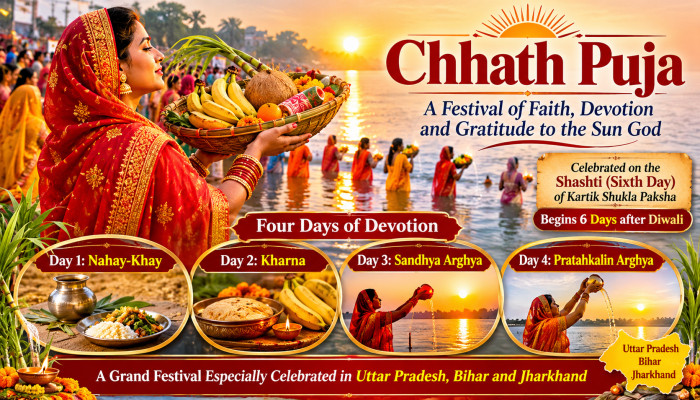
The four-day sequence is not simply a collection of rituals. Nahay-Khay teaches preparation and purity; Kharna represents restraint and sharing; Sandhya Arghya acknowledges the setting Sun; and Usha Arghya celebrates renewal and continuity. Its folk songs preserve the voices of generations of women. Its thekua and other offerings preserve culinary traditions. Its bamboo baskets and earthen lamps sustain traditional craftsmanship. Its gatherings demonstrate the capacity of regional culture to create collective belonging.
At the same time, the future of Chhath depends upon maintaining a meaningful distinction between faith and blind faith. Scientific awareness, environmental responsibility, health precautions and voluntary participation must accompany the preservation of its religious character. Such an approach is consistent with Article 51A(h) of the Constitution of India, which calls upon citizens to develop scientific temper, humanism and the spirit of inquiry and reform (Government of India, 1950). The development of scientific temper does not necessarily require the rejection of religious faith; rather, it encourages informed reasoning, critical reflection and the rejection of unsubstantiated claims (Ansari, 2016; Chakraborty & Pandey, 2024). The international expansion of Chhath presents an opportunity for Bihar to contribute more prominently to the global understanding of Indian cultural heritage. The festival should be promoted not merely as an expression of regional religious identity but as a living tradition of ecological reverence, social solidarity and cultural continuity.
The devotee does not offer prayers only when the Sun rises in splendour. The setting Sun receives the same reverence. In a world increasingly obsessed with success, power and visibility, this ritual carries a profound lesson about humility, gratitude and acceptance. The Sun rises everywhere. Chhath reminds the world to be grateful for it.
Note: Several narratives and ritual descriptions in this section are informed by conversations with Nutan Ji and Simpy Rani, a vrati from Darbhanga, Bihar. Inputs from other individuals have also contributed to different sections, alongside published scholarly sources.
References
Government of Bihar, Department of Tourism. (n.d.). Chhath Puja. Bihar Tourism. https://tourism.bihar.gov.in/en/experiences/festivals-and-fairs/festivals/chhath-puja
Ministry of Culture, Government of India. (2025, September 16). Ministry of Culture leads multinational nomination of Chhath Mahaparva to UNESCO's Intangible Cultural Heritage List. https://culture.gov.in/latest-news/ministry-culture-leads-multinational-nomination-chhath-mahaparva-unescos-intangible
Press Information Bureau, Government of India. (2025, September 16). Ministry of Culture convenes consultations on multinational nomination of Chhath Mahaparva to UNESCO's Intangible Cultural Heritage List. https://www.pib.gov.in/PressReleaseIframePage.aspx?PRID=2167207&lang=2®=48
Chakraborty, S. (n.d.). Chhath Puja: Origin of the festival, and the story of Devasena. Sahapedia. https://www.sahapedia.org/
Encyclopaedia Britannica. (n.d.). Chhath Puja. https://www.britannica.com/topic/Chhath-Puja
The Indian Express. (2025). Chhath Puja 2025 explained: History, significance, rituals, and why it holds a special place in Bihar. https://indianexpress.com/article/explained/explained-culture/chhath-puja-what-is-the-festival-its-significance-10329982/
Yadav, A. (2026). Chaṭha Pūjā as lived religion: Beliefs, practices and festivities. Asian Anthropology, 25(2), 133–136. https://doi.org/10.1080/1683478X.2025.2563988
Gunarathna, R. M. D. S., & Madara, W. (2025). A cultural study of Chhath Puja. 11th International Research Conference, Sabaragamuwa University of Sri Lanka, Abstract Book. https://www.sab.ac.lk/sslsas/abstracts/PastAbstractsPDF/11th_SSLSAS_2025_Abstract_Book.pdf
Manjul, S., & Manjul, S. K. (2026). An archaeological and ethnographic exploration of ritual survivals within Chhath Puja: Evidence for the persistence of early agrarian traditions in the Middle Ganga Plains. Indian History Journal. https://doi.org/10.66871/ihj.v1i1.018
Rig Veda. (n.d.). Mandala 3, Sukta 62, Mantra 10. The Gayatri Mantra, traditionally associated with Savitr and solar illumination.
Singh, R. P. B. (2009). Ethno-geography of the Sun Goddess festival, ‘Chhatha’, in Bhojpur region, India: From locality to universality. Man in India, 89(1–2), 103–120.
Sagar, S., & Sharma, R. N. (2026). From cuisine to ceremony in Mauritius: A sociological study of cultural preservation in the Bhojpuri diaspora. Sociological Bulletin, 75(3), 341–357. https://doi.org/10.1177/00380229261423571
Bihar Bhawan, Government of Bihar. (2024). Newsletter: Chhath Puja—A celebration of faith, devotion and nature. https://www.biharbhawan.gov.in/docs/eMagazine/Newsletter_Dec_2024.pdf
Jagran. (2021). Mahaparv Chhath Puja: The shade of Chhath is unique in Mithila; many stories are prevalent. https://www.jagran.com/bihar/bhagalpur-mahaparv-chhath-puja-the-shade-of-chhath-is-unique-in-mithila-many-stories-are-prevalent-22190993.html
Disclaimer: The opinions expressed within this article are the personal opinions of the author. MyIndMakers is not responsible for the accuracy, completeness, suitability, or validity of any information on this article. All information is provided on an as-is basis. The information, facts or opinions appearing in the article do not reflect the views of MyindMakers and it does not assume any responsibility or liability for the same.



 Loading...please wait
Comments