




Chandrayaan-3 receives prestigious 2026 Goddard Award
- In Reports
- 04:16 PM, May 22, 2026
- Myind Staff
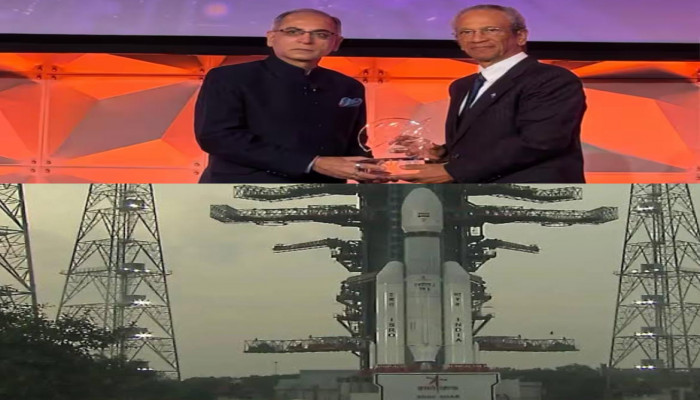
India’s lunar mission Chandrayaan-3 has received the prestigious 2026 Goddard Astronautics Award from the American Institute of Aeronautics and Astronautics. The award was presented in Washington DC on May 21 during the AIAA ASCEND 2026 Conference. The recognition marks another major achievement for India’s space programme and highlights the global impact of the mission led by the Indian Space Research Organisation.
Chandrayaan-3 created history on August 23, 2023, when it became the first spacecraft to successfully make a soft landing near the Moon’s south pole. The region is considered scientifically and strategically important because no mission had previously explored the lunar surface in that area. The successful landing placed India among the leading nations in space exploration and drew worldwide attention to the country’s growing capabilities in advanced space technology.
The mission played an important role in expanding scientific understanding of the Moon’s south polar region. It provided valuable data that could support future human missions to the Moon. Chandrayaan-3 also confirmed the presence of important chemical elements in the lunar soil near the south pole. Scientists believe these resources may one day help sustain manufacturing and other long-term operations on the Moon’s surface. The findings have added significant value to global lunar research and future exploration plans.
India’s Ambassador to the United States, Vinay Kwatra, accepted the award on behalf of ISRO at the conference. During his address, Ambassador Kwatra spoke about Prime Minister Narendra Modi’s Space Vision 2047. He highlighted India’s long-term plans for deep space exploration, human spaceflight missions, and the rapid growth of the country’s commercial space sector. He also stressed the importance of stronger cooperation between India and the United States in the field of space research and technology.
In his remarks, Ambassador Kwatra called for greater collaboration between governments, industries, and research institutions of both countries. He said such partnerships would help strengthen the growing relationship between India and the United States in space exploration and innovation. The award ceremony reflected the increasing global recognition of India’s contributions to space science and technology.
The Goddard Astronautics Award is regarded as the highest honour given by the AIAA for exceptional achievements in astronautics. The award can be presented either to an individual or to a team. In the case of team nominations, contributors are listed and up to two representatives are selected to formally receive the honour on behalf of the team. The recognition is considered one of the most respected achievements in the international aerospace community.
The award was established by Mrs Goddard in memory of her husband, Robert H. Goddard. Goddard is remembered as a visionary scientist, pioneering engineer, and one of the earliest innovators in rocket technology. His experiments with liquid rocket engines laid the foundation for the development of modern astronautics and future space missions around the world.
The award later evolved into its present form in 1975 when the institute renamed and expanded the selection criteria of its earlier Goddard Award. The earlier version mainly recognised contributions in propulsion engineering and energy conversion. After the changes, the award began honouring broader achievements in astronautics, including major advancements in space exploration and technology.
The recognition of Chandrayaan-3 with the 2026 Goddard Astronautics Award is another milestone for India’s space journey. It highlights the country’s growing influence in global space exploration and underlines the success of ISRO’s efforts in carrying out cost-effective yet highly ambitious missions. The achievement also reflects India’s expanding role in shaping the future of lunar exploration and international space cooperation.



 Loading...please wait
Comments