




Centre sets up empowered committee to implement CAA in West Bengal ahead of Assembly polls
- In Reports
- 06:07 PM, Feb 21, 2026
- Myind Staff
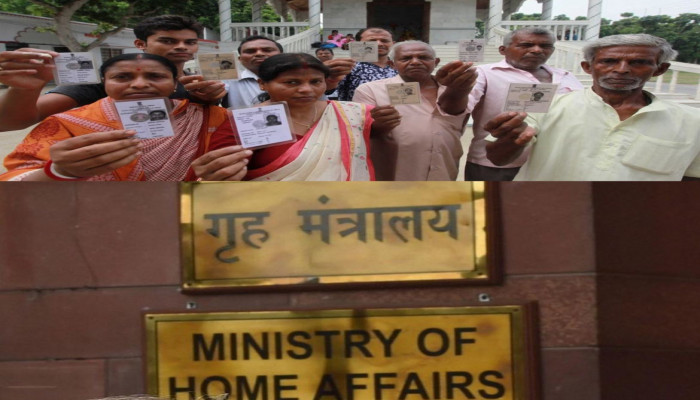
The Centre has taken a major step towards implementing the Citizenship Amendment Act (CAA) in West Bengal by forming an Empowered Committee to process applications for Indian citizenship under the law. The move comes at a time of ongoing political tension in the state, where the All India Trinamool Congress (TMC) government has repeatedly opposed the CAA, calling it discriminatory.
On Friday, ahead of the upcoming Assembly elections in West Bengal, the Centre operationalised the process of granting citizenship under the CAA through a gazetted notification. The notification formally announced the constitution of an Empowered Committee in the state to examine and process citizenship applications under the Act.
An official order issued by Additional Secretary NiteshKumar Vyas detailed the formation and structure of the committee. The order stated:
“In exercise of the powers conferred by sub-section (1) of section 6B of the Citizenship Act, 1955 (57 of 1955) read with sub-rules (1) and (3) of rule 11A of the Citizenship Rules, 2009, the Centre appoints the Deputy Registrar General of the Directorate of Census Operations, West Bengal, as the head of the committee.”
As per the notification, the Deputy Registrar General of the Directorate of Census Operations, West Bengal, will serve as the head of the Empowered Committee. The committee will also include several other members. These members will be:
• A Deputy Secretary-rank officer from the Subsidiary Intelligence Bureau.
• Nominees from the jurisdictional Foreigners Regional Registration Officer.
• The State Informatics Officer of the National Informatics Centre of the State of West Bengal, not below the rank of Under Secretary.
• The Postmaster General or a nominated postal officer of Deputy Secretary rank.
The order further mentioned that two invitees will participate in the committee’s meetings. These include a representative from the Principal Secretary (Home) or Additional Chief Secretary (Home) of the West Bengal government, and a nominee from the jurisdictional Divisional Railway Manager.
The notification issued by the Ministry of Home Affairs (MHA) formally activates the Citizenship (Amendment) framework in West Bengal. It does this by setting up the state-level Empowered Committee under Section 6B of the Citizenship Act and Rules 11A and 13A of the Citizenship Rules.
This development builds upon an earlier all-India framework that was created through an MHA notification dated March 11, 2024. That notification had established a mechanism across the country to process citizenship applications under the CAA. However, for the system to work effectively in each state, separate state-specific committees were required to be constituted. The latest notification now enables West Bengal to operationalise that framework in practice.
The main responsibility of the Empowered Committee will be to scrutinise applications submitted by eligible individuals under the CAA. The committee will coordinate with district-level verification bodies to check documents and claims. After verification, it will decide whether to approve or reject the grant of Indian citizenship.
According to the MHA, the new notification aligns the West Bengal committee’s terms with the March 11, 2024 order. Similar committees have already been set up in other states for verifying and granting citizenship under the CAA.
The Citizenship (Amendment) Act, 2019, was implemented in 2024 after the government notified the rules under the law. The Act provides for fast-tracked Indian citizenship to undocumented non-Muslim migrants from Pakistan, Bangladesh, and Afghanistan who entered India on or before December 31, 2014.
Under the CAA, Indian nationality will be granted to persecuted non-Muslim migrants belonging to six communities: Hindus, Sikhs, Jains, Buddhists, Parsis, and Christians from the three specified countries. The law aims to provide relief to these groups who, according to the government, faced religious persecution in their home countries.
The formation of the Empowered Committee in West Bengal comes amid continuing political differences between the Centre and the state government. The Trinamool Congress government has consistently opposed the CAA and has described it as discriminatory. The Centre, however, has maintained that the Act is meant to provide humanitarian support to persecuted minorities and does not take away anyone’s citizenship.
With the constitution of this committee, the process of examining and granting citizenship applications under the CAA can now formally begin in West Bengal. The committee will function as the key authority in the state for handling applications, verifying eligibility, and ensuring that the provisions of the Act are implemented as per the notified rules.
This move is being seen as significant, especially in the context of the approaching Assembly elections in West Bengal, where the issue of the CAA has remained politically sensitive and widely debated.



 Loading...please wait
Comments