




Centre bans new mining leases across Aravalli range to protect fragile ecosystem
- In Reports
- 01:19 PM, Dec 25, 2025
- Myind Staff
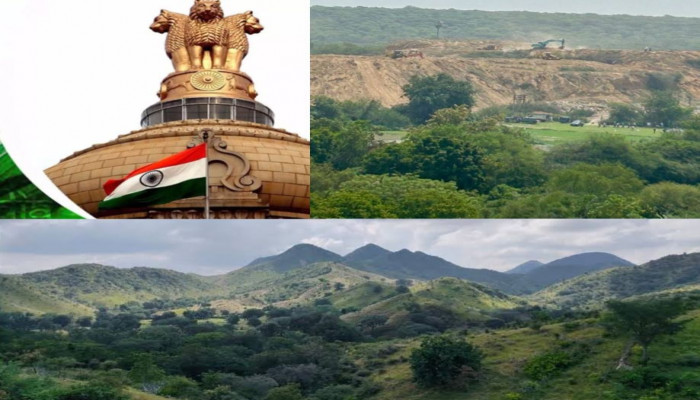
In a major step to protect the ecologically sensitive Aravalli range, the Union Ministry of Environment, Forest and Climate Change has directed all concerned states to impose a complete ban on granting new mining leases across the entire Aravalli landscape. The ancient mountain range stretches from Delhi to Gujarat and plays a crucial role in maintaining environmental balance in the region.
According to the ministry, the prohibition will apply uniformly across the Aravallis, irrespective of state boundaries. The decision has been taken to preserve the integrity of one of the oldest geological formations in the world and to curb illegal and unregulated mining activities that have caused significant environmental damage over the years.
The ministry said the directions aim to safeguard the Aravallis as a continuous ecological ridge running from Gujarat through Rajasthan and Haryana to the National Capital Region (NCR). The region has long faced threats from rampant mining, deforestation, and land degradation, which have impacted biodiversity and water resources.
“The prohibition will apply uniformly across the entire Aravalli landscape and is intended to preserve the integrity of the ancient geological range,” the ministry stated, underlining the need for strict protection measures.
Along with banning new mining leases, the Centre has also asked the Indian Council of Forestry Research and Education (ICFRE) to identify more areas where mining should be completely prohibited. These new no-mining zones will be identified in addition to areas already protected under existing regulations.
The identification process will be based on ecological, geological, and landscape-level considerations, keeping in mind the fragile nature of the region. The aim is to ensure that environmentally sensitive and conservation-critical areas receive maximum protection.
ICFRE has also been tasked with preparing a science-based Management Plan for Sustainable Mining (MPSM) for the entire Aravalli region. The plan will assess the cumulative environmental impact of mining activities and evaluate the ecological carrying capacity of the landscape.
According to the ministry, the management plan will identify ecologically sensitive zones, suggest measures for conservation, and outline steps for restoration and rehabilitation of degraded areas. The draft plan will be placed in the public domain to allow for stakeholder consultations.
While no new mining leases will be allowed, the Centre clarified that existing mines will continue to operate under strict regulation. State governments have been directed to ensure full compliance with environmental safeguards and adherence to Supreme Court orders related to mining in the Aravalli region. Ongoing mining activities will be monitored closely, and additional restrictions may be imposed to ensure that operations follow sustainable mining practices. The ministry stressed that there would be no relaxation in environmental norms for mines already in operation.
The latest order comes amid concerns and claims that recent policy changes could open the Aravallis to mining. Union Environment Minister Bhupender Yadav firmly rejected these allegations, calling them “misinformation.”
“There is no dilution of protection for the Aravallis,” Yadav said, adding that the government remains committed to protecting the region. He emphasised that no mining is permitted in the Delhi-NCR area and that legally sanctioned mining accounts for only a small fraction of the Aravalli landscape.
The minister said the government is following a balanced approach that considers both ecological protection and economic needs. “The framework backed by the Supreme Court is meant to curb illegal mining and strengthen environmental safeguards, not weaken them,” he said.
The ministry reiterated that the fresh directions would expand the coverage of areas protected from mining, taking into account local topography, biodiversity, and ecological sensitivity. It stressed that the Aravallis play a critical role in preventing desertification, conserving biodiversity, recharging groundwater aquifers, and providing essential environmental services.
“The government remains committed to the long-term protection of the Aravallis,” the ministry said, recognising the mountain range as vital to the environmental health of north-western India.
The latest move is seen as a strong signal of the Centre’s intent to preserve the Aravalli ecosystem and ensure that economic activities do not come at the cost of irreversible environmental damage.



 Loading...please wait
Comments