




Canadian Admission of Khalistani Role in Downing of Air India Flight 182: Will It Improve Bilateral Relations?
- In Military & Strategic Affairs
- 06:10 PM, Aug 21, 2026
- Shubhi Malhotra & Dr Adityanjee
Introduction
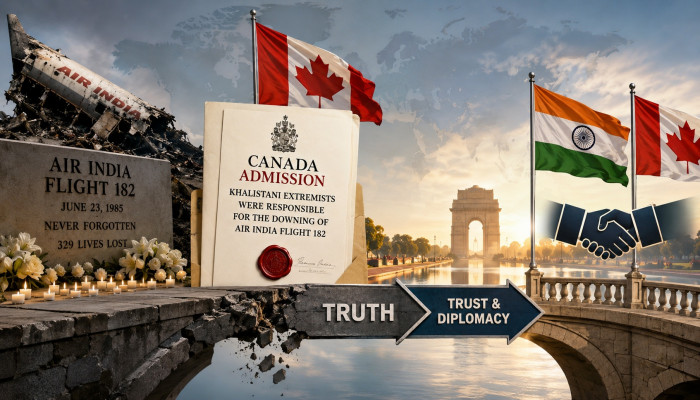
On June 23, 2026, the 41st anniversary of the deadliest terrorist attack in Canadian history, Canada's intelligence agency, the Canadian Security Intelligence Service (CSIS), did something it had never done in four decades: it formally named the perpetrators. In a public statement marking the National Day of Remembrance for Victims of Terrorism, CSIS declared that "a bomb planted by Canada-based Khalistani extremists destroyed" Air India Flight 182 on June 23, 1985, killing all 329 people aboard. Calling it a "heinous act of terror," the agency acknowledged what India had asserted consistently since the morning the wreckage was found off the coast of Ireland: that the Kanishka bombing was Khalistani terrorism, planned and executed from Canadian soil.
For India, the statement was vindication, bitter, belated, and incomplete. For the families of the 329 victims, including 268 Canadian citizens and 82 children, it was long overdue official confirmation of what they had always known. For bilateral relations between India and Canada, already navigating a cautious reset after years of rupture over the Hardeep Singh Nijjar affair, the admission adds a new and significant variable to an already complex equation.
This article examines the historical context of the Kanishka bombing and Canada's gross and perhaps deliberate institutional failures, the political dynamics that may have driven the 2026 admission of guilt, and the prospects for meaningful improvement in India-Canada bilateral relations.
The Kanishka Bombing: A Crime Four Decades in the Making
Air India Flight 182 was travelling from Montreal to New Delhi via London on June 23, 1985, when a bomb concealed inside a checked suitcase exploded mid-air over the North Atlantic, off the coast of Ireland, killing all 329 passengers and crew on board. It remains the single deadliest act of aviation terrorism before the September 11, 2001 terror attacks in the United States, and the deadliest terrorist attack in Canadian history.
The attack was orchestrated by Canada-based Khalistani terrorists as retaliation for Operation Blue Star, the Indian Army's June 1984 storming of the Golden Temple in Amritsar to dislodge armed Sikh terrorists led by Jarnail Singh Bhindranwale. The bombing was planned, financed, and executed by members of the Babbar Khalsa, a Khalistani terrorist organisation operating from Canada's west coast, particularly from British Columbia. A coordinated second bomb, concealed in luggage checked onto a connecting flight at Tokyo's Narita Airport, also exploded on the same day, killing two baggage handlers.
Despite the scale of the atrocities and the volume of intelligence pointing unambiguously to Khalistani networks on Canadian soil, the investigation and prosecution that followed were, by any standard, a catastrophic institutional failure aided and abetted by the Canadian political establishment. The 2010 Air India Commission of Inquiry, led by former Supreme Court Justice John Major, documented in exhaustive detail the failures of Canadian law enforcement and intelligence: warnings from the Indian government and Air India about specific threats were ignored; passenger baggage screening was inadequate; intelligence agencies failed to coordinate; and the evidence gathered was mishandled in ways that ultimately undermined prosecutions.
Only one individual, Inderjit Singh Reyat, the bomb-maker, was ever convicted, receiving a fifteen-year sentence. The masterminds and principal organisers of the attack walked free. The botched investigation has long been regarded as one of Canada's greatest law enforcement and intelligence failures, and a source of sustained grievance for India and for the Canadian Sikh community that lost its own members in the bombing.
Four Decades of Institutional Avoidance
Why did it take forty-one years for CSIS to formally and publicly name the perpetrators?
The answer lies at the intersection of domestic vote-bank politics, intelligence failures, and a culture of institutional avoidance. Canada's large and politically significant Sikh community, concentrated particularly in ridings in British Columbia and Ontario, has historically made successive federal governments reluctant to confront Khalistani terrorism within Canada directly. Political leaders across party lines calculated that publicly naming Khalistani networks as terrorist threats risked alienating a significant electoral constituency.
This political calculation had grave consequences. For decades, warnings from India about the activities of Khalistani organisations on Canadian soil were treated with insufficient urgency. Organisations that India had designated as terrorist groups continued to operate freely in Canada, organising rallies, raising funds, and in some documented instances, celebrating the Kanishka bombing. Canada's broad interpretations of freedom of expression protected terrorist activities that New Delhi characterised as incitement to violence and support for terrorism.
The 2010 Major Commission was unsparing in its indictment of these failures. Justice Major found that stronger security measures and better intelligence coordination could have prevented the tragedy, and that authorities had ignored repeated warnings from the Indian government and Air India about possible Khalistani attacks.
The 2026 Admission
The timing of the CSIS statement reflects a confluence of political, diplomatic, and strategic factors that, taken together, explain why Canada chose this moment for an admission long resisted.
The Nijjar Affair and Its Aftermath: The September 2023 declaration by then-Prime Minister Justin Trudeau that Canadian security agencies were pursuing "credible allegations" linking agents of the Indian government to the killing of Khalistani activist Hardeep Singh Nijjar in Surrey, British Columbia, triggered the most severe rupture in India-Canada relations in modern memory. India vehemently denied the allegations, expelled Canadian diplomats, and suspended visa services for Canadian citizens. The standoff exposed the depth of mutual mistrust: India accused Canada of harbouring Khalistani terrorists; Canada accused India of conducting transnational repression on Canadian soil without providing any evidence.
The Nijjar affair severely damaged Canada's diplomatic credibility, not only with India but internationally. Canada's public accusations were made without providing New Delhi with substantive evidence, a pattern India found both insulting and in violation of basic diplomatic norms. The prolonged standoff had tangible costs: trade stalled, diaspora community relations frayed, and Canada's ability to engage India, the world's most populous country and a rising strategic partner, was materially constrained.
The Carney Reset: The political transition in Ottawa proved critical. Mark Carney replaced Trudeau as Prime Minister in 2025, bringing a markedly different posture toward India. Unlike his predecessor, Carney avoided public attribution of responsibility to the Indian government in the Nijjar case, adopting a more restrained and process-driven approach. His invitation to Prime Minister Narendra Modi to attend the G7 summit in Kananaskis, Alberta, in June 2025 provided the first significant diplomatic opening, leading to an agreement to restore full diplomatic representation, reinstate High Commissioners, and resume visa services and ministerial dialogues. Carney's four-day visit to India in February–March 2026, his first as Prime Minister, further cemented this direction, with the two leaders pledging to expand bilateral trade to $50 billion by 2030 and finalise a Comprehensive Economic Partnership Agreement.
The CSIS admission of June 2026 fits logically into this reset narrative. It signals to India that Canada is willing to confront its own institutional failures on Khalistani terrorism, a concession that carries diplomatic weight and helps address one of New Delhi's most persistent grievances.
Domestic Reckoning: Forty-one years after the bombing, with most of the perpetrators dead and the political landscape of the Sikh diaspora itself evolved, the overwhelming majority of Canadian Sikhs have no sympathy for Khalistani terrorism; the domestic political cost of naming the perpetrators is substantially lower than it once was. The CSIS admission, issued on the anniversary of the attack and framed as part of Canada's National Day of Remembrance for Victims of Terrorism, was a statement Canada could now make without the political consequences it might have feared in earlier decades.
India's Response
India's response to the CSIS admission has been one of measured acknowledgement rather than triumphalism. New Delhi views the statement as a formal vindication of the position it has maintained for four decades that the Kanishka bombing was Khalistani terrorism planned on Canadian soil, and that Canada's response to that terrorism was inadequate. As multiple Indian commentators have noted, India did not need Ottawa to tell it who bombed Air India Flight 182. It needed Ottawa to have cared enough to say so when it mattered, and to act decisively when the perpetrators were still alive and prosecutable.
The admission does not address several issues that remain unresolved from India's perspective. It does not revisit the question of why warnings were ignored. It does not explain the investigation and prosecution failures. It does not constitute an apology. And it does not resolve the broader issue of Canada's continued tolerance of Khalistani networks that, as former Indian High Commissioner Sanjay Verma has noted, continue to engage in anti-India activities, extortion within the Canadian Sikh community, and the illegal transfer of funds for violent purposes in India.
India has also been careful not to allow the CSIS admission to crowd out the Nijjar affair. New Delhi continued to maintain that India's role in Nijjar's death had not been credibly established, and that Nijjar, designated a terrorist by India, did not merit the status Canada accorded him. Finally, on July 8th, 2026, Canada was compelled to state there was no evidence linking the Indian government to the killing of Hardeep Singh Nijjar. This came nearly three years after then Prime Minister Justin Trudeau insinuated a possible connection between Indian agents and the murder. The Royal Canadian Mounted Police (RCMP) said its organised crime investigation and the charges filed do not indicate any involvement by Indian officials.
The Structural Challenges in Bilateral Relations
Even as both sides navigate a diplomatic reset, the underlying structural tensions that have repeatedly disrupted India-Canada relations remain unresolved.
The Khalistan Question: Canada is home to the world's largest Sikh diaspora outside India, estimated at over 7,70,000 people. The vast majority of Canadian Sikhs are moderate, prosperous, and integrated citizens with no sympathy for separatist violence. However, a vocal and politically organised minority continues to advocate for Khalistan, and some elements within this community have links to networks that India designates as terrorist organisations. Canadian laws on free expression make it difficult to proscribe advocacy that stops short of explicit incitement to violence, while India's threshold for what constitutes dangerous extremism is considerably lower. This definitional gap is not easily bridged by diplomatic goodwill alone.
Transnational Repression vs. Counter Terrorism: Canada views the alleged killing of Nijjar, a Canadian citizen, on Canadian soil as a grave violation of its sovereignty, regardless of Nijjar's political activities. India views the presence on Canadian soil of individuals it has designated as terrorists as a threat to its own sovereignty and security. Both positions reflect legitimate, if incompatible, conceptions of how sovereignty operates in an interconnected world. The Carney government has sought a "balanced partnership grounded in mutual respect for concerns and sensitivities", a formulation that acknowledges both sets of grievances without resolving either.
Intelligence and Law Enforcement Cooperation: Despite political tensions, security cooperation between India and Canada has continued at a functional level. RCMP cooperation with Indian authorities in the Nijjar case has been described as "good" by Canadian officials. NSA Ajit Doval's visit to Ottawa, where he met counterparts and agreed on a shared work plan for bilateral cooperation on national security and law enforcement, reflects a pragmatic recognition that both countries face common threats, including organised crime networks with links to extremist groups, that require sustained intelligence cooperation.
Will the Admission Improve Bilateral Relations?
The honest answer is: in part, and at the margins, but not transformatively.
The CSIS admission matters symbolically and diplomatically. It places on official Canadian record what India has argued for four decades, strengthening the narrative basis for a reset. It signals that Canada under Carney is willing to confront an uncomfortable chapter of its own history in the interest of diplomatic repair. And it removes one long-standing irritant in the relationship: Canada's studied official silence on who bombed Air India Flight 182.
But bilateral relationships are not rebuilt by symbolic statements alone. The structural tensions identified above, over Khalistan, transnational repression, and intelligence failures, have not been resolved by the CSIS statement. The Nijjar affair has not been formally closed, and the legal proceedings related to the alleged assassins identified by Canadian police remain ongoing. India will watch whether the CSIS admission translates into concrete action against Khalistani networks operating in Canada, enhanced monitoring, proscription of terrorist organisations, enforcement against fundraising for violent purposes, and prosecution of those who celebrate terrorist attacks.
The economic logic of a closer relationship is compelling. Bilateral trade stands at approximately $13 billion annually, a fraction of the potential given the size of both economies and the deep people-to-people connections of the Indian diaspora in Canada. The target of $50 billion by 2030 is ambitious but not implausible if political momentum is sustained. Canada's pension funds have already invested $100 billion in India, and the Comprehensive Economic Partnership Agreement, if finalised by year-end as Carney has pledged, would provide a formal framework for expanded commercial engagement. Canada's need to diversify trade away from a United States reshaped by Trumpian protectionism provides additional strategic impetus to deepen ties with India.
The geopolitical environment also works in favour of rapprochement. India's growing centrality in the Indo-Pacific, as a market, a manufacturing hub, a democratic counterweight to China, and a member of the Quad, gives Canada strategic reasons to invest in the relationship that go beyond the bilateral. Similarly, India's interest in maintaining diverse partnerships with middle powers that share democratic values makes Canada, however complicated, a partner worth cultivating.
Conclusion
Canada's admission, forty-one years after the fact, that Khalistani extremists bombed Air India Flight 182 is a necessary step in the repair of India-Canada relations. But it is not sufficient on its own. The admission vindicates India's position and closes a long chapter of official Canadian equivocation. It contributes to the diplomatic reset initiated by PM Carney and supported by PM Modi. It offers some measure of acknowledgement, however belated, to the families of 329 victims who deserved better from the country in which most of them lived.
But the deeper work of building a stable, trust-based relationship between India and Canada requires more than retrospective honesty about the past. It requires sustained action against Khalistani extremism in the present. It requires a credible process to address the Nijjar case and the competing sovereignty concerns it has raised. It requires that both governments resist the temptation to let domestic political calculations- in Canada, the Sikh Canadian vote; in India, the optics of appearing to yield to Canadian pressure crowd out the genuine strategic interests that both nations share.
A relationship as deep, as complex, and as important as that between India and Canada cannot be defined permanently by a single tragedy in 1985 or a single assassination in 2023. What it can be defined by, if both governments choose, is a shared commitment to the truth, to accountability, and to the kind of strategic partnership that the twenty-first century demands.
The CSIS statement of June 2026 is, at last, one honest beginning.
References
- After 41 Years, Canada Accepts Khalistani Role in 1985 Air India Bombing. (2026, June 26). Firstpost. https://www.firstpost.com/vantage/after-41-years-canada-accepts-khalistani-role-in-1985-air-india-bombing-vantage-on-firstpost-vd1979353/
- Padmanabhan, K. (2026, June 26). In a first, Canada Intel agency blames ‘Khalistanis’ for 1985 air India Kanishka bombing that killed 329. ThePrint. https://theprint.in/diplomacy/in-a-first-canada-intel-agency-blames-khalistanis-for-1985-air-india-kanishka-bombing-that-killed-329/2970535/
- Panda, R. (2026, March 3). India-Canada Relations Reset Following Carney’s India Visit – Analysis. EurasiaReview. https://www.eurasiareview.com/03032026-india-canada-relations-reset-following-carneys-india-visit-analysis/
- Sharma, N. (2026, January 12). From rupture to reset: The slow and cautious repair of India-Canada relations. The India Way Magazine. https://www.foreignpolicyindia.in/2026/01/guest-india-canada-relations-reset
- Verma, S. K. (2026, February 26). India–Canada relations: From rupture to strategic Rebalancing. orfonline.org. https://www.orfonline.org/expert-speak/india-canada-relations-from-rupture-to-strategic-rebalancing
- Dr. Vineet Singh & Dr. Adityanjee (March 2026) The Great Indo-Canadian Tango: Canada’s soul-searching and Diplomatic Catharsis Beckons to New Possibilities
- Dr. Vineet Singh & Dr. A. Adityanjee (September 2025) Navigating the Canada–U.S. Trade War: Remedial Options for PM Mark Carney
- Dr. Vineet Singh & Dr. A. Adityanjee (December 2025) Canada’s Terror Footprints: Preventing Pakistanisation of Canada’s Civic Polity
- Business Today Desk ‘Nothing has come out…’: Canada says no Indian govt link to Hardeep Singh Nijjar’s killing (Jul 8, 2026)
Disclaimer: The opinions expressed within this article are the personal opinions of the author. MyIndMakers is not responsible for the accuracy, completeness, suitability, or validity of any information on this article. All information is provided on an as-is basis. The information, facts or opinions appearing in the article do not reflect the views of MyindMakers and it does not assume any responsibility or liability for the same.



 Loading...please wait
Comments