




Can Malaysia’s Scheme for Social Protection for the Self-employed, Gig Workers Be Considered Effective?
- In Economics
- 11:52 PM, Jul 10, 2026
- Mukul Asher
Malaysia, a country located in Southeast Asia, in 2026, is estimated to have a population of 34 million; a GDP in nominal terms of USD 516 billion; a per capita GDP in nominal terms of USD 15,000 and a share of 0.72 per cent in global GDP based on the PPP (Purchasing Power Parity) method 1.
According to the World Bank, in 2025, Malaysia’s total labour force was 18.7 million, with an LFPR (Labour Force Participation Rate) of 71 per cent. Women and non-Malaysian workers constituted 37 per cent and 15 per cent of the total labour force, respectively 2.
In the case of Malaysia, the World Bank defines informal sector workers as “… those in employment not covered by a pension, retirement savings (with EPF) or employment injury insurance (from SOCSO) … many of those who are covered by EPF and/or SOCSO may still experience some vulnerabilities in their work life, especially if their levels of contribution are low and their exposure to risks is high” 3.
According to the World Bank, Malaysia has 4.1 million workers in the informal sector, accounting for roughly 27 per cent of the country's total workforce. This includes independent own-account workers, gig-economy participants, and unregistered business owners who lack standard social protections such as Employees Provident Fund (EPF) or SOCSO coverage. It is these 4.1 million workers that the recent social protection initiatives of Malaysia are aiming to cover.
Malaysia’s EPF scheme, launched in 1951, is a defined contribution scheme for private sector and non-pensionable government sector workers. It is technically not a pension scheme, as members can, because of the political economy challenge facing the policymakers, withdraw all of the accumulated balances at age 55. The official estimates of life expectancy at age 55 in Malaysia are 21 years for men and 25 years for women. Thus, there is a long period when the EPF members have to manage retirement on their own from the full withdrawal of their balances. There are limited pre- 55 years of age provisions for housing, medical expenses, education and others.
The standard mandatory contribution rate is 23 per cent, shared between the employer and employee, without any wage ceiling. The income tax exemption for contributions has a ceiling of RM 7000 per year. All dividends earned on EPF savings are fully income tax-exempt. All permitted withdrawals, including the final withdrawal, are also tax exempt. The absence of wage ceiling is likely to provide disproportionate income tax benefits to higher-wage earners.
As of the end of 2025, assets of the EPF were RM 1.4 trillion (about 60 per cent of GDP). The median Employees Provident Fund (EPF) savings balance for members approaching retirement age (54 to 55) in Malaysia is approximately RM154,000, well below the EPF desired RM 240,000. This suggests a very skewed distribution of EPF balances.
As of the end of 2025, EPF membership was 18.1 million, but active members were 10.6 million. The active members thus were about 58 per cent of the labour force, implying that around two-fifths of the workers, or about 8.7 million workers, are not covered by the EPF and therefore do not benefit from the prime national social protection scheme 4.
Such a high proportion of inactive workers suggests a need to reform EPF’s database systems.
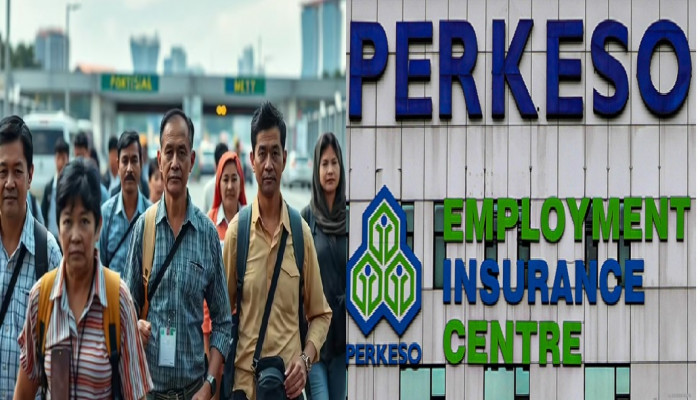
The other major social security organisation in Malaysia is SOCSO (PERKESO). It administers a mandatory social security program established in 1971 under the Employees' Social Security Act 1969 to protect workers against workplace accidents, illnesses, and invalidity.
All employers with at least one employee must register and contribute to the system, which covers Malaysian citizens, permanent residents, and foreign workers with valid permits. The contribution structure involves employers paying 1.75% and employees contributing 0.75% of monthly wages up to a ceiling of RM5,000, a total of 2.5% 5.
Recently, the Malaysian government reversed the mandatory nature of the 24-hour Non-Employment Injury Scheme for local workers, making it voluntary.
About 7 million workers (less than two-fifths of the labour force) are covered by SOCSO. Accumulated balances of SOSCO are around RM 32 billion, a non-significant amount.
The 7 million workers of SOCSO include self-employed and gig workers registered under the Self -Employed Social Security Scheme (SESSS). The SESSS (LINDUNG KENDIRI) was introduced to protect individuals who are self-employed under the provisions of the Self-Employment Social Security Act 2017 6.
Recent Initiatives for Self-employed and Gig workers in Malaysia
In addition to the SESSS initiative noted above, there are two other initiatives taken by the Malaysian policymakers to expand social protection coverage to the self-employed and the gig workers.
The first is the EPF-managed i-Saraan scheme, introduced in 2010. It is a voluntary program designed to help self-employed Malaysians, freelancers, and gig-economy workers build retirement savings while earning special government matching incentives.
If a person contributes a total of RM2,500 in a calendar year, he/she will receive the maximum government incentive of RM500, or RM 5000 over the lifetime. Under the i-Saraan voluntary scheme, there is no fixed contribution rate. Any amount of contribution starting from a minimum of RM1 up to a maximum of RM100,000 per year is acceptable.
Total cumulative historical data or an all-time lifetime sum is not officially tracked and published as a single metric by the EPF, a limitation which needs to be addressed urgently.
Press report suggests that about USD 2.5 billion RM (about USD 0.6 billion) is the annual contribution. The amount collected is invested by the EPF in the same manner as its other funds. Being voluntary, the number of persons participating is relatively low, at most around 0.7 million. The coverage, therefore, may be termed inadequate at this point in time, though it could improve over time.
This scheme is being extended to e-hailing/or p-hailing sectors. Platform providers under the e‑hailing and/or p‑hailing sectors must make i-Saraan Plus contributions on behalf of their workers through the employer. This is to enable the members to qualify for a special incentive of 20% (up to a maximum of RM600 per year) of the total voluntary contributions made in the current year.
The second initiative is the Gig Workers ACT (GWA)
The Gig Workers Act (GWA) was passed by the Parliament in September 2025 and enforced from April 2026. It is thus a new Act and overlaps with the other initiatives. Gig workers in Malaysia are estimated to be around two million. As it has only recently passed, data are not available.
A recent study, however, assesses the GWA as follows.
“The GWA’s mandate is for contracting entities to register gig workers in the Self-Employment Social Security Scheme (SESSS). It is a breakthrough for gig workers in ensuring they are insured for work-related injury. This should raise the participation of gig workers in the SESSS, which stood at only a quarter of overall gig workers in May 2025, with exceedingly lower rates in the arts sector. Nonetheless, some gaps have been highlighted, including possible exclusion of workers under foreign platforms and implementation challenges, such as duplicative SESSS membership for workers engaged with more than one platform.
The omission of mandated participation in the EPF and Employment Insurance System (EIS) exposes gig workers to inadequate retirement savings and unemployment benefits. Their inclusion would face some hurdles; the EPF rests under the ministry’s jurisdiction (Finance), and unemployment can be difficult to define in the gig economy with fluid entry and exit. These social protection lacunae are the crucial gig worker issues to be addressed next, although it is also unclear which institution would oversee such policy deliberations” 8.
The above analysis strongly suggests that the EPF and SOCSO, as currently organised and governed, have not been able to cover only a limited percentage of self-employed and gig workers. The initiatives of the Malaysian policymakers to include them in social protection schemes can be assessed as having very limited effectiveness. The following measures are suggested to enhance the effectiveness of social protection initiatives for the self-employed and the gig workers.
First, organisational reforms of EPF and SOCSO merit serious consideration. The two organisations have the main mandate to provide benefits which are compulsory, not voluntary. The voluntary nature of recent initiatives in Malaysia, especially the SESSS, requires different structures in terms of databases and their integration; compliance and audit provisions; and the benefit delivery structures.
Second, high-frequency, good-quality data needs to be collected regularly by the government to inform the progress of these initiatives and to make adjustments in the details of the scheme.
Third, consideration should be given to integrating the recent initiatives at the Federal government level with the state-level initiatives to bring about greater coherence. Similarly, a system-wide perspective, rather than a standalone perspective of these initiatives, could be given consideration.
Fourth, measures to enhance trust and confidence in the EPF and SOCSO, as well as in the overall governance structures of Malaysia, need to be undertaken in the current fragmented multi-polar world where many economic, trade, and social aspects have been weaponised, and this trend is expected to accelerate.
References
- https://www.imf.org/external/datamapper/profile/MYS (Accessed on 7 July 2026)
- https://data.worldbank.org/indicator/SL.TLF.TOTL.IN?locations=MY (Accessed on 7 July 2026)
- https://documents1.worldbank.org/curated/en/099022124104067227/pdf/P18109313c28d408918ef910df6cdd46ce4.pdf (Accessed on 7 July 2026)
- https://www.kwsp.gov.my/en/w/news/epf-declares-6-15-dividend-for-simpanan-konvensional-and-6-15-for-simpanan-shariah (Accessed on 7 July 2026)
- https://www.omnihr.co/blog/socso-malaysia (Accessed on 6 July 2026)
- https://www.perkeso.gov.my/en/our-services/protection/self-employed.html (Accessed on 7 July 2026
- https://www.iseas.edu.sg/articles-commentaries/iseas-perspective/2026-48-gig-workers-in-malaysia-is-the-new-law-a-good-deal-by-lee-hwok-aun/ (Accessed on 7 July 2026)
Disclaimer: The opinions expressed within this article are the personal opinions of the author. MyIndMakers is not responsible for the accuracy, completeness, suitability, or validity of any information on this article. All information is provided on an as-is basis. The information, facts or opinions appearing in the article do not reflect the views of MyindMakers and it does not assume any responsibility or liability for the same.



 Loading...please wait
Comments