



Cambodian PM accuses Thailand of occupying its land after Trump-brokered ceasefire
- In Reports
- 06:58 PM, Feb 18, 2026
- Myind Staff
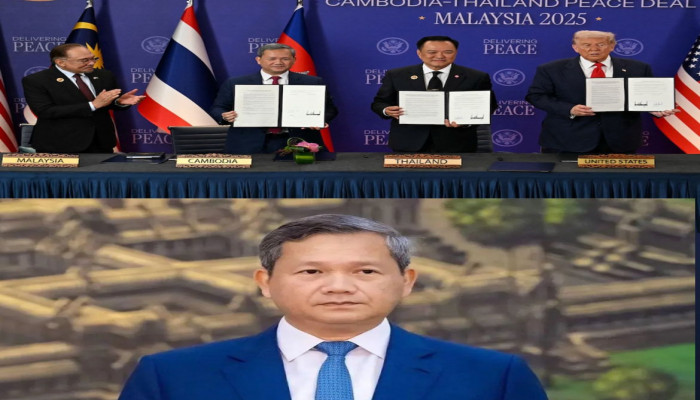
Cambodian Prime Minister Hun Manet has claimed that Thailand is still occupying Cambodian territory even after a ceasefire deal brokered by U.S. President Donald Trump ended major fighting last year. In an interview with Reuters on Tuesday, Hun Manet said Thai troops have moved into areas that Cambodia considers its own and have not withdrawn, raising fears that the border conflict could flare up again.
Hun Manet said the situation remains tense and “fragile” despite the ceasefire reached on December 27. He urged Thailand to allow the Joint Boundary Commission (JBC) to begin work on the disputed border as soon as possible so that both countries can confirm the boundary lines through official technical processes.
This was Hun Manet’s first interview with international media since taking over as Cambodia’s leader in 2023 after his father Hun Sen stepped down. During the interview, he also spoke about Cambodia’s improving relationship with Washington and efforts to crack down on cyber scam networks operating inside the country.
The Cambodia-Thailand border has long been disputed, but tensions rose sharply after fighting broke out in July last year. The conflict became the worst border violence between the two countries in more than a decade. It forced hundreds of thousands of people to flee their homes and disrupted trade along the 508-mile (817-kilometre) border.
An earlier peace agreement signed in October, with Trump and Malaysia’s prime minister involved in negotiations, failed within weeks. However, a new ceasefire was reached at the end of December, bringing the fighting to a halt. Despite this, Hun Manet says Thai troops are still positioned inside the Cambodian land.
“We still have Thai forces occupying deep into Cambodian territory in many areas,” Hun Manet told Reuters. He claimed that Thai soldiers have placed shipping containers and barbed wire inside areas that Thailand itself had previously recognised as Cambodian territory. According to him, people living in those areas are unable to return home.
Hun Manet stressed that Cambodia is not making baseless accusations but is describing what it believes are facts on the ground. “This is not an accusation, but it’s a statement of the facts on the ground,” he said.
He added that Cambodia cannot accept what it sees as a violation of its sovereignty and territorial integrity. He said the best way to confirm the truth is through the Joint Boundary Commission, which uses treaties and agreements already signed by both countries. Cambodia hopes Thailand will agree to begin demarcation work soon, especially in the “hot zones” where tensions are highest.
Hun Manet also said Thailand had delayed starting the demarcation process because of the election held on February 8. Thailand’s Prime Minister Anutin Charnvirakul, he said, gained political support from rising nationalist feelings during the election period following the border dispute.
Now that the election is over, Hun Manet said Cambodia hopes Thailand will cooperate at least at the technical level and allow officials to start measuring and marking the border. He said this would help restore normal life for residents affected by the conflict.
Thailand has rejected Cambodia’s claims. Thai authorities have said they are keeping their troops in position as part of de-escalation measures and insist that they are not occupying Cambodian land. Thailand’s foreign ministry did not respond immediately to Reuters’ questions regarding Hun Manet’s comments.
Hun Manet was in Washington this week to attend a meeting of Trump’s Board of Peace, a body created to oversee a Gaza peace plan but which Trump has said may also handle other global conflicts. Hun Manet said he hoped the board could help reduce tensions on the Cambodia-Thailand border.
The Cambodian leader also spoke about the changing relationship between Cambodia and the United States. Hun Manet, who is a graduate of the U.S. Military Academy at West Point, said ties with Washington have improved since he became prime minister. He added that Cambodia’s relations with China and the U.S. are not in conflict.
He stated that Cambodia does not want to choose between China and the United States. “We are a sovereign country. We pursue the policy of friends with our countries,” he said.
In recent years, Cambodia moved closer to China, which has helped upgrade the Ream naval base. Some Western nations have raised concerns that China may gain military access there. Hun Manet said Cambodia has “nothing to hide” regarding the base.
Hun Manet also addressed criticism from the West about human rights and democracy. Past U.S. governments have often demanded improvements in these areas before strengthening ties. Hun Manet said democracy should not only be judged by political party activity, but also by health, education, and press freedom.
However, media watchdog Reporters Without Borders ranked Cambodia 161 out of 180 countries in its 2024 World Press Freedom Index, citing detentions of journalists.
The Reuters report also highlighted concerns about cyber scam centres operating in Cambodia. The U.S. Treasury Department last year imposed sanctions on many individuals linked to compounds in Cambodia where large-scale fraud was carried out, including online romance scams targeting people worldwide.
Hun Manet admitted that such scam centres exist but said the Cambodian government is taking action. He said authorities are deporting people working in scam centres, shutting down compounds, and preparing a new law to fight cybercrime. He also argued that online scams are not only Cambodia’s problem, but also exist in other countries.



 Loading...please wait
Comments