



Cabinet clears bills to enable 33% women's reservation in Lok Sabha, state assemblies
- In Reports
- 12:40 PM, Apr 09, 2026
- Myind Staff
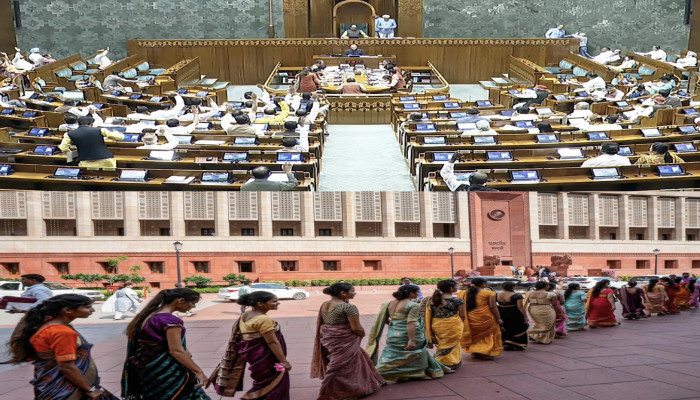
The Union Cabinet has approved the introduction of two key bills aimed at enabling 33% reservation for women in the Lok Sabha and state legislative assemblies. This decision comes ahead of a special three-day session of Parliament scheduled from April 16 to 18, where the government plans to fast-track the process. According to a person familiar with the development, the Cabinet’s approval also includes setting up a delimitation commission, which will play a crucial role in restructuring constituencies for the implementation of the reservation.
The move builds on the Women’s Reservation Bill, also known as the Nari Shakti Vandan Adhiniyam, 2023, which was passed by Parliament in September 2023. The law mandates that one-third of the total seats in the Lok Sabha and state assemblies be reserved for women. While the bill has already been cleared legislatively, its implementation has been pending due to procedural and structural requirements such as delimitation and census-linked processes.
Recent developments suggest that the government is considering delinking the implementation of the reservation from the ongoing census. This step is intended to speed up the rollout of the policy and ensure that it can be implemented in time for the 2029 general elections. By removing the dependency on census data, the government aims to avoid delays that could push the timeline further.
To accommodate the reservation without reducing the representation of existing constituencies, the government is planning to increase the total number of seats in State legislatures. The proposal involves expanding the strength of the Lok Sabha by 50%, taking it from the current 543 seats to approximately 816 seats. Out of these, 273 seats would be reserved for women. This approach ensures that the share of each state remains proportionally the same, addressing concerns that some regions might lose representation due to the reservation policy.
The estimated figure of 816 seats is close to the calculated projection of 814.5 seats, which results from a 50% increase in the current strength. This expansion is seen as a balanced solution that allows for the inclusion of women’s reservation while maintaining political stability and representation across states.
Prime Minister Narendra Modi had earlier announced the special session of Parliament to accelerate the implementation of the bill. He also assured southern states that their representation would not be reduced as part of the process. This reassurance comes amid longstanding concerns from southern regions about losing parliamentary seats due to population-based delimitation.
In addition to introducing the reservation-related bills, the government has indicated its plan to establish a delimitation commission by June. The commission will be responsible for redrawing constituency boundaries in line with the proposed increase in seats and reservation requirements. This step is essential for ensuring that the reservation policy is applied fairly and systematically across the country.
The Cabinet’s decision marks a significant step toward operationalising one of the most discussed political reforms in recent years. By combining legislative action with structural changes like seat expansion and delimitation, the government is attempting to create a clear path for the implementation of women’s reservation. If executed as planned, the reform could reshape political representation in India by ensuring greater participation of women in law-making bodies.
The upcoming parliamentary session is expected to be crucial in determining how quickly these proposals move forward. With the groundwork now being laid through Cabinet approval and planned legislative action, the focus will shift to execution and consensus-building among political stakeholders.



 Loading...please wait
Comments