



Cabinet approves 2 percent rise in DA, Bharat Maritime Insurance Pool, railway projects in Andhra
- In Reports
- 05:59 PM, Apr 18, 2026
- Myind Staff
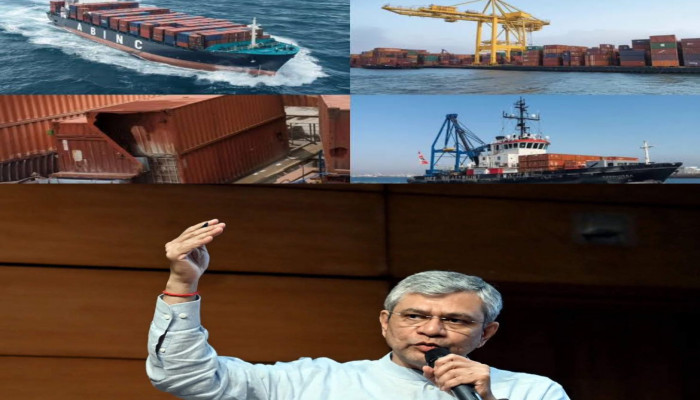
₹12,980 Cr Maritime Insurance Boost Headlines Cabinet’s Big Infrastructure and Welfare Push
The Union Cabinet has approved a major financial and policy package to boost India’s maritime sector, improve rural connectivity, support government employees, and expand railway infrastructure. The decisions, announced by Union I&B Minister Ashwini Vaishnaw, together involve an estimated outlay of over ₹1.28 trillion and are designed to address both economic and strategic needs.
A key highlight of the Cabinet’s decisions is the approval of a Bharat Maritime Insurance Pool with a sovereign guarantee of ₹12,980 crore. Announcing the move, Vaishnaw said, “The Cabinet has approved the creation of a Bharat Maritime Insurance Pool with a sovereign guarantee of ₹12,980 crore.” This initiative is intended to provide stable and uninterrupted insurance coverage to Indian shipping companies, especially at a time when global uncertainties and geopolitical tensions have made maritime operations more risky and expensive.
The minister explained that rising tensions in West Asia have led to increased insurance premiums and reduced availability of coverage for ships. This has created challenges for Indian shipping and trade. The new insurance pool aims to address these concerns by offering a reliable domestic solution. It will cover various types of maritime risks, including hull and machinery, cargo, protection and indemnity (P&I), as well as war-related risks.
The scheme will apply to India-flagged vessels, India-controlled ships, and vessels linked to Indian trade routes. It will operate with participation from domestic insurance companies. By doing so, the government hopes to reduce dependence on foreign insurers and ensure continuity in trade operations. Vaishnaw said, “This scheme is for those shippers who transit their vessels, while the VCGC is for individual exporters. Due to the West Asian crisis, we saw that this was needed.” He further added, “We need a good insurance system in this regard; this will help reduce costs,” and noted, “This is an insurance pool. A sovereign guarantee is the major benefit here.”
Alongside this, the Cabinet has also approved a 2 per cent increase in Dearness Allowance (DA) for central government employees and Dearness Relief (DR) for pensioners. The revised rates will bring DA and DR to 60 per cent of basic pay or pension. This change will be effective from January 1, 2026. The decision is expected to benefit more than 50 lakh employees and around 68 lakh pensioners across the country. The government has estimated the annual financial impact of this increase at ₹6,791 crore.
In another significant move, the Cabinet approved the continuation of the Pradhan Mantri Gram Sadak Yojana (PMGSY-III) till March 2028. The scheme’s revised outlay stands at ₹83,977 crore, with costs shared between the Centre and state governments. The extension focuses on improving rural road connectivity, especially linking villages to agricultural markets, schools, and healthcare facilities.
Vaishnaw highlighted that timelines under the scheme have also been extended. Road and bridge works in plain areas are to be completed by March 2028, while bridge works in hilly regions will continue till March 2029. He noted that the extension will help strengthen rural economies, improve access to essential services, and create employment opportunities in the process.
The Cabinet also cleared two major railway expansion projects aimed at increasing capacity on important routes. The first project involves the construction of the third and fourth railway lines between Ghaziabad and Sitapur. This project will span 403 km and is estimated to cost ₹14,926 crore. It is part of the high-density Delhi–Guwahati corridor and is expected to be completed within four years.
According to Vaishnaw, the project will include six new stations across Uttar Pradesh. “It is aimed at facilitating faster movement of both passenger and freight trains, while also supporting industrial hubs along the corridor,” he said. The additional lines are expected to ease congestion and improve efficiency on this busy route.
The second railway project approved by the Cabinet focuses on the east coast corridor. It involves the construction of third and fourth railway lines between Rajahmundry (Nidadavolu) and Visakhapatnam (Duvvada). This project comes with an estimated cost of ₹9,889 crore. It is expected to significantly enhance capacity on one of the country’s critical rail routes.
The government believes that this expansion will improve both freight and passenger movement while reducing congestion. It will also support economic activity along the corridor by making transportation more efficient and reliable.
Overall, the Cabinet’s decisions reflect a balanced approach that combines infrastructure development, economic resilience, and welfare measures. From strengthening maritime security and trade to improving rural connectivity and railway capacity, the initiatives aim to support long-term growth while addressing immediate challenges. The inclusion of financial support for employees and pensioners further underlines the government’s focus on public welfare alongside development goals.



 Loading...please wait
Comments