



Bulgaria’s former euro-sceptic president Rumen Radev set for a landslide victory
- In Reports
- 05:41 PM, Apr 20, 2026
- Myind Staff
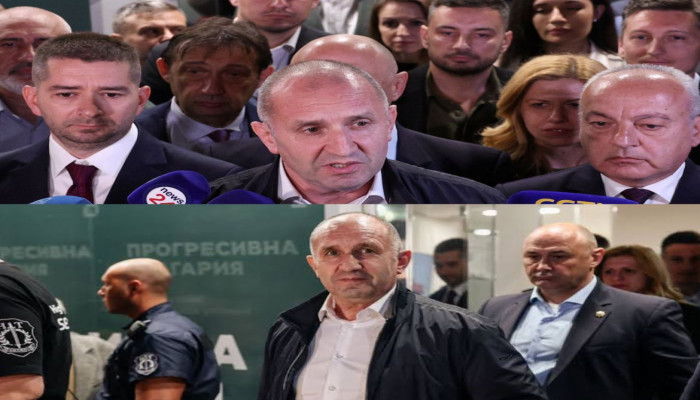
Former president Rumen Radev has secured a sweeping victory in Bulgaria’s parliamentary elections, marking a major political moment for the country. Official results released on Monday show that his party, Progressive Bulgaria, has gained a dominant lead, outperforming expectations and leaving long-established political groups far behind. The outcome may bring a period of stability after years of repeated elections and could influence the country’s position within the European Union and NATO.
With 91.7% of ballots counted, Progressive Bulgaria received 44.7% of the vote. This strong result puts the party in a position where it could potentially form a government on its own. However, Radev has not ruled out the possibility of working with other parties, including pro-European groups or smaller political formations. His closest competitors lagged far behind. The We Continue the Change–Democratic Bulgaria (PP-DB) coalition secured 13.2%, while GERB, led by former Prime Minister Boyko Borissov, received 13.4%.
Speaking after the results, Radev described the outcome in strong terms. "This is a victory of hope over distrust, a victory of freedom over fear, and finally, if you will, a victory of morality," he said at a press conference on Sunday night. His message reflects the broader mood among voters who have grown frustrated with ongoing political instability and corruption concerns.
Radev, known for his eurosceptic stance and past opposition to military support for Ukraine, had stepped down from his largely ceremonial presidential role earlier this year to contest the parliamentary elections. His decision followed mass protests in December that forced the previous government out of power. The election result suggests that his campaign successfully tapped into public dissatisfaction, especially in a country that has faced eight elections in just five years.
Many voters appear eager for change. Evelina Koleva, a digital marketing manager based in Sofia, expressed cautious optimism. "There is now an opportunity for the things people have been hoping to see change to actually become visible," she told Reuters. Her statement reflects a broader sense of hope among citizens who are tired of repeated political crises.
During his campaign, Radev drew comparisons with Viktor Orbán due to his comments about strengthening ties with Moscow and restoring the supply of Russian oil and gas to Europe. He also criticised the European Union’s heavy reliance on renewable energy sources. Despite these views, he has not provided detailed policy plans, leaving uncertainty about how far he might shift Bulgaria’s foreign and economic policies.
Bulgaria holds a strategic position as a Black Sea nation and an EU member on the bloc’s southeastern edge. It recently adopted the euro in January, a move that Radev had openly criticised. However, analysts believe that he is unlikely to reverse this decision or block broader EU support measures for Ukraine.
On Sunday, he signalled a willingness to cooperate with other political groups on judicial reforms and reaffirmed the country’s broader direction. He stated that Bulgaria would "make efforts to continue on its European path."
Despite the optimism among some, others remain cautious. Venelin Spasov, a 31-year-old real estate broker from Sofia, voiced uncertainty about the future. "I don’t know whether to believe there will be a change in the political class," he said. "But I hope it’s for the best because, after all, it is high time we had some kind of change." His comments highlight the mixed feelings among the public, balancing hope with scepticism.
Economic concerns were a key factor in shaping voter sentiment. Although Bulgaria has made significant progress since the fall of communism in 1989, challenges remain. The country joined the EU in 2007 and has seen improvements in life expectancy and employment levels. Its unemployment rate is now among the lowest in the EU, and the adoption of the euro has brought stronger financial safeguards.
However, Bulgaria still trails behind other EU nations in several areas. The rising cost of living has become a major issue, especially after the transition to the euro. Public dissatisfaction grew when the previous government proposed a budget that included tax increases and higher social security contributions. These measures triggered protests and eventually led to the government’s collapse.
Experts believe that addressing economic and demographic challenges will be crucial for the new leadership. Tihomir Bezlov, a senior fellow at the Centre for the Study of Democracy in Sofia, pointed out the key issues ahead. "The country’s main challenge is the economic crisis and the demographic crisis," he said. "There do not seem to be many ideas in the winning camp on either of these issues." His remarks underline concerns about whether the new government has a clear plan to tackle these pressing problems.
Radev’s victory represents a significant shift in Bulgaria’s political landscape. It reflects public demand for stability and change after years of uncertainty. While his win could bring a more stable government, questions remain about the direction his leadership will take, both domestically and internationally. The coming months will be critical in determining whether his administration can meet public expectations and address the country’s ongoing challenges.



 Loading...please wait
Comments