




Building India’s Global Leadership in Innovative Biopharma
- In Health & Wellbeing
- 07:51 PM, Sep 30, 2026
- Rudra Dubey
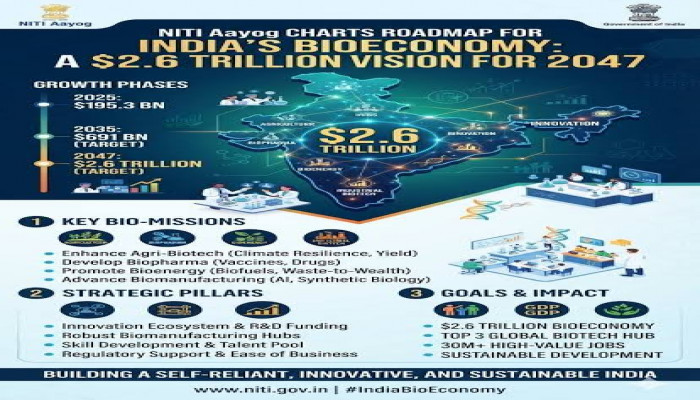
The NITI Frontier Tech Hub’s recent consultation offers an opportunity to connect work already underway across government, research institutions, industry, and investors. India has experience developing and supplying medicines at scale. The next shared ambition could be to take more Indian-origin innovative products from discovery to demonstrated clinical benefit, international approval, and sustained value for India.
A 2026 review identified 1,095 drug projects or molecules pursued by Indian companies from the mid-1990s through 2025, including 98 classified at Phase I, 63 at Phase II, 19 at Phase III, and 21 approved drugs or treatments. These are different projects at different stages—not a clinical success rate. They provide a useful starting point for examining which types of support help promising assets advance.
India can build on product experience as well: ROTAVAC received WHO prequalification; NexCAR19 established an indigenous CAR-T pathway; and nafithromycin received Indian marketing authorisation. Each followed a distinct route, so each offers practical lessons for future product teams.
Relevant lessons from international experience
The most useful comparisons are specific examples of how research, development, and commercial capabilities have been joined. Their figures are not directly comparable to India’s pipeline totals.
|
International example |
Verified outcome |
Opportunity for India |
|---|---|---|
|
United States: A Connected Translational network |
The NIH Clinical and Translational Science Awards program funds more than 60 medical institutions and explicitly supports shared expertise, partnerships, training, and improvements from early translation through clinical research. |
As Biopharma SHAKTI and ICMR expand clinical capacity, connect selected sites with specialist development services and common quality measures. The value of a network lies in the studies it can execute together. |
|
Japan: retain a role in a Global Partnership |
Daiichi Sankyo partnered with AstraZeneca in 2019 to develop and commercialise its antibody–drug conjugate Enhertu globally, while retaining exclusive Japanese rights and responsibility for manufacturing. Their agreement included a $1.35 billion upfront payment and shared development costs and profits outside Japan. The companies reported $4.982 billion in combined Enhertu sales in 2025. The upfront payment, potential milestones, and product sales are different financial measures and should not be added together. |
Help Indian innovators prepare differentiated assets for international partnerships while negotiating deliberately over retained rights, manufacturing, future development, and value sharing. |
|
A global oncology company: develop an original asset across markets |
BeOne Medicines traces its BTK inhibitor zanubrutinib from its discovery program into international clinical development and FDA approval in 2019. It reported $3.9 billion in global BRUKINSA sales in 2025, including $2.8 billion in the United States. This is one company’s experience, not a national benchmark. |
Plan target-market evidence and clinical development early enough that an Indian-origin product can compete internationally, whether the innovator commercialises it directly or with a partner. |
|
Global R&D commitment: sustain a portfolio |
Roche reported CHF 10.4 billion in pharmaceutical R&D expenditure in 2025 and a pipeline of 66 new molecular entities across 107 projects. Its scale cannot be transferred directly to India or an individual Indian company. |
Design public and private finance to support successive product milestones and a portfolio of assets, while allowing rigorous decisions to stop programs whose evidence does not justify further investment. |
These examples suggest several possible routes to global value. A product can be developed through a connected research network, advanced by an Indian company internationally, or partnered with a global company while the Indian innovator retains meaningful rights and participation. India can support all three.
A joint agenda for NITI Aayog and partner agencies
1. Select a portfolio around patient need and product potential. NITI Aayog could convene DBT/BIRAC, the Department of Pharmaceuticals, ICMR, CDSCO, clinicians, companies, and investors to agree on selection criteria for Indian-origin assets. Each selected program would have a target product profile covering its intended patients, evidence of differentiation, development requirements, intellectual property, and potential markets. Independent reviews at successive milestones would help teams make timely decisions.
2. Connect funding across the full development path. BIRAC’s early and later support, the National Biopharma Mission, PRIP, and the RDI scheme provide complementary starting points. The practical step is to make the transition between them predictable for an asset that meets agreed evidence standards. PRIP’s ₹5,000-crore framework covers novel entities alongside other product categories; the ₹1-lakh-crore RDI scheme offers a wider financing framework. Reporting innovative therapeutics separately would make their contribution to this particular ambition visible.
3. Organise facilities around the package a product team must deliver. NITI’s proposed bioinnovation clusters, DBT/BIRAC facilities, and NIPER expertise could provide connected access to validated assays, toxicology, CMC development, GMP clinical supply, bioanalysis, and regulatory support. Shared facilities would then be assessed by the quality and timeliness of completed product-development work.
4. Make the clinical network a distinctive Indian strength. Biopharma SHAKTI proposes ₹10,000 crore over five years and more than 1,000 accredited clinical-trial sites. Working with ICMR’s INTENT network, partners could develop therapeutic-area groups with common training and measures for recruitment, retention, data quality, and inspection readiness. That would help Indian-origin programs generate evidence suited to their intended markets.
5. Build partnership and market planning into development. The Daiichi Sankyo example shows why a licensing agreement should be evaluated for the rights and long-term participation it preserves, as well as its initial payment. NITI’s proposed IP and investment coordination functions could help teams prepare for regulatory engagement, due diligence, licensing negotiations, and commercialisation.
A Shared Measure of Success
The participating bodies could follow supported Indian-origin innovative assets through clinical phases, regulatory decisions by jurisdiction, international licenses, payments received, original-product sales, and royalties retained in India. Indian approval, WHO prequalification, FDA approval, and EMA approval should be recorded as distinct achievements. Aggregated public reporting could show national progress while protecting confidential product information.
This would give each initiative a clear contribution to a common outcome. India’s 2035 bioeconomy leadership would be demonstrated most convincingly by products that improve care across borders and create enduring value for the Indian institutions and companies that originated them.
Disclaimer: The opinions expressed within this article are the personal opinions of the author. MyIndMakers is not responsible for the accuracy, completeness, suitability, or validity of any information on this article. All information is provided on an as-is basis. The information, facts or opinions appearing in the article do not reflect the views of MyindMakers and it does not assume any responsibility or liability for the same.



 Loading...please wait
Comments