




Budget 2026 outlines infra expansion, defence spending rise and AI roadmap
- In Economics
- 07:08 PM, Feb 01, 2026
- Myind Staff
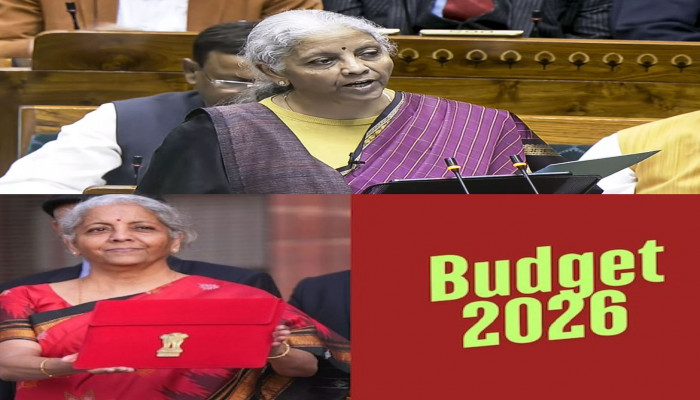
Finance Minister Nirmala Sitharaman on Sunday presented Budget 2026, laying out a roadmap that places infrastructure expansion, domestic manufacturing, digital and AI capacity, defence modernisation and tax simplification at the centre of India’s economic strategy. The budget aims to balance long-term growth with fiscal discipline, even as markets reacted with volatility immediately after the speech.
The government has projected economic growth of around 7 per cent for the coming year, while maintaining the fiscal deficit target at 4.3 per cent of GDP. The budget is framed around the government’s “three Kartavya” philosophy, which focuses on growth, competitiveness and inclusion as the core pillars of policy-making.
Prime Minister Narendra Modi described the budget as one that strengthens India’s reform journey and reflects the aspirations of 140 crore citizens. He said it gives fresh momentum to India’s push towards becoming the world’s third-largest economy.
This budget outlines key changes across infrastructure, manufacturing, MSMEs, defence, taxation, healthcare, semiconductors, AI and capital expenditure, while also explaining why equity markets saw a sharp knee-jerk fall despite a largely growth-oriented approach.
Infrastructure continues to be the cornerstone of the government’s economic strategy. One of the major announcements is a new dedicated freight corridor between Dankuni and Surat, aimed at improving logistics efficiency and reducing freight movement costs.
The budget also proposes the addition of 20 national waterways, strengthening inland water transport. Alongside this, a coastal cargo promotion scheme has been introduced to gradually shift more freight to inland and coastal routes, reducing pressure on road and rail networks over the long term.
Tier II and Tier III cities are expected to play a larger role in future growth. The budget outlines plans to develop these cities into City Economic Regions, supported by high-speed rail connectivity, stronger logistics infrastructure and deeper urban investment. This approach is intended to spread economic activity beyond major metros.
Manufacturing has received a significant boost in Budget 2026. The government announced support for semiconductor fabrication under the India Semiconductor Mission (ISM) 2.0, along with targeted support for electronics components, biopharma, construction equipment, sports goods and rare earth magnets.
Around 200 industrial clusters will be revived as part of this push. The budget also highlights plans for new chemical parks and container manufacturing units to add industrial capacity and reduce import dependence.
Customs duty rationalisation is another key feature. The government has proposed duty reductions to lower costs for aircraft parts, microwave components, seafood processing inputs and aerospace materials.
Manmeet Kaur, Partner at Karanjawala & Co., said, “The focus on domestic manufacturing is a strategic step to reduce import dependence and create employment.” She added that the real test will be whether these measures translate into broad-based income gains across the economy.
Micro, small and medium enterprises (MSMEs) have been given targeted support through both equity and liquidity measures. A Rs 10,000 crore SME Growth Fund has been announced to improve access to equity capital for smaller businesses.
On the liquidity side, the government has made mandatory the use of the Trade Receivables Discounting System (TReDS) for procurement by Central Public Sector Enterprises (CPSEs). Credit guarantees for invoice discounting have also been introduced to ease working capital stress for MSMEs.
The introduction of “Corporate Mitras” is aimed at helping smaller businesses navigate regulatory and compliance requirements in a more affordable and efficient manner.
Defence spending continues its upward trend in Budget 2026. The overall defence allocation has risen to around Rs 7.85 lakh crore, compared to about Rs 6.81 lakh crore in the previous year. This marks an increase of nearly 15 per cent, signalling a stronger push towards military readiness and modernisation amid ongoing security concerns about China and Pakistan.
Capital expenditure for defence has also seen a significant jump. Estimates place defence capex at around Rs 2.31 lakh crore, up from Rs 1.80 lakh crore last year. This reflects a sharper focus on advanced weapon systems and strengthening domestic defence production capacity.
The Ministry of Defence remains one of the largest recipients of budgetary allocations, covering salaries, pensions, modernisation projects and procurement of high-end military equipment.
Tax-related announcements in Budget 2026 go beyond procedural tweaks and aim to reduce everyday burdens on taxpayers while simplifying compliance.
One key announcement is the reduction of Tax Collected at Source (TCS) on overseas tour packages and remittances for education and medical expenses under the Liberalised Remittance Scheme. The TCS rate has been cut from 5 per cent to 2 per cent, easing cost pressures for families.
In another relief measure, interest awarded by motor accident tribunals to natural persons will now be exempt from income tax, ensuring that accident victims receive the full benefit of legal compensation.
The finance minister also announced that the New Income Tax Act will come into effect from April 1, 2026. The new law is designed to replace older, more complex provisions with a modernised and streamlined framework.
Lokesh Shah, Partner at CMS Induslaw, said, “The new Income Tax Act from April 2026 is an important step toward simpler and clearer tax law.” Moin Ladha, Partner at Khaitan & Co., added that merging assessment and penalty processes and lowering pre-deposit requirements would reduce litigation for taxpayers.
Additional measures include extended timelines for revising income tax returns, simplified income tax filing and easing of certain TDS rules.
The budget introduces a major relief measure for patients suffering from high-cost illnesses. Customs duties have been waived on 17 critical cancer drugs, making advanced oncology treatments more affordable for families who rely on imported medicines.
Manish Dodeja, Chief Operating Officer at Care Health Insurance, said, “The exemption of customs duty on 17 critical cancer drugs is a welcome move that directly lowers treatment costs and eases the financial burden on patients and their families. It reflects a strong policy focus on patient welfare and access to life-saving therapies.”
He also highlighted the impact of reduced TCS on medical remittances, saying, “This provides tangible relief to families seeking specialised care overseas for reimbursement-related claims from international insurance covers and helps reduce financial pressure. Together, these measures strengthen the healthcare ecosystem and underscore the importance of financial protection in enabling timely and quality care.”
Beyond traditional manufacturing, Budget 2026 places strong emphasis on semiconductors and electronics. The government’s focus on ISM 2.0 signals its intent to deepen India’s role in advanced global supply chains.
Mohammad Athar Saif, Partner and Leader for CP&I and Industrial Development at PwC India, said Semiconductor Mission 2.0 strengthens India’s long-term positioning, though execution will be critical.
Sujay Shetty, Managing Director for ESDM and Semiconductor at PwC India, said the focus on rare earth mining and domestic electronics production, backed by a large outlay, could significantly improve India’s standing in global supply chains.
The budget outlines a clearer strategy for AI and digital infrastructure. Long-term tax holidays have been announced for foreign companies setting up data centres and cloud facilities in India.
A safe harbour regime for data and cloud service providers is expected to reduce regulatory friction and provide greater operational certainty for firms serving global clients.
The finance minister emphasised the importance of digital public infrastructure, sector-specific data platforms and advanced skilling to enable wider AI adoption. The focus on high-quality datasets, compute access and specialised training aims to accelerate AI use across healthcare, manufacturing, financial services and public administration.
Industry analysts note that data centre operators are likely to benefit directly, while allied sectors such as industrial real estate, power equipment, cooling systems and network infrastructure could see increased demand.
Capital expenditure remains a key pillar of the government’s growth strategy. Capex has been increased to Rs 12.2 lakh crore, supporting infrastructure, construction and industrial supply chains.
Anil Rego, Founder and Fund Manager at Right Horizons PMS, said the budget impact is tilted towards pro-cyclical themes. He noted that higher capex improves visibility for infrastructure, capital goods, cement and logistics sectors as multi-year projects translate into strong order books.
He added that public sector undertakings may see renewed investor interest due to a combination of strong capex, asset monetisation and improved infrastructure financing frameworks. However, he cautioned that public sector banks may see mixed reactions due to the absence of recapitalisation.
Equity markets fell sharply after the budget speech, driven largely by an increase in Securities Transaction Tax (STT) on futures and options trades. The higher trading costs led to the rapid unwinding of intraday positions.
Divam Sharma, co-founder and fund manager at Green Portfolio PMS, said, “Traders tend to react instantly to any cost change in the F&O segment, even if the longer term impact is limited.”
Additional pressure came from algorithmic and quant-driven unwinding, as well as the absence of major consumption-side stimulus. Clarification on the new buyback tax framework, which treats buyback proceeds as capital gains, also contributed to cautious sentiment.
Despite the sell-off, analysts stressed that the reaction was more mechanical than structural. Sonam Srivastava, Founder of Wright Research PMS, said markets still see the budget as reinforcing India’s capex cycle and fiscal predictability. Varun Gupta, CEO of Groww Mutual Fund, said the broader policy direction remains supportive for long-term equity flows.
The fiscal stance in Budget 2026 remains conservative, with a continued glide path towards consolidation. Gross market borrowing is expected to stay stable, and states will receive Rs 1.4 lakh crore in Finance Commission grants.
Transport and defence receive the highest allocations, followed by rural development, agriculture, education, health and energy. Capital expenditure has been protected, while revenue spending has been contained.
Overall, Budget 2026 prioritises infrastructure, manufacturing, semiconductors, AI, defence and tax simplification. It offers fewer immediate consumption incentives but focuses on long-term structural gains.
Disclaimer: The opinions expressed within this article are the personal opinions of the author. MyIndMakers is not responsible for the accuracy, completeness, suitability, or validity of any information on this article. All information is provided on an as-is basis. The information, facts or opinions appearing in the article do not reflect the views of MyindMakers and it does not assume any responsibility or liability for the same.



 Loading...please wait
Comments