




Bronze statue of Korean Queen Heo Hwang-ok unveiled in Ayodhya, Reflecting Ancient India–Korea Cultural Links
- In Reports
- 05:44 PM, Dec 25, 2025
- Myind Staff
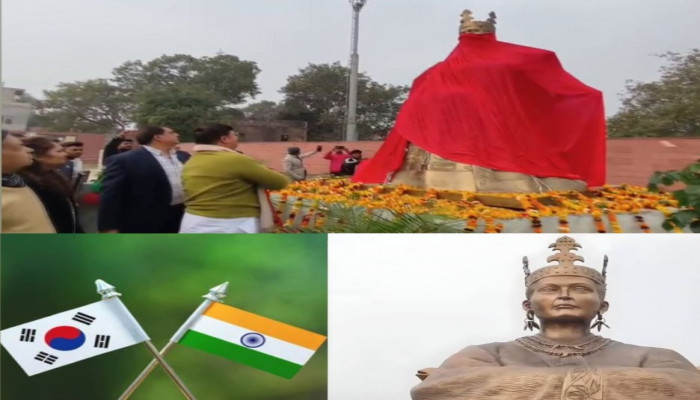
Ayodhya, one of India’s most historic cities, has added a new chapter to its history with the inauguration of a bronze statue of the Korean Queen Heo Hwang-ok. Queen Hwang-ok is deeply rooted in Korean folklore and believed to have origins in India. According to legend, she was an Indian princess named Suriratna from Ayodhya who travelled across the sea nearly 2,000 years ago to become a queen in Korea. The unveiling of the statue highlights the long-standing cultural and historical connections between India and South Korea.
The statue honours a story that dates back to 48 AD. As per traditional legends, Princess Suriratna sailed from India to Korea to marry King Kim Suro, the founder of the ancient Gaya kingdom. After her marriage, she came to be known as Queen Heo Hwang-ok. She is remembered in Korean history for her role in shaping the early legacy of the Gaya kingdom and is believed to have introduced elements of Indian culture during her time as queen.
For many South Koreans, Ayodhya holds significance beyond Indian mythology. It is believed to be the birthplace of Princess Suriratna, making the city culturally important to millions of Koreans who consider themselves her descendants. The unveiling of the statue has added a new dimension to Ayodhya’s historical identity, linking it to Korea’s ancient past.
According to folklore, Princess Suriratna undertook a long sea journey from India to Korea after learning about her destined marriage. The journey is said to have been guided by divine instruction. After reaching Korea, she married King Kim Suro and became a respected queen known for her wisdom and devotion. She is also credited, according to legend, with carrying Indian cultural values and Buddhist influences across the seas.
The story of Queen Heo Hwang-ok appears in Samguk Yusa (Memorabilia of the Three Kingdoms), a famous Korean historical compilation of legends and folklore. The text refers to her homeland as “Ayuta.” Many scholars and believers identify “Ayuta” with Ayodhya, although historians continue to debate this claim. As reported by the BBC, some Chinese-language records also mention that the king of Ayodhya dreamt that his daughter must marry King Suro and therefore sent her on an ocean journey.
Anthropologist Kim Byung-mo had earlier supported this interpretation. He stated that “Ayuta may indeed be Ayodhya,” suggesting a possible historical link between the two regions. However, historians have also noted that there is no definitive proof confirming the historical existence of Princess Suriratna. Despite this, the legend remains an important cultural belief in Korea.
According to the legend, Queen Heo Hwang-ok and King Kim Suro ruled wisely and lived long lives. They are believed to be the ancestors of the Karak clan, whose members still trace their lineage to her. Even today, members of the Karak clan visit Ayodhya regularly, treating it as a sacred and symbolic place that connects them to their ancestral roots.
The newly unveiled statue is not the first tribute to Queen Heo Hwang-ok in Ayodhya. In 2001, a memorial dedicated to her was established through a partnership between the Uttar Pradesh government and South Korea’s Gimhae city. The memorial was later redeveloped in 2015 to further strengthen cultural ties. Each year, visitors from South Korea, especially members of the Karak clan, visit the memorial, seeing it as a bridge between the two cultures.
The statue and memorial together serve as reminders of how ancient stories, migration and shared beliefs can connect distant civilisations. They reflect the deep cultural bonds that have existed between India and Korea for centuries, even if rooted in legend rather than proven history.
The importance of Ayodhya for South Korea has also been acknowledged at the diplomatic level. South Korean Ambassador Chang Jae-Bok highlighted this cultural connection and said, “South Korea will work on attending Ram temple inauguration, if India issues invitation.” His statement reflects the growing engagement between India and South Korea, particularly in cultural and heritage-related matters. Overall, the unveiling of the bronze statue of Queen Heo Hwang-ok in Ayodhya stands as a symbol of shared history, cultural exchange and mutual respect between India and South Korea. While historians may continue to debate the factual accuracy of the legend, its cultural significance and impact on bilateral ties remain strong.



 Loading...please wait
Comments