




Brazen Illicit Cross-Border Arms Supply via WhatsApp Shadow Market Groups in Kuki-Dominated Regions of Manipur
- In Current Affairs
- 03:16 PM, Mar 22, 2026
- Vladimir Adityanaath
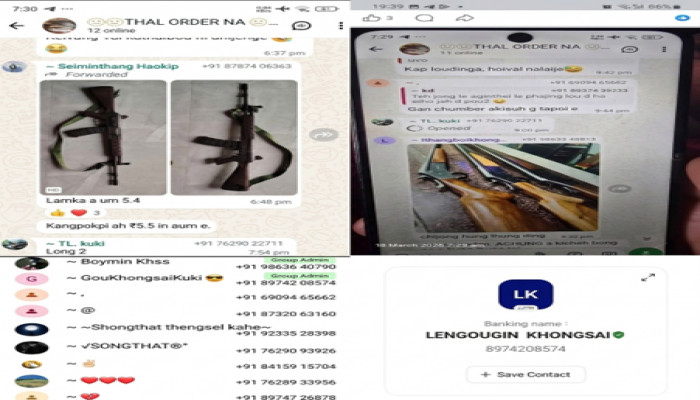
Markets for military-grade weapons have moved beyond jungles, border trails and hidden depots into the digital realm in the Kuki-dominated districts of Manipur, where it is becoming disturbingly accessible.
At the centre of these allegations is a WhatsApp group brazenly titled “THAL ORDER”. According to sources familiar with its activity, the group functions less like a covert network and more like an open bazaar, where assault rifles and other sophisticated weapons are discussed, priced and scheduled for delivery with unsettling normalcy. Transactions are negotiated in plain language. Delivery locations and timelines are coordinated. Participants are said to operate with a confidence that suggests assurance instead of secrecy.
The group is reportedly administered by individuals identified as L. Seiminchung Khongsai and Lengougin Khongsai and prominent participants like Mangminglal Hangshing, Sei David Haokip and Paominson Kipgen.

One message, translated from a local dialect, describes weapons as ‘extremely cheap’ and readily accessible across Churachandpur and Kangpokpi, while claiming that such low-cost military-grade arms remain out of reach for Meiteis. It further states that a consignment of three assault rifles is already “en route for delivery”.
If these accounts withstand scrutiny, they point to the emergence of a shadow market — digitally enabled, socially embedded, and logistically functional — taking shape in regions already strained by insurgency, fractured governance, and unforgiving terrain. Despite repeated assurances from both the state administration and the Union government, evidence on the ground suggests that sophisticated weapons are not only flowing into Manipur but are allegedly being traded with alarming openness in districts such as Kangpokpi and Churachandpur.
Non-State Actors: The ‘Contractors’ of Conflict Along the Border
Most sophisticated military-grade weapons entering Manipur are traced back to Myanmar, sourced through a fragmented and informal ecosystem. At its core are-
1. Well-established supply chain and launchpads: The India–Myanmar border remains one of South Asia’s most active illicit arms routes, intertwined with narcotics networks and insurgent financing. Weapons originating from Southeast Asian black markets, Myanmar civil war stockpiles and Chinese-origin or global surplus stocks move through the Sagaing region or Chin State before entering India through the porous frontiers of Manipur or Mizoram.
2. Insurgent groups, foreign mercenaries and weapons specialists acting as “quasi-contractors”: Insurgent groups operating along the Indo–Myanmar border function as quasi-contractors, with cadres facilitating cross-border movement and border-adjacent camps doubling as storage hubs.
Foreign mercenaries and weapons specialists form another layer in this setup. Individuals such as Daniel Stephen Courney are alleged to have supplied drones and protective gear during the peak of the 2023–25 violence in Manipur. Matthew VanDyke, along with six Ukrainian operatives, was arrested for allegedly supplying weapons and facilitating drone technology transfers to insurgents in Myanmar.
Ground-level documentation by activists like Vladimir Adityanaath has also pointed to the presence of Eastern European combat veterans and drone specialists training anti-junta forces in FPV kamikaze drone operations, improvised aerial payloads and sniping techniques in Chin State near the Mizoram border. Camp Victoria, located across the Tiau river near Champhai, has emerged as one such reported training site.
The Weapon Pipeline: From Warzones to WhatsApp
1. Cross-Border Movement of Weapons Along Manipur’s International Frontier

Despite heightened surveillance, key corridors along the India–Myanmar frontier continue to facilitate the movement of arms into Manipur. The Moreh–Tamu axis endures as a primary crossing point, while the well-established timber smuggling routes along the forested and remote regions of Chandel District have evolved into established transit routes.
Disclaimer: The opinions expressed within this article are the personal opinions of the author. MyIndMakers is not responsible for the accuracy, completeness, suitability, or validity of any information on this article. All information is provided on an as-is basis. The information, facts or opinions appearing in the article do not reflect the views of MyindMakers and it does not assume any responsibility or liability for the same.



 Loading...please wait
Comments