




Bollywood, Are You Listening? The Unmade Story of Yellapragada Subbarow, the Indian Scientist Who Helped Save the World
- In Mathematics, Science & Technology
- 12:56 PM, Jul 30, 2026
- Dr. Siddhartha Dave
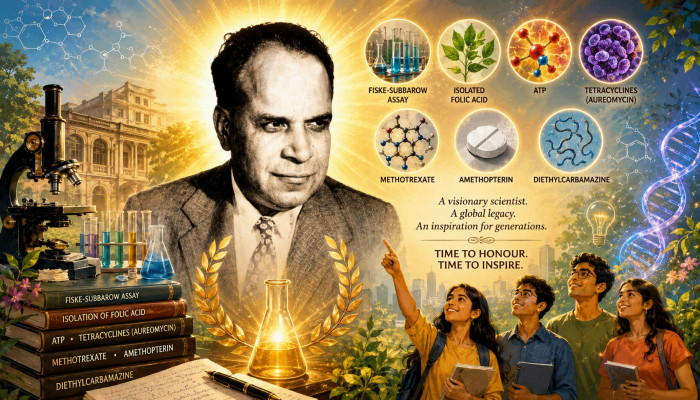
There are stories that deserve to be told because they inspire. There are others that deserve to be told because they correct history. And then there is the life of Dr Yellapragada Subbarow—a son of Bharat whose extraordinary contributions transformed modern medicine, saved tens of millions of lives, and yet remain largely unknown outside scientific circles.
If Bollywood is searching for its next great biographical epic, it need not look to fiction. The life of Yellapragada Subbarow contains every element of a timeless cinematic masterpiece: poverty, perseverance, patriotism, discrimination, scientific brilliance, betrayal, sacrifice, and a legacy that continues to heal humanity long after his death.
It is astonishing that while countless films have celebrated fictional heroes, the story of the man behind some of the greatest medical breakthroughs of the twentieth century has never reached the young Gen Z minds.
A Village Boy Who Refused to Surrender
Yellapragada Subbarow was born on 12 January 1895 in Bhimavaram, then part of the Madras Presidency (present-day West Godavari district, Andhra Pradesh), into a Telugu Brahmin family. His father was a Sanskrit scholar.
His childhood was marked by unimaginable tragedy. His father succumbed to tropical sprue, and the same disease claimed two of his brothers. Watching his loved ones slowly waste away left a permanent impression on the young Subbarow. He resolved that his life's mission would be to fight disease and reduce human suffering.
Academic success did not come easily. His education at Rajahmundry was repeatedly interrupted by family tragedies. He failed his school examinations twice before finally matriculating on his third attempt from the Hindu High School in Madras. It was an early lesson in resilience that would define the rest of his life.
He later passed the Intermediate Examination from Presidency College and entered the prestigious Madras Medical College. His education was made possible not by wealth but by the generosity of friends and philanthropist Kasturi Suryanarayana Murthy, whose daughter he would later marry.
A Patriot Who Paid the Price
Subbarow's patriotism was not merely intellectual. Inspired by Mahatma Gandhi's call to boycott British goods, he chose to wear khadi surgical attire during his medical training. This seemingly simple act invited the displeasure of his surgery professor, M. C. Bradfield.
Although he performed well in the written examinations, he was denied the prestigious MBBS degree and instead awarded the lesser Licentiate in Medicine and Surgery (LMS) qualification.
The discrimination altered the course of his career.
Unable to enter the Madras Medical Service, he accepted a position teaching anatomy at Dr Lakshmipathi's Ayurvedic College in Madras.
Far from treating this as a setback, Subbarow became fascinated by Ayurveda. He believed its healing traditions deserved rigorous scientific investigation and began researching ways to place Ayurvedic medicine on a modern scientific foundation. This synthesis of ancient Bhartiya knowledge and modern biomedical science reflected a mindset far ahead of its time.
Support from the Malladi Satyalingam Naicker Charities of Kakinada and financial assistance from his father-in-law finally enabled him to pursue advanced studies abroad.
On 26 October 1922, carrying borrowed money, limited English, and immense determination, the 27-year-old Subbarow arrived in Boston.
Harvard's Forgotten Genius
At Harvard Medical School, Subbarow joined the Department of Biochemistry under the distinguished scientist Dr Cyrus H. Fiske.
The laboratory became his world. Long hours. Little pay. No complaints.
In 1925, the partnership produced one of the most influential laboratory techniques in medical history—the Fiske–SubbaRow assay, a reliable method for measuring phosphorus in biological fluids.
Nearly a century later, the technique continues to be used in clinical medicine, including investigations relating to kidney disease, vitamin D disorders, and prostate cancer. It remains one of the most cited biochemical methods ever developed.
Yet this achievement was only the beginning.
Unlocking the Energy of Life
In 1926, Subbarow and Fiske made a discovery that fundamentally changed biology.
They identified the central role of adenosine triphosphate (ATP)—the universal energy molecule that powers every living cell.
The discovery revolutionised biochemistry and overturned prevailing theories, including assumptions associated with the work of the 1922 Nobel laureate regarding muscular function. Muscles were not powered primarily by glycogen; ATP was the immediate energy currency of life.
Every medical student today learns about ATP.
Very few are taught the name of the Indian scientist who helped establish its central biological significance. Subbarow completed his PhD in 1930.
What followed should have been the beginning of an illustrious academic career. Instead, it became a lesson in institutional prejudice.
Excellence Without Recognition
For another decade, Subbarow continued producing groundbreaking research at Harvard. Paper followed paper. Discovery followed discovery. Promotion never came.
The department had never granted tenure to a foreign-born scientist, and despite his extraordinary accomplishments, it refused to begin with an Indian. The irony was painful. His colleagues socialised with him, visited his home, played tennis, and went fishing with him. The same colleagues repeatedly voted against granting him tenure. Discrimination extended beyond the university. An aviation enthusiast, Subbarow purchased an aircraft and learned to fly.
On another occasion, when he attempted to visit a bowling alley, he was turned away because it admitted only the "Caucasian race." Scientific brilliance could not overcome racial barriers in America of that era.
Betrayed in the Laboratory
Professional disappointment soon gave way to something even more painful.
His mentor, Cyrus H. Fiske, reportedly became increasingly jealous of his gifted protégé. Important scientific work by Subbarow was suppressed and, according to later accounts, even destroyed.
Years afterward, Nobel laureate George Hitchings acknowledged the injustice:
"Some of the nucleotides isolated by Subbarao had to be rediscovered years later by other workers because Fiske, apparently out of jealousy, did not let Subbarao's contributions see the light of the day."
Some discoveries had to be made all over again because the original work never reached the scientific community. Few scientists have suffered such a profound injustice at the hands of their own mentor.
Harvard's Loss Became Humanity's Gain
In May 1940, after Harvard denied him tenure for the final time, Subbarow left the university after seventeen years. Lederle Laboratories in New York immediately recognised what Harvard had failed to appreciate. He joined as Associate Director of Research and, within the year, became Director of Research.
The next eight years would permanently change the history of medicine.
Medicines That Changed the World
Subbarow developed diethylcarbamazine, an oral drug effective against filarial worms and other tropical parasitic infections that had crippled soldiers serving in the Pacific theatre during the Second World War. The medicine remains in use today under World Health Organisation programmes against lymphatic filariasis.
He successfully isolated folic acid from liver tissue and developed methods for its large-scale production. Today, folic acid supplementation during pregnancy prevents devastating neural tube defects in millions of babies across the world every year. There is a poignant symmetry in this achievement. The disease that had devastated his own family became one whose consequences could increasingly be prevented through advances he helped make possible.
The Birth of Chemotherapy
One of the greatest revolutions in medical history began with a telephone call. Dr Sidney Farber believed that blocking folic acid metabolism might halt childhood leukaemia. Subbarow's team transformed that idea into reality. They developed Aminopterin. In December 1947, Farber administered the drug to an eight-year-old boy dying of leukaemia. Within weeks, the cancer entered remission. For the first time in history, chemotherapy had defeated cancer—even if only temporarily. Modern cancer treatment had begun. Subbarow's team later refined the medicine into Amethopterin, today known worldwide as Methotrexate.
Methotrexate remains among the most important medicines ever developed. It is used in the treatment of leukaemia, lymphoma, breast cancer, lung cancer, rheumatoid arthritis, psoriasis, Crohn's disease, and numerous autoimmune disorders. The World Health Organisation lists it among its Essential Medicines. Every prescription written today carries, silently, the legacy of Yellapragada Subbarow.
The Antibiotic Revolution
In 1948, Subbarow's laboratory produced another breakthrough. Aureomycin, the world's first tetracycline antibiotic. Unlike penicillin, Aureomycin possessed broad-spectrum activity against numerous bacterial infections, including typhus, cholera, and pneumonia. It opened the door to the tetracycline family of antibiotics—including doxycycline and minocycline—which continue to treat plague, malaria, anthrax, and many drug-resistant bacterial infections across the globe. Few scientists transform medicine once. Subbarow did so repeatedly.
A Quiet Death for a Giant
On 8 August 1948, at only 53 years of age, Yellapragada Subbarow suffered a fatal heart attack at his home in New York. He died having transformed modern medicine. Yet there was no front-page obituary. No major national memorial. No Nobel Prize. Not even a nomination.
In 1988, George Hitchings received the Nobel Prize for work that rested substantially upon scientific foundations laid by Subbarow. History celebrated the edifice. It overlooked one of its principal architects.
Recognition That Came Too Late
In 1950, Argosy magazine published a remarkable profile titled "Miracle Man of the Miracle Drugs." It began with unforgettable words:
"You've probably never heard of Dr. Yellapragada Subbarow. Yet because he lived you may be alive and are well today. Because he lived you may live longer."
Those words remain equally true today. Harvard has never officially honoured him in proportion to his contributions. Most American medical schools still do not adequately teach his story. The Nobel Committee never corrected the historical omission. Yet science itself has quietly preserved his memory. A genus of fungi was named Subbaromyces in his honour.
A species of jumping spider from the genus Tanzania bears the name Tanzania yellapragadai. His hometown, Bhimavaram, has named a street after him.
In Bharat, his centenary was commemorated with a Government of India postage stamp, his childhood home has been converted into a museum, and generations of medical students continue to learn about his contributions.
Why Bharat Must Tell His Story
There are biographies that entertain. There are biographies that educate. The life of Yellapragada Subbarow does both—and much more. His story captures the spirit of a civilisation that values knowledge above recognition and service above fame.
He failed examinations twice yet transformed global medicine. He faced racial discrimination but never abandoned scientific excellence. He was denied academic recognition but gave humanity medicines that continue to save countless lives.
He demonstrated that patriotism and scientific inquiry are not opposing ideals. His embrace of khadi, his interest in modernising Ayurveda through scientific research, and his unwavering commitment to medicine reflected an authentically Bharatiya intellectual tradition that combined civilisational confidence with universal service.
In an age obsessed with celebrity, Subbarow reminds us that true greatness often works in silence.
A Bollywood Epic Waiting to Be Made
Indian cinema has successfully brought to life the stories of scientists, sportspersons, soldiers, entrepreneurs, and freedom fighters. Yet one of the greatest scientific minds produced by Bharat remains absent from popular culture.
His life possesses every ingredient of compelling cinema: a humble village childhood, repeated academic setbacks, family tragedy, Gandhian conviction, colonial discrimination, intellectual triumph, racial prejudice in America, institutional betrayal, scientific breakthroughs that changed the world, and an ending that is as heartbreaking as it is inspiring.
This is not merely the story of one scientist. It is the story of how brilliance can survive injustice, how service can outlive recognition, and how an Indian denied honours can still earn humanity's gratitude.
This author hopes that a visionary producer, director, or screenwriter will finally bring Yellapragada Subbarow to the silver screen. Such a film would not simply celebrate an extraordinary individual; it would inspire a new generation of young Bharatiya scientists to dream beyond recognition and work for the larger good of humanity.
For too long, the world has benefited from his discoveries without knowing his name.
That silence must end.
Every time a pregnant mother takes folic acid, every time a cancer patient receives methotrexate, every time a physician prescribes doxycycline, the invisible hand of Yellapragada Subbarow continues to heal the world.
It is now Bharat's responsibility to ensure that the world also remembers the man behind those miracles.
Jai Hind.
The article first appeared at https://organiser.org/author/siddhartha-dave/
Disclaimer: The opinions expressed within this article are the personal opinions of the author. MyIndMakers is not responsible for the accuracy, completeness, suitability, or validity of any information on this article. All information is provided on an as-is basis. The information, facts or opinions appearing in the article do not reflect the views of MyindMakers and it does not assume any responsibility or liability for the same.


 Loading...please wait
Comments