




Blueprint of a Hindu Rashtra
- In Book Reviews
- 11:08 AM, Mar 24, 2026
- Ramaharitha Pusarla
With the rise and advent of the Westphalian ‘Nation States’ framework in international relations, geographical or territorial identity began to supersede indigenous or civilisational identity. The nation-state concept, applied to a relatively homogenous population, has inadvertently inculcated loyalty towards geographical boundaries. For a country with an illustrious antiquity and spanning a vast geographical expanse, colloquially referred to as a sub-continent and with an ocean named after it, the narrow definition of the Nation State has seriously constrained its identity and fostered a sense of nationalism centred on sovereignty. The nationalism of the 18th century is largely an insular concept.
Unfortunately, the dominant Western narrative has positioned Nation as an equivalent to the Indic version of Rashtra, which is all-inclusive and has deep cultural and spiritual significance. It refers to a ‘political entity or a country formed by a community with a shared identity, culture and history’. It is basically a socio-cultural construct where people’s approach towards life, relationship with nature and the universe and outlook towards history and tradition align. Rashtra, the Sanskrit term, has been in vogue since the Vedic times, referring to a spiritual entity and is based on memory and shared heritage.
This set of geo-cultural values has been at the heart of Bharateeya civilisation. Centuries of foreign invasions, marauding and assault on its identity and cultural roots have weakened this concept. Sadly, the all-inclusive concept of Rashtra is now conveniently replaced by the 18th-century nationalism ideology. Rashtra is lazily equated to the term Nation, which takes race, language and geographical limits as its basis. Consequently, any reference to Hindu Rashtra is first met with scepticism, which is rather unfortunate.
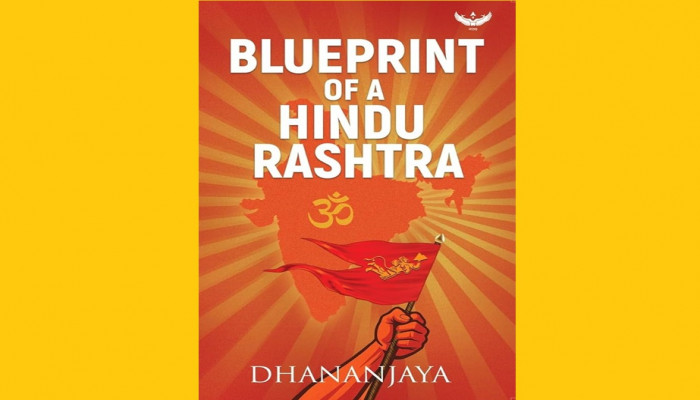
Rashtra embodies the collective will of a community to live together in pursuit of a common goal. Confronting widespread misconceptions about Rashtra- often born of ignorance, the book- “Blueprint of a Hindu Rashtra” makes a passionate appeal to Hindus to reflect on their civilisational identity. Written under the pen name of ‘Dhananjaya’, the book mourns the erosion of the ‘Kshatra attribute’ among Hindus and seeks to awaken them from the civilisational amnesia.
Challenging prevalent misapprehensions about Hindu Rashtra, the author unequivocally asserts the need for a Hindu Rashtra. The identity of this civilisation is inalienable from Hinduism. To restore its civilisational identity, Bharat has to become a Hindu Rashtra. Hindus are a global minority facing imminent threats to their survival from the proselytising religions. The author puts forth a compelling case for Hindus to unite and work towards realising the goal of Hindu Rashtra. The slow and steady decline of the geographical spread of Hindus within the geographical precincts of India should serve as a wake-up call for Hindus to build a civilisational Hindu Rashtra.
Laid out in three major parts, twenty chapters including a conclusion and two appendices, the book delves into the Why, What and How of Hindu Rashtra. Busting myths about Hindu Rashtra, the author clearly spells out, “the purpose of a Hindu Rashtra is to give Hindus breathing space, without taking anything away from the others. It is aimed to make Hindus self-aware and organised, and allow them to respond effectively to the h realities of the present times. A Hindu Rashtra means creating boundaries and walls around Dharma for self-protection, and for keeping out and removing the existential threats that the Dharma is facing” (p59).
Outlining the framework for Hindu Rashtra, the author enlists the need for legislative, judicial and constitutional amendments. He sets forth the need to set up the Ministry of Dharma, to free the temples and tirthas from government control, to institutionalise the Dharma Mahasabha, to reform the education system, and to protect and revive culture. The grand vision of Hindu Rashtra, though seemingly ambitious, is the most plausible solution to preserve ancient Hindu civilisation.
Relentless vilification of Hindu practices, derogatory remarks against their Devi Devatas, along with raising anti-Hindu hate, are a constant reminder of Hindus being under threat abroad and within India. Hindus are being systematically pushed to accommodate and adjust. They are expected to tolerate self-harm under the guise of secularism in India.
The book reflects on the ever-shrinking space for Sanatana Dharma in India. Packing the harsh realities together, the author urges Hindus to shed complacency. Brevity has turned out to be a double-edged sword for the book. While it can be read in a single sitting as the message is neatly presented as power capsules, the glaring absence of specific details fails to lend the book a scholarly gravitas. Timely, relevant and unapologetic, the book is an important read for a practising Sanatani.
No of Pages: 158, Price: ₹ 299
Publishers: Garuda Books
Disclaimer: The opinions expressed within this article are the personal opinions of the author. MyIndMakers is not responsible for the accuracy, completeness, suitability, or validity of any information on this article. All information is provided on an as-is basis. The information, facts or opinions appearing in the article do not reflect the views of MyindMakers and it does not assume any responsibility or liability for the same.



 Loading...please wait
Comments