




Beyond Oil Quota: Decoding UAE’s Exit from OPEC
- In Military & Strategic Affairs
- 01:46 AM, May 04, 2026
- Ramaharitha Pusarla
More than two months into the Iran-US war, the Strait of Hormuz remains blocked. Iran has tightened its grip on this strategic asset. Handling over 20% of global energy supplies, restrictions on the Strait have deepened the global economic crisis. Mediation attempts have come to an abrupt halt. The writing on the wall, as per columnists, is NACHO- ‘Not A Chance Hormuz Opens’. Fully aware of the looming squeeze on oil exports, Gulf nations are steadily ratcheting up plans to mitigate the fallout of Hormuz closure.
At a time when Arab countries met in Riyadh to discuss the repercussions of Iran's war, the UAE announced its exit from OPEC on April 28, effective from May 1st. This decision comes at a time when the world is facing a severe oil crunch. The timing of the announcement hasn’t come as a real shocker, given the UAE’s disappointment over a lack of solidarity and support from Gulf Countries.
Since Feb 28, Iran has launched over 6400 drone attacks targeting US bases and other critical assets in the region. However, the UAE faced disproportionate attacks from Iran compared to its primary adversary, Israel- 2800 drone and missile strikes as opposed to 930 attacks on Israel over a similar period. Even among the Gulf countries, the UAE faced the highest number of strikes, followed by Saudi Arabia, Kuwait, Qatar and Bahrain. Needless to say, while the UAE and Bahrain signed the Abraham Accords, the UAE has proactively strengthened ties with Israel since then.
UAE’s announcement to exit OPEC has turned out to be the endgame for its simmering differences with Saudi Arabia. Saudi Arabia and the UAE added more heft to the oil cartel, given their spare production capacity. The UAE is the third-largest oil producer in OPEC with a capacity of 4.85 million barrels per day. But its quota is capped at 3.2 million barrels. For long, the UAE faced losses from the underutilisation of vast production capacity. Disassociating from OPEC, the UAE can increase production at will. OPEC operates on quotas to regulate oil production and, concomitantly, global oil prices. President Trump has often accused OPEC of manipulating the global oil prices by pegging the production levels for a profitable production margin.
Saudi Arabia, the de facto leader of OPEC, seeking higher prices, to fuel its Vision 2030, enforced voluntary production cuts through quotas. By withdrawing from OPEC, the UAE will be free to increase its production. With the lowest production costs globally, the UAE can capitalise on its capacities to significantly scale up the output. Freed from the OPEC+ quota system, the UAE can advance its ambitious economic diversification agenda. Harnessing oil revenues, the UAE can accelerate its transition to green energy and renewables and realise the long-term goal of moving away from an oil-dependent economy status.
Using oil revenues, the UAE has built world-class maritime infrastructure, established a premier financial services hub and positioned itself as an economic powerhouse of the region. Under the garb of attacking US bases, Iran targeted airports, energy facilities, data centres, banks and digital infrastructure, significantly impacting its economy. The closure of the Strait of Hormuz has critically paralysed Abu Dhabi’s oil exports. As a result, the UAE could export ~1.5 million barrels from Port Fujairah through its Abu Dhabi Crude Oil Pipeline (ADCOP), far less than its capacity of 5 million barrels per day. The UAE was hardest hit by the Iran War.
On the other hand, Saudi Arabia’s export volumes remained stable. Barring some interruptions, the oil trade remained uninterrupted as Saudi Arabia rerouted supplies through the East-West Pipeline, bypassing the Strait of Hormuz. By April 12, Riyadh restored its full export capacity of 7 million barrels per day. With the fate of the Strait of Hormuz in limbo, the UAE initiated financial backstop talks with the US. Beyond the economic logjam, the Iran War has deepened fissures between Saudi Arabia and the UAE.
Both countries have been supporting the warring factions in Yemen, Sudan and Somalia. The dissonance on the Yemen front between Arab states became apparent after Saudi fighter jets struck Mukkalla seaport on the Red Sea, targeting the transfer of weapons from the UAE to the Southern Transition Council (STC), a dissident group. Saudi Arabia accused the UAE of arming the STC, which carried out military operations along its southern border. Deeming it a national security threat and a ‘red line’, with immediate effect, Saudi-allied Yemen’s Presidential Leadership Council (PLC) issued a decree suspending the joint defence agreement with the UAE, and ordered withdrawal of forces within 24 hours.
UAE’s exit from OPEC has many facets; while an obvious weakening of the oil cartel is imminent, there are many layers to it. Over the past decade, the UAE has been slowly evolving an economic architecture to expand its influence. Punching above its weight, the UAE is expanding its presence in the Red Sea, Horn of Africa, Eastern Mediterranean and North Africa. Actively strengthening its control over Red Sea maritime choke points, especially the Bab al-Mandab Strait, the UAE is quietly expanding its logistical empire. The Red Sea is a vital artery for the UAE’s oil exports. To protect its global trade flows and insulate supply chains from regional volatilities, the UAE is consistently diversifying its influence through economic investments in these regions. The UAE’s quiet presence in these strategically important maritime ports along the corridor has put it at odds with Saudi Arabia, Egypt and Turkey.
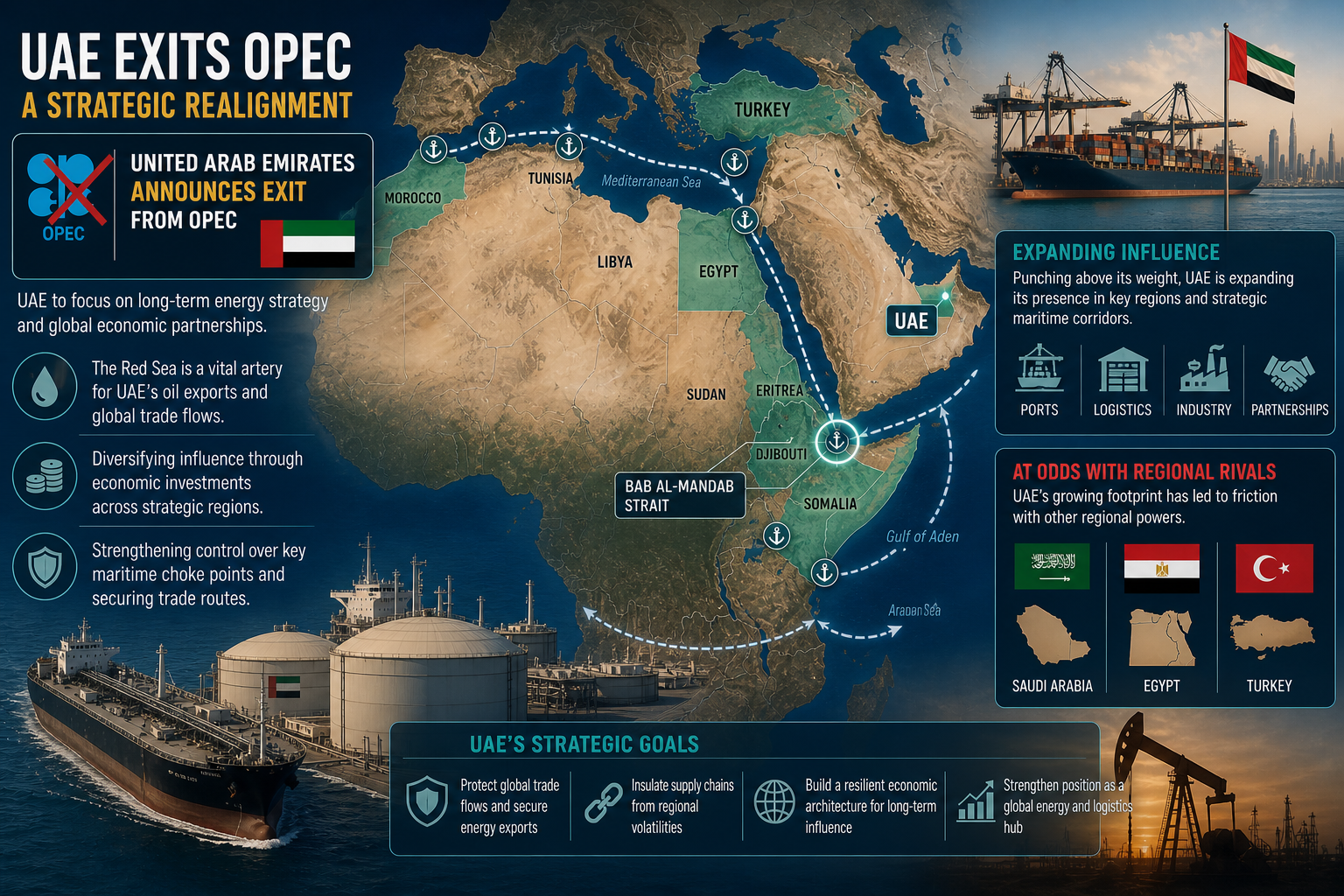
Extending its presence in the South Red Sea region, the UAE invested in the Port Berbera of Somaliland to connect it to Ethiopian trade routes and create a maritime corridor by integrating inland Africa with global shipping. Israel’s recognition of Somaliland eventually helped the UAE to access the airstrip of Port Berbera. This enabled the UAE to deepen its strategic depth in the Red Sea region, creating a Berbera axis, where the UAE-Israel-Ethiopia are pitted against Saudi Arabia-Egypt-Turkey-Somalia. Contesting Emirati influence in the Red Sea region, Saudi Arabia has entered Eritrea. Aligning with the US, Saudi Arabia is monitoring trade flows through the Red Sea region.
Alongside, the UAE is also building an Eastern Mediterranean corridor with Greece, Cyprus, Israel and India. This logistical corridor is a subset of the India Middle East Europe Maritime Economic Corridor (IMEC) steered by India. The IMEC, launched at the 2023 G20 Summit in New Delhi, suffered a hit after the October 7th attacks. While the overland routes passing through the Middle East are effectively frozen, India and France are actively pushing for IMEC’s maritime logistics.
As a part of its regional strategy of controlling Mediterranean route access, the UAE supports Khalifa Haftar’s forces. UAE’s patronage of Haftar has two purposes. Aside from pushing arms and weapons delivery through Haftar to RSF forces in Sudan, the UAE is gaining control in North Africa to establish a strategic logistics and military corridor. Saudi Arabia also engages with Haftar through Pakistan. To establish its leverage over Haftar, Saudi Arabia has recently facilitated a $4 billion arms deal between Haftar’s Libyan National Army (LNA) and Pakistan. But the deal is jeopardised with Saudi Arabia reportedly “revisiting its strategy”.
Another region of Saudi-Emirati contestation has been Sudan. Saudi Arabia has been providing financial and logistical support to the Sudanese Armed Forces (SAF) while the UAE backs the Rapid Support Forces (RSF). The brutal conflict between SAF and RSF for the past three years has led to the worst humanitarian crisis. Amid the Iran War, Western countries have forced Saudi Arabia to stall the $1.5 billion arms sale through Pakistan. Officially claiming to support humanitarian efforts in Sudan, Riyadh is actively engaging with SAF through Pakistan. With Saudi Arabia pulling the plug on its $1.5 billion financial support under Western pressure, Pakistan has officially called off its defence deal with Sudan.
The rift between the UAE and Saudi Arabia has been brewing for some time now. But the final straw on the camel’s back was Pakistan’s mediation of US-Iran talks. The UAE believed that Pakistan was unlikely to be neutral. Pakistan, which has been a pernicious defence logistics channel for Saudi, eventually became its strategic defence partner with the signing of Strategic Mutual Defence Agreement (SMDA) in September 2025. The UAE perceived a conflict of interest due to the SDMA pact between Saudi Arabia and Pakistan. As relations between Saudi Arabia and the UAE began to fester, Abu Dhabi felt sidelined as Riyadh aligned with Turkey, Pakistan and Egypt as part of Iran-US war negotiations.
Historically a recipient of Emirati financial support, Pakistan’s role as the pernicious handmaiden of Saudi has riled it. In fact, Pakistan’s “meek response” to Iranian attacks, its less beholden approach to Abu Dhabi, sharp rhetoric against Israel and India might have influenced the UAE to call for urgent repayment of the $3.5 billion loan. Emirati’s strategic framework, anchored by the 2020 Abraham Accord, has been further strengthened by Israel’s deployment of cutting-edge defence systems during the Iran conflict.
The ongoing war has positioned Israel as the strategic defence partner of the UAE. This new strategic realignment signalled Emirati prioritisation of the UAE-Israel-India axis to bolster its economic influence and maritime presence in the region and beyond. Aggressively pursuing “We the UAE 2031”, a 10-year roadmap launched in 2022, the UAE is signing Comprehensive Economic Partnership Agreements (CEPA)s to build a knowledge-based economy. In 2022, the UAE joined India, Israel and the United States in the I2U2 group and the IMEC initiative that resonated with its core goals of increasing non-oil exports, entering the top 10 league of countries in human development, health, education and safety. To realise its vision, the UAE needs an uninterrupted flow of oil revenues.
Stifling Saudi Arabia’s institutional control of OPEC, Hormuz blockade has curtailed its oil exports and dwindled the UAE’s dollar reserves. Exercising its sovereign right, the UAE has left OPEC. Even in the past, showcasing disagreements- Angola, Qatar, Indonesia and Ecuador exited OPEC. Gabon exited in 1995 and rejoined in 2016. The UAE has followed the same precedent. Headquartered in Geneva initially and later shifted to Vienna, OPEC was founded by 12 nations in 1960 in Baghdad. Comprising Iran, Iraq, Kuwait, Algeria, Congo, Equatorial Guinea, Gabon, Libya, Nigeria, Saudi Arabia, the UAE and Venezuela, OPEC emerged as a major bloc in 1973 when its Arab members imposed an oil embargo against nations supporting Israel.
Around that period, OPEC controlled nearly half of the world’s oil. But its influence began to wane after the US and others started producing oil. Joining hands with ten non-OPEC members- Azerbaijan, Bahrain, Brunei, Kazakhstan, Malaysia, Oman, Mexico, Russia, South Sudan and Sudan to stabilise global oil supply, OPEC formed OPEC+ in 2016. Figuratively, OPEC+ controlled nearly 59% of global oil production. But its heft began to gradually erode due to competition from other countries, defections, green energy transitions and internal dissent. The USA and Guyana, two major oil-producing countries, operate outside this alliance.
While the Strait of Hormuz blockade has marginalised OPEC’s leverage, the UAE’s exit would severely reduce its market influence. Unlike the exit of other countries, the UAE’s departure brought to the fore dissensions and faultlines among Gulf Countries. OPEC symbolised Gulf cohesiveness and its consensus decision-making helped it to weaponise oil.
The OPEC+ formed in 2016 in response to America’s shale production, helped Russia to mitigate the impact of Western sanctions and provided stable trade channels. In his first term, Trump had been highly critical of OPEC+ and accused it of artificially inflating prices. UAE’s withdrawal will weaken the group and its monopoly. Now the collective consensus will be overpowered by differences over Iran and Yemen within the group. The UAE has been the safety valve of the group. Abu Dhabi’s move is a major foreign policy victory for Trump.
The UAE plans to establish Murban crude as the global benchmark to compete with WTI and Brent and has invested $122 billion to raise production capacity. Now, it wants to freely trade oil and allow market forces to determine production volume. By exiting OPEC, the UAE is now staking its strategic autonomy to position itself as the major regional maritime power. The ongoing Iran War has revealed deeper rifts in the Middle East region for maritime influence between Saudi Arabia and the UAE.
UAE’s exit from OPEC will augur well for India’s efforts to tame the impact of rising oil prices on domestic inflation. The geographical proximity will reduce the shipping expenses and time. With premiums on ships transiting Hormuz surging, oil shipments from the UAE’s Port Fujairah can directly reach India. A weaker OPEC can cause global oil price volatility. The world must brace for cycles of unstable oil prices. OPEC traditionally trades in dollars. Given the UAE’s willingness to diversify from dollars, its strategic move could weaken the petrodollar system. India and China, the major oil consumers, can now settle oil trade in national currencies. India-UAE ties reached a new high with the CEPA and a steady increase in trading volumes. UAE’s move to maximise the oil output will bode well for India’s energy security.
Unrelenting geopolitical turbulences are reshaping the world order, compelling nations to prioritise national interests. The Hormuz blockade has pivotally underscored the centrality of maritime influence for economic clout. Nations are increasingly embracing “Port Diplomacy”- building an extensive logistics network to control maritime chokepoints that serve both as leverage and investments to enhance economic heft. UAE’s OPEC exit has revealed its strategic vision to expand its influence beyond borders and emerge as a regional maritime power.
Disclaimer: The opinions expressed within this article are the personal opinions of the author. MyIndMakers is not responsible for the accuracy, completeness, suitability, or validity of any information on this article. All information is provided on an as-is basis. The information, facts or opinions appearing in the article do not reflect the views of MyindMakers and it does not assume any responsibility or liability for the same.



 Loading...please wait
Comments