




Bengal’s Verdict and the Global Echo: Why Modi’s West Bengal Victory is Being Watched Across Borders
- In Politics
- 07:11 PM, May 08, 2026
- Siddhartha Dave
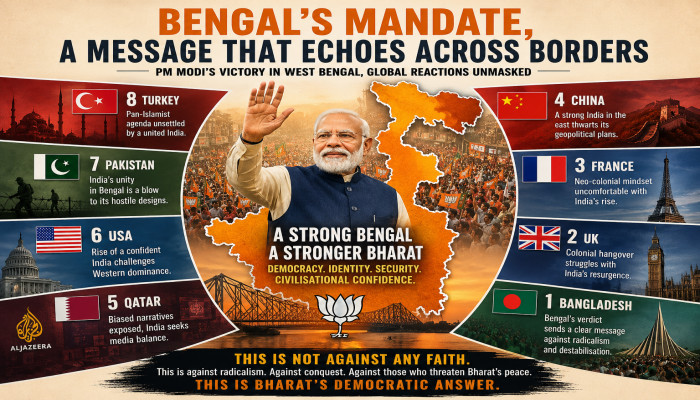
The electoral triumph of Narendra Modi-led BJP in West Bengal is not merely a regional political development. It is a geopolitical event with implications extending far beyond the borders of Bharat. Historically, West Bengal has remained more than an electoral battleground; it has been a civilisational frontier, a gateway connecting Bharat to the eastern flank of the subcontinent, and a region deeply intertwined with questions of migration, identity, ideology, and national security.

Every election in Bengal attracts unusual levels of international attention. The reasons are not difficult to understand. The state sits adjacent to Bangladesh, a country whose internal political and ideological churn has direct consequences for Bharat’s security matrix. Bengal also carries the historical memory of Partition, refugee movements, Left-wing ideological experimentation, and religious polarisation. When BJP secured a decisive mandate in such a strategically sensitive geography, it inevitably sent signals that are interpreted globally.
The reactions emerging from various international media ecosystems after the election reveal something deeper than routine commentary. They expose anxieties regarding the rise of a politically assertive Bharat under Modi’s leadership. For many external actors accustomed to viewing Bharat through colonial, ideological, or geopolitical lenses, a confident and consolidated Bharat disrupts old assumptions.
Turkey and the Pan-Islamist Narrative
Among the countries where sections of the media and ideological establishments appeared visibly uncomfortable with BJP’s success was Turkey. Over the past decade, Turkey, under its present political dispensation, has increasingly projected itself as a voice of global political Islam. Turkish media outlets and affiliated ideological platforms have repeatedly attempted to intervene in narratives concerning Bhartiya Muslims and internal debates within Bharat.
For certain ideological groups in Turkey, the consolidation of Hindu political consciousness in Bharat challenges their broader worldview. A politically fragmented Bharat serves the interests of transnational ideological actors far better than a united civilisational state conscious of its cultural identity. The reactions in sections of Turkish media following the Bengal verdict reflected precisely this discomfort.

Pakistan’s Strategic Anxiety
If there was one predictable reaction, it came from Pakistan. For decades, Pakistan’s strategic establishment has viewed instability within Bharat as a geopolitical opportunity. Bengal carries a painful historical memory of the atrocities committed during the 1971 genocide in East Pakistan. Ironically, the same forces that once unleashed violence upon Bengalis now seek influence within Bangladesh through religious radicalisation and political outreach, post ouster of Sheikh Hasina.
A politically assertive Bengal aligned with a strong nationalist government in New Delhi directly undermines Pakistan’s long-term strategic objectives in the eastern corridor. The emergence of a consolidated Hindu vote resisting radicalisation and demographic anxieties creates barriers against the ideological expansionism that Pakistan has historically attempted to nurture in the region. Unsurprisingly, sections of Pakistani media responded with hostility and anti-India rhetoric.
The American Establishment and the Question of Power
The reactions from sections of the American establishment also deserve careful scrutiny. While the strategic partnership between Bharat and the United States continues to expand in areas such as defence and technology, it would be naïve to assume the absence of deeper geopolitical calculations.

Historically, Western powers have often preferred a balance where emerging civilisational states remain dependent and strategically manageable. A self-confident Bharat aspiring for great power status inevitably creates unease within sections of the Western policy and media ecosystem. The criticism emerging from influential American commentary platforms following Modi’s Bengal success fits into this larger pattern where ideological narratives are frequently employed to pressure rising non-Western powers.
Qatar and Information Warfare
The role of Qatar, particularly through media networks such as Al Jazeera, has repeatedly generated debate within Bharat. Coverage related to Bhartiya internal affairs has often been criticised for selective framing and ideological bias.
.
The Bengal election results once again triggered narratives portraying the outcome through highly polarised lenses. This also underlines a broader strategic challenge for Bharat — the need to strengthen globally credible Bhartiya media institutions capable of shaping international discourse rather than merely reacting to externally generated narratives. Information warfare today is as consequential as conventional warfare, and Bengal’s verdict once again highlighted this reality.
China’s Calculus in the Eastern Theatre
For China, the eastern theatre of the Bharatiya subcontinent remains geopolitically significant. Beijing’s expanding footprint in Bangladesh, combined with its broader encirclement strategies in the Indo-Pacific, makes political developments in Bengal highly relevant to Chinese strategic planners.
A fragmented or politically unstable Bharat would naturally benefit Chinese ambitions. Conversely, a politically consolidated Bharat with strong control over sensitive border and coastal regions complicates Beijing’s calculations. There are growing concerns within strategic circles regarding China’s willingness to engage with radical or destabilising elements when such engagement advances its geopolitical interests. In that context, BJP’s emphatic victory in Bengal represents not merely a domestic mandate but a strategic signal regarding Bharat’s internal cohesion.
France, Neo-Colonialism, and Elite Narratives
The reactions from sections of the media in France also reflect a deeper discomfort visible across parts of Europe whenever formerly colonised nations assert independent civilisational confidence.
Despite growing defence cooperation between Bharat and France, sections of French intellectual and media circles continue to view Bharat through paternalistic frameworks shaped by post-colonial assumptions. France’s continuing influence over territories in Africa and elsewhere has often drawn accusations of neo-colonial behaviour. Therefore, when Bharat rises as a major civilisational and geopolitical actor under a culturally rooted political leadership, it unsettles entrenched Western assumptions regarding global power hierarchies.

Britain’s Colonial Hangover
The reaction from sections of the establishment in the United Kingdom perhaps reflects the longest historical continuity. British colonialism extracted immense wealth from Bharat, engineered devastating famines, institutionalised communal divisions, and reshaped the subcontinent’s political landscape for imperial purposes.
Yet, many sections of British academia, media, and political commentary continue to position themselves as arbiters of democracy and morality concerning Bharat. The discomfort with Modi’s political success is not merely ideological; it also reflects the unease of a former colonial power watching a once-subjugated civilisation reclaim confidence and agency. Bengal’s verdict further strengthened the image of a Bharat increasingly resistant to external ideological pressure.
Bangladesh: The Immediate Strategic Theatre
At the centre of the geopolitical significance of this election lies Bangladesh itself. No other country is more directly affected by political developments in Bengal. The verdict carries implications for border management, migration, radicalisation networks, demographic anxieties, and regional security.
The message emerging from Bengal is not directed against any peaceful community or faith. Rather, it is perceived as a response against radical exclusivist ideologies and forces seeking destabilisation through demographic and ideological expansionism. For many in Bangladesh who hoped for a politically weakened Bharat in the eastern corridor, the result is a reminder that democratic consolidation in Bharat remains robust.
Beyond an Election
Ultimately, the Bengal verdict is about far more than electoral arithmetic. It represents the emergence of a new political psychology in Bharat — one where civilisational confidence, national security consciousness, and cultural rootedness increasingly shape democratic behaviour.
West Bengal’s mandate has therefore become a geopolitical signal. It tells the world that Bharat’s eastern frontier is no longer merely a passive observer in the strategic contest unfolding across the Bhartiya Up-mahadweep. Under Modi’s leadership, Bengal has become part of a larger narrative of national consolidation, strategic assertion, and civilisational resurgence
Jai Hind.
Disclaimer: The opinions expressed within this article are the personal opinions of the author. MyIndMakers is not responsible for the accuracy, completeness, suitability, or validity of any information on this article. All information is provided on an as-is basis. The information, facts or opinions appearing in the article do not reflect the views of MyindMakers and it does not assume any responsibility or liability for the same.



 Loading...please wait
Comments