




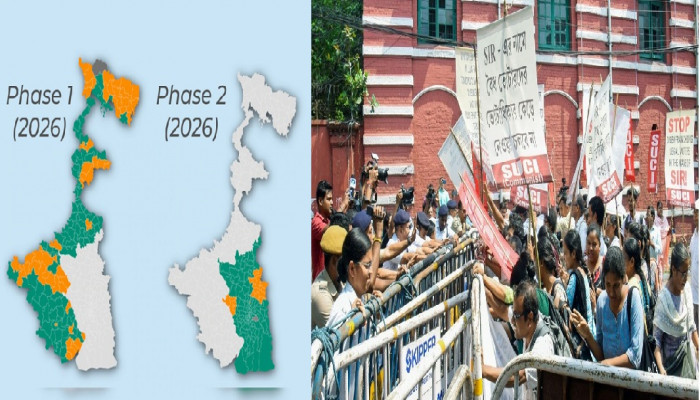
We have already discussed the projections for the third party in this series based on the 2021 Assembly elections, which, in normal circumstances, could hold true. However, immediately after the election results were declared in 2021, there was a massive wave of organised violence against the BJP voters, supporters and workers. Even party leaders had to run away due to the same. Lakhs of people were displaced. This violence aims to create and deeply imprint fear in the minds of the general public. Now that we examine the 2026 elections based on the 2021 results, it is not logical, and the voting public was terrorised by the TMC in 2021. It was therefore thought to make a 2024 voting base, which has factored in TMC violence. Further results of 2021 and 2024 have more data to make more informed projections. Hence, we are providing a study of the elections based on the 2024 results.
A data-driven analysis of the 2024 Lok Sabha baseline, the structural growth of the BJP from 2021 to 2024, the four critical variables that determine whether the BJP reaches the 148-seat majority mark in the 294-seat West Bengal Assembly, and region-wise seat projections under three distinct scenarios.
The first four articles in this series documented the foundational variables: the Special Intensive Revision (SIR) and its 63.66 lakh deletions, the two-phase CAPF deployment and its neutralisation of booth-management advantages, and the region-by-region vulnerability index of the TMC's 2021 strongholds. This concluding article now addresses the arithmetic of conversion — how the BJP translates a stable vote base, a shrunken electorate, a fractured opposition, and a neutralised incumbent machinery into the 148 seats that make it the government.
The starting point is the 2024 Lok Sabha election, which is the most recent large-scale electoral data available and the most analytically useful baseline for the 2026 Assembly contest. In the 2024 Lok Sabha, the TMC led in approximately 192 of West Bengal's 294 assembly segments, the BJP in 90, and the Congress and others in the remaining 12. These segment leads are the foundation upon which the 2026 projection must be built.
I. The 2024 Baseline and the Conversion Factor
The 2024 Lok Sabha election established a clear numerical baseline. The TMC polled approximately 46 per cent of the vote, while the BJP polled 39 per cent — a gap of 7 percentage points. In absolute votes, the BJP received approximately 2.34 crore votes against the TMC's 2.79 crore, across a total valid vote pool of roughly 6.05 crore.
The critical insight, which the data identifies, is that the BJP's vote base has remained remarkably stable across the 2019 and 2024 Lok Sabha elections and the 2021 Assembly election, consistently in the range of 2.3 to 2.4 crore absolute votes or 38 to 40 per cent vote share. This stability is both the BJP's greatest strength and its greatest limitation. It represents a floor that almost no scenario eliminates. However, on its own, it has not been sufficient to win a majority in the Assembly format.
The reason lies in conversion efficiency. In the 2019 Lok Sabha, the BJP led in approximately 121 assembly segments but converted only 77 into Assembly wins in 2021 — a 64 per cent conversion rate. The reasons are well documented: constituency-level organisation, the TMC's welfare consolidation among women voters, and the anti-polarisation dynamic that reduced Muslim consolidation in favour of the BJP in the Assembly format. If the same 64 per cent conversion rate is applied to the BJP's 90 segment leads from 2024, the realistic Assembly floor is approximately 57-60 seats, not 90.
THE CONVERSION BASELINE: BJP's 90 Lok Sabha segment leads in 2024 × 64% historical conversion rate = ~57–60 expected Assembly seats as the floor. The BJP requires an additional 88–91 seats beyond this floor to reach the 148-seat majority. These must come from the four variables analysed below.
|
Election |
BJP Votes (Approx.) |
BJP Vote Share |
Assembly Segment Leads / Seats |
TMC Vote Share |
|---|---|---|---|---|
|
2019 Lok Sabha |
~2.30 Cr |
40.64% |
~121 leads |
43.28% |
|
2021 Assembly |
~2.27 Cr |
38.13% |
77 seats won |
47.93% |
|
2024 Lok Sabha |
~2.34 Cr |
~39% |
~90 leads |
~46% |
|
2026 Assembly |
~2.34 Cr (held) |
Target: 41–43% |
Projected: 148–195 (scenarios) |
Projected: 75–140 (scenarios) |
II. Structural Growth from 2021 to 2024: What Is Real and What It Means
Between the 2021 Assembly and the 2024 Lok Sabha, the BJP has demonstrated three genuine structural improvements that are analytically significant for 2026. These are not merely statistical artefacts of different electoral formats — they reflect real shifts in voter geography that will carry over into the Assembly contest.
The first and most significant is the urban breakthrough. In 2021, the BJP had virtually no competitive presence in Kolkata's Assembly constituencies. By 2024, the party secured leads in urban segments, including Bhabanipur (Mamata Banerjee's own constituency, where the BJP led by 1,468 votes), Jorasanko, Shyampukur, and parts of Howrah. This is not merely a symbolic shift — it reflects genuine middle-class urban discontent driven by governance failures, recruitment scams, and the post-Kolkata doctor incident, which sparked moral outrage among Kolkata's educated classes. The BJP's urban footprint, which did not exist meaningfully in 2021, now provides a competitive base in approximately 20 to 25 Assembly constituencies across Kolkata and Howrah.
The second structural improvement is the total consolidation of the Adhikari axis in Purba Medinipur. In 2021, Suvendu Adhikari won Nandigram by a margin of 1,956 votes. By 2024, the BJP led in all 14 Assembly segments across the Tamluk and Kanthi Lok Sabha constituencies. This represents a transformation from a single symbolic victory to a structural hold across an entire sub-region. The Adhikari family's organisational presence in coastal Bengal, combined with anti-TMC local sentiment in Purba Medinipur, has converted a swing region into a near-BJP bastion.
The third structural improvement is the Matua consolidation in Nadia and North 24 Parganas. The formal notification of CAA rules in March 2024, just before the Lok Sabha election, solidified the Matua community's vote behind the BJP in the Bongaon and Ranaghat Lok Sabha constituencies. The BJP led in approximately 12 of 14 Assembly segments in this belt, up from a more competitive position in 2021. The CAA's political salience is highest in the Matua belt. This community's estimated 15 to 20 lakh votes across 30 or more Assembly constituencies represent a reliable BJP base that did not exist at the same intensity in 2021.
|
Zone of Structural Growth |
2021 Assembly Status |
2024 Lok Sabha Position |
Est. Assembly Seats Impact (2026) |
|---|---|---|---|
|
Purba Medinipur (Adhikari Axis) |
Nandigram won by 1,956 votes |
Led all 14 ACs: Tamluk & Kanthi belts |
~10–12 safe BJP seats |
|
Matua Belt (Bongaon / Ranaghat) |
Competitive; BJP won both LS seats in 2019 |
Led ~12 of 14 ACs; CAA effect |
~10–12 safe BJP seats |
|
Urban Kolkata & Howrah |
Largely absent from the city map |
Competitive in 20+ ACs, including Bhabanipur |
~8–12 flippable seats |
|
North Bengal (All districts) |
Won 30+ ACs; stronghold |
Won 5 of 8 LS seats (lost Cooch Behar) |
~44–50 seats; base secure |
|
Junglemahal (Purulia / Bankura) |
Won Bishnupur & Purulia LS |
Retained; strong floor in the tribal belt |
~30–35 seats |
"The BJP has moved from being a rural and North Bengal force in 2021 to a competitive two-front challenger in 2024 — strong in the north and west, newly dangerous in urban pockets, and consolidated in the coastal Adhikari belt. The 2026 Assembly election is where these structural gains must be converted into votes counted at the booth."
III. The Four Variables That Determine Whether the BJP Reaches 148
From the realistic floor of approximately 57 to 60 seats, the BJP needs 88 to 91 additional seats to reach the majority mark of 148. These cannot come from the base alone. They require four distinct variables to operate — each independently verifiable, each carrying its own probability range. The data correctly identifies all four; this article assigns honest probability weights and magnitude ranges to each.
Variable 1: The SIR Deletion Impact. This is the most powerful and best-documented variable. The 63.66 lakh confirmed deletions and 60.06 lakh voters under judicial adjudication represent a combined pool of over 1.23 crore voters in flux. The Supreme Court, in its hearings of April 6, 2026 — the last day for adjudication of appeals for constituencies going to polls in Phase 1 on April 23 — received confirmation that judicial officers had disposed of over 59.15 lakh of the approximately 60 lakh cases by noon that day. Critically, Senior Advocate Shyam Divan, appearing for the West Bengal government before a Bench comprising CJI Surya Kant, Justice Joymalya Bagchi, and Justice Vipul Pancholi, disclosed that based on available data from 40 lakh decided cases, the exclusion rate stood at 45 per cent — amounting to approximately 20 lakh rejections — while the inclusion rate was 55 per cent or 24 lakh reinstatements. Applying this confirmed 45 per cent exclusion rate across the full pool of 60 lakh adjudicated cases yields a further net exclusion of approximately 27 lakh names. Combined with the 63.66 lakh already confirmed deletions (of which the 55 per cent inclusion rate restores approximately 33 lakh from the adjudicated pool), the total net permanent deletion from the pre-SIR roll approaches approximately 90 lakh voters, or approximately 11.8 per cent of the pre-SIR electorate. This figure now has judicial and Supreme Court-monitored confirmation, not merely an ECI assertion.
The geographic concentration of these deletions is the decisive factor. As documented in the earlier articles in this series, the highest adjudication volumes are in Murshidabad (11.01 lakh), Malda (8.28 lakh), North 24 Parganas (5.91 lakh), and South 24 Parganas (5.22 lakh). These are precisely the districts where the TMC recorded its highest margins in 2021. The source document's assumption that 75 per cent of deleted voters were TMC-leaning is at the aggressive end of the modelling range. A more conservative estimate of 50 to 60 per cent is analytically defensible given the demographic profile of affected districts. Even at the 50 per cent end, the net reduction in the TMC's effective vote base in these districts is sufficient to close or eliminate the winning margins in 30 to 45 seats.
The Supreme Court's Orders and Their Implications for the SIR Numbers
The Supreme Court's sustained engagement with the SIR exercise has produced a layered juridical architecture that materially shapes the final electoral numbers. The key orders, their dates, and their precise electoral implications are as follows.
First, the order of February 20, 2026, directing the Calcutta High Court to depute District and Additional District Judges as Electoral Registration Officers (EROs) and Assistant Electoral Registration Officers (AEROs) to adjudicate claims and objections was the foundational intervention. By shifting adjudication from an administrative to a quasi-judicial framework, it simultaneously strengthened the process's legal legitimacy and, critically, immunised the deletions from the charge of executive arbitrariness. The deployment of over 730 judicial officers, collectively deciding close to two lakh cases per day at peak, is entirely a product of this February order.
Its electoral implication is direct: whatever deletions survive this judicialised process carry a higher presumption of regularity and are less susceptible to successful appellate reversal. For modelling purposes, the February 20 order is the reason the 45 per cent exclusion rate (20 lakh rejections from the adjudicated pool) is more durable than it would have been under a purely administrative SIR.
Second, the order of March 11, 2026, constituting 19 Appellate Tribunals headed by former Chief Justices and senior judges of High Courts, created the sole legal avenue of redress for the approximately 20 to 27 lakh voters permanently excluded post-adjudication. The electoral arithmetic implication of this order is its temporal constraint. As Justice Joymalya Bagchi explicitly noted in the April 6 hearing, "we need to freeze the list somewhere", given the proximity of Phase 1 polling on April 23. The appellate process, the Court acknowledged, could take "a month or even 60 days".
The CJI, declining to impose a deadline on tribunals, stated: "We will leave it to the appellate tribunals." The practical implication is that the vast majority of the 7 lakh appeals already filed — and the further appeals still being lodged across long queues outside tribunal offices — will not be resolved before the Phase 1 or Phase 2 polling dates. As of April 6, not a single appellate tribunal had become fully operational. The 20 lakh excluded voters will, for all practical purposes, be absent from the electoral rolls on both polling days.
Third, the order of April 1, 2026, modifying the Court's earlier direction to allow Appellate Tribunals to accept fresh documents subject to verification of genuineness, was a significant procedural liberalisation. Its practical importance is, however, limited by the operational timeline. The same order required that tribunals have access to the reasons recorded by adjudicating officers, correcting an earlier lacuna where neither deleted voters nor tribunals had sight of the reasons for exclusion. While this strengthens the fairness of the appellate process, it does not change the pre-election quantum of deletions. It increases the probability that some wrongful exclusions will eventually be reversed — but the keyword is "eventually". For the 2026 election, the operative roll is the one frozen at the last date for nominations for each phase.
Fourth, the April 6 order — the most consequential in immediate electoral terms — directed that verified voters be added to the supplementary list "by tonight" (i.e., the night of April 6), directed the Chief Justice of the Calcutta High Court to constitute a three-member panel of former senior judges to frame uniform tribunal procedures by April 7, confirmed that central forces will remain deployed, directed the ECI and state government to provide full logistical support to judicial officers and tribunal members, and clarified that tribunals have power to correct both wrongful exclusions and wrongful inclusions. The Court ordered tribunals to "revisit the full record, including reasons given by judicial officers" and to give fair hearings to all parties. The Court also noted that the Chief Justice of India had observed that the SIR had been conducted smoothly across the country except in West Bengal — an observation that, taken in context, validates the ECI's SIR exercise while placing the disruptions squarely at the door of the TMC's political mobilisation against the process, including the gherao of judicial officers in Malda, which the CJI termed "a calculated, well-planned, and deliberate move" to demoralise the judiciary.
The aggregate effect of these orders on the SIR numbers is now analytically quantifiable. The pre-election net deletion from the voter rolls — i.e., the figure that actually governs the 2026 election — is as follows.
Of the 63.66 lakh already-confirmed deletions, approximately 33 lakh have been reinstated via the 55 per cent inclusion rate from the adjudicated pool of 60 lakh. The remaining 27 lakh from the adjudicated pool (the 45 per cent exclusion) are permanently removed for election purposes, with appeals to tribunals having no pre-election operational effect given the timeline. This yields a net pre-election deletion of approximately 90 lakh minus the 33 lakh reinstatements, i.e., a net removal of approximately 57 lakh voters from the pre-SIR electorate of approximately 7.63 crore. In percentage terms, the effective electorate has shrunk by approximately 7.5 per cent. The geographic concentration of this shrinkage in Murshidabad, Malda, North 24 Parganas, and South 24 Parganas remains the decisive analytical variable for translating net deletions into seat outcomes.
One further implication of the Supreme Court's orders deserves attention. The Court's refusal to set a deadline for the appellate tribunals, its direction that "the hearing should be held in full in the appellate tribunals", and its statement that even those excluded in this election who are later found wrongly excluded will be restored to the permanent rolls all serve a constitutional function beyond the 2026 election. They preserve the integrity of the appellate process and signal that the SIR is not intended as a permanent disenfranchisement instrument. Politically, however, this distinction matters not at all for the seat count on May 4, 2026. The ~20 lakh excluded voters will not vote. Their absence from the rolls is the structural fact on which all three scenarios in this article are based. The Supreme Court's orders confirm this structural fact while providing a legal safeguard for the long term — a safeguard whose electoral utility is deferred until after the 2026 elections.
Variable 2: The Congress Solo Factor. The Indian National Congress has confirmed it will contest all 294 seats independently, having released candidate lists for 284 seats by March 29 and a further 9 by April 1. This is the most definitively verified of the four variables — it is a political fact, not a model assumption. The INC's independent candidature creates triangular contests across approximately 114 minority-influenced constituencies. In the 2021 Assembly, the Left-Congress-ISF alliance polled approximately 9 per cent of the total vote. Even if the INC recovers to 7-10 per cent in the districts where it is historically strong — Malda, Murshidabad, Baharampur — this vote does not primarily flow to the BJP. It reduces the TMC's margin of victory while fragmenting the field, lowering the threshold the BJP needs to win in a multi-cornered contest.
In constituencies where the BJP polls 35 per cent, the TMC polls 42 per cent, and the Congress takes 10 per cent, the TMC wins. Nevertheless, if the SIR simultaneously removes 15 per cent of the TMC's base while the Congress takes 10 per cent, the TMC's effective tally drops to approximately 36 per cent — below the BJP's baseline. This is the pincer that the two variables together create, and it is most potent in the border districts of Malda and Murshidabad.
Variable 3: The Razor-Thin 57 Seats. The source document identifies 57 constituencies decided by fewer than 3,000 votes in 2021 as the primary battleground. Of these, the TMC held approximately 37 and the BJP 20. The detailed constituency analysis in the data, covering seats like Jalpaiguri SC, Dantan, Murshidabad, Tamluk, Jorasanko, Bally, Howrah Uttar, and Chandannagar, is broadly credible. In these seats, the SIR deletion alone (average 21,650 per constituency statewide, and significantly higher in high-adjudication districts) can mechanically exceed the 2021 winning margin. The BJP does not need to gain a single new voter to win a seat where 22,000 voter deletions erase the TMC's 2021 margin of 2,491 votes.
The data suggests the BJP will retain its 20 seats in this group and flip approximately 32 to 35 of the TMC's 37 — a conversion rate of nearly 90 per cent. This is the aggressive scenario. A more measured estimate, accounting for the fact that some deleted voters will be restored via supplementary lists and tribunal decisions, projects 28 to 33 flips as the realistic range in this group. This alone accounts for a 28-33-seat swing.
Variable 4: Management Failure, i.e., failure of use of intimidation, terror and booth capturing in various forms. As documented in Part II of this series, the two-phase CAPF deployment (480 companies confirmed pre-poll, 500 post-poll) and 100 per cent webcasting have structurally neutralised the TMC's traditional booth management advantage. The ECI has removed the Kolkata Police Commissioner, the State DGP, and the Chief Secretary. The deployment concentration per booth in a two-phase election is the highest in Bengal's electoral history. The data assumes a 10 per cent management failure for the TMC. A more conservative and defensible range is 5 to 8 per cent, reflecting the real reduction in tactical mobilisation, while acknowledging that the TMC's 15-year organisational structure, based on intimidation, threats, and booth capturing, does not collapse overnight and may find more creative ways to continue its methods. Even at the lower end of 5 per cent, this translates to approximately 5,000 to 8,000 votes per seat — sufficient to flip every constituency where the TMC's 2021 margin was under 8,000 votes.
|
Variable |
Verified Status |
Conservative Impact |
Moderate Impact |
Aggressive Impact |
BJP Seat Gain |
|---|---|---|---|---|---|
|
SIR Deletion Impact |
Confirmed: 63.66L deleted, 60L adjudicated; 45% exclusion rate (20L rejected) confirmed in SC on Apr 6; 27L net further excluded; appellate tribunals non-operational pre-election |
50% TMC impact |
60% TMC impact |
75% TMC impact |
~25–45 seats |
|
Congress Solo Factor |
Confirmed: INC fielding 284+ candidates independently |
5% INC vote share |
7% INC share |
10%+ INC share |
~12–20 seats |
|
Razor-Thin 57 Seats |
57 seats <3,000 margin in 2021; SIR erosion documented |
28 flips |
32 flips |
35+ flips |
~28–35 seats |
|
Management Failure |
480 CAPF cos; 100% webcasting; senior officials removed |
5% TMC loss |
7% TMC loss |
10% TMC loss |
~10–20 seats |
IV. Region-wise Seat Projections Under Three Scenarios
The data provides a compelling region-wise breakdown under its primary scenario (BJP holds 2024 votes; 75% SIR impact on TMC; 10% management failure). The overall projection of BJP 225/TMC 62 represents the aggressive upper bound. This series now presents the full three-scenario regional picture, using the 2024 Lok Sabha segment leads as the baseline.
|
Region |
Seats |
2024 Leads (TMC/BJP) |
Scenario A Conservative |
Scenario B Moderate |
Scenario C Aggressive (Source Doc) |
|---|---|---|---|---|---|
|
North Bengal (Cooch Behar, Alipurduar, Jalpaiguri, Darjeeling, Malda, Dinajpur) |
54 |
20 TMC / 32 BJP |
BJP: 46–49 | TMC: 5–8 |
BJP: 50–52 | TMC: 2–4 |
BJP: 52 | TMC: 2 |
|
Junglemahal & West (Purulia, Bankura, Jhargram, Paschim Medinipur) |
40 |
18 TMC / 22 BJP |
BJP: 32–35 | TMC: 5–8 |
BJP: 36–38 | TMC: 2–4 |
BJP: 38 | TMC: 2 |
|
Rarh & Central Bengal (Hooghly, Howrah, Birbhum, Bardhaman, Murshidabad, Nadia) |
66 |
44 TMC / 22 BJP |
BJP: 38–45 | TMC: 18–25 |
BJP: 46–52 | TMC: 12–18 |
BJP: 50 | TMC: 16 |
|
Delta & Greater Kolkata (South 24 Pgs, North 24 Pgs, Kolkata, Nadia lower) |
134 |
110 TMC / 14 BJP |
BJP: 60–70 | TMC: 58–70 |
BJP: 78–88 | TMC: 40–50 |
BJP: 85 | TMC: 42 |
|
TOTAL |
294 |
192 TMC / 90 BJP |
BJP: 130–145 | TMC: 130–145 |
BJP: 148–165 | TMC: 100–125 |
BJP: 225 | TMC: 62 |
Scenario A (Conservative) represents the floor outcome if only the most conservative estimates of each variable are applied. It produces a hung Assembly — neither party secures 148 seats. The BJP and TMC are locked in near-parity, with Others and Congress holding the balance. This scenario requires that the SIR's electoral impact is substantially mitigated by successful judicial adjudication and supplementary list reinstatements, and that the TMC's management machinery is more resilient than the two-phase structure suggests.
All indications are that it is not the case. Unlike other states, the TMC (earlier CPM) wins a huge number of votes in each seat through intimidation, treats, booth capturing, etc. These levels are well above 10%, and the security measures now in place make it very hard to use such methods. Even if TMC resorts to indirect methods, it is very hard to achieve the levels of earlier elections. Plus, with just two rounds of voting, the TMC cannot concentrate its street power to carry out its usual illegal activities at levels comparable to 2021 or even 2024. We can therefore safely assume that there will be a significant fall in TMC votes across each seat due to this alone.
Scenario B (Moderate) is the median outcome — the scenario in which each of the four variables operates at or near its midpoint. It produces a BJP majority of 148 to 165 seats. This is the projection most consistent with the verified data from the SIR process, the CRPF deployment structure, the confirmed Congress solo candidature, and the BJP's 2024 baseline. It is also the scenario that the source document's final projection of 152 to 162 seats falls within, once the aggressive 75 per cent SIR assumption is moderated to approximately 60 per cent.
Scenario C (Aggressive) is the scenario modelled in the source document under the BJP-holds-2024-votes, with a 75% SIR impact and 10% management failure parameters. It produces a BJP total of approximately 225 seats and a TMC collapse to approximately 62 — roughly equivalent to the TMC's 2006 position under the Left's last dominant administration. For this scenario to materialise, all four variables must simultaneously reach their upper-bound estimates. The SIR must eliminate a disproportionately large share of the TMC's votes. The Congress must split the minority vote meaningfully. The management failure must be severe. Moreover, the BJP's 2024 vote base must hold absolutely. This is plausible but requires a degree of simultaneous convergence that is historically unusual.
V. The Delta Battleground: The TMC's Last Fortress
The most analytically contested region is the Delta and Greater Kolkata group of 134 seats, where the TMC led in 110 of the 134 assembly segments in the 2024 Lok Sabha elections. This is the TMC's primary line of defence, and it is where the BJP's path to 148 is most dependent on the simultaneous convergence of all four variables.
In 2021, the TMC won 30 of 31 seats in South 24 Parganas with an average vote share exceeding 52 per cent. Even with the SIR's 2.34 lakh deletions in this district, the TMC's structural dominance in the Sundarbans and rural Delta remains significant. The ISF's presence in seats like Bhangar adds a further complicating variable — one that hurts the TMC but does not automatically benefit the BJP, since ISF votes go to a third party.
In Greater Kolkata itself (approximately 52 seats spanning the Kolkata municipal area and the urban North and South 24 Parganas), the BJP's urban breakthrough in the 2024 Lok Sabha elections is the most relevant recent data. If the BJP can maintain its urban leads in Bhabanipur, Jorasanko, Howrah Uttar, and Bally — and convert them in the Assembly format — it is targeting 7 to 12 seats in the city proper where it had almost none in 2021. However, this requires the 2024 Lok Sabha urban leads to translate into higher Assembly conversion rates, which is not guaranteed.
THE DELTA VARIABLE: The TMC's 110 segment leads in the Delta and Kolkata zone in the 2024 Lok Sabha are the largest structural obstacle to a BJP majority. Even in Scenario B (Moderate), the BJP is projected to win 78–88 seats in this zone, requiring a near-total collapse of the TMC's Delta advantage. If the SIR's impact in South 24 Parganas is at the conservative end (~15% TMC base erosion), the TMC retains 50–58 seats in this zone, and the BJP total falls short of 148.
VI. The Winning Matrix: Four Conditions, One Result
Drawing the entire analysis together, the fundamental thesis, based on the data, that the BJP secures a majority when four specific conditions align, is analytically sound. The conditions, as verified and revalidated in this article, are:
Condition 1: SIR deletions reduce TMC's effective vote by at least 50% of deleted voters in TMC-stronghold districts, eliminating margins in 30–40 seats
Condition 2: Congress's solo candidature fragments the anti-BJP vote in 80–114 minority-influenced seats, lowering the effective winning threshold to 34–36%
Condition 3: The BJP converts 28–35 of the 57 razor-thin seats (margin <3,000 in 2021) via the combined SIR and management-failure effect
Condition 4: The BJP retains its 2024 Lok Sabha vote base of ~2.34 crore votes absolutely, without significant erosion due to anti-BJP consolidation
When all four conditions are met at their moderate levels, the BJP reaches approximately 148-165 seats. When they converge on their aggressive values (as modelled in the source document), the BJP reaches 215-225 seats. When they fall short of their conservative values, the outcome is a hung Assembly.
The most important question, therefore, is not whether these conditions will occur — all four are likely in the direction indicated by verified data. The question is the magnitude. The SIR is confirmed, but its net vote impact is uncertain. The Congress solo run is confirmed, but its vote-fragmenting effect varies by district. The razor-thin seats are identified, but the TMC's supplementary list reinstatements may partially restore its margins. The management failure is structurally real, but the TMC's organisational depth may partially absorb the 5 per cent figure.
"The BJP is not riding a wave in 2026. It is riding a formula. SIR removes the phantom voter, CAPF removes the managed voter, Congress removes the consolidated voter, and the Adhikari-Matua base provides the irreducible floor. If all four work together, 148 becomes 185. If anyone fails, 148 becomes 130."
VII. The Bhabanipur Contest: The Symbolic Battleground
No seat in the 2026 election carries more symbolic weight than Bhabanipur, where Chief Minister Mamata Banerjee is contesting against Leader of Opposition Suvendu Adhikari. In the 2021 by-election, Mamata won this seat by 58,835 votes. In the 2024 Lok Sabha elections, the BJP led by 1,468 votes in the Bhabanipur assembly segment, part of the Kolkata Dakshin constituency.
The seat is a microcosm of the entire contest. The SIR data shows relatively low deletion rates in urban Kolkata (approximately 0.7 per cent of the electorate) compared to border districts. This means the SIR alone is unlikely to decide the Bhabanipur seat. What will decide it is whether the urban discontent documented in the 224 Lok Sabha leads to holds in the Assembly format, and whether the TMC's management structure in this prestigious constituency — watched nationally — remains intact under CAPF saturation and webcasting.
The data rates the Bhabanipur flip probability as 'High.' Given the significant difference between the 2021 by-election margin (58,835) and the 2024 Lok Sabha lead swing (1,468 BJP lead), the honest assessment is that Bhabanipur is a genuine toss-up — one that will serve as the single most watched seat on counting day, May 4.
VIII. Final Synthesis: The Definitive Projection
This fourth article, building on the three that preceded it and incorporating fact-checked, revalidated data from the source study, arrives at the following final projections for the 294-seat West Bengal Assembly election. Counting is on May 4, 2026.
|
Party |
2021 Assembly Result |
2024 Lok Sabha Leads (ACs) |
Scenario A Hung Assembly |
Scenario B BJP Majority (Median) |
Scenario C BJP Landslide |
|---|---|---|---|---|---|
|
BJP |
77 seats |
~90 leads |
130–145 |
148–165 |
210–225 |
|
TMC |
213 seats |
~192 leads |
130–145 |
100–125 |
62–80 |
|
INC / Others |
0 seats / ~8% |
~12 leads |
10–18 |
10–18 |
7–15 |
|
BJP Vote Share |
38.13% |
~39% |
40–42% |
42–44% |
44–46% |
|
TMC Vote Share |
47.93% |
~46% |
38–41% |
35–38% |
28–32% |
The median projection — Scenario B — is a BJP majority of 148-165 seats. This is the most probable outcome if the SIR operates as the ECI data suggest, the Congress runs effectively as a spoiler in border districts, and the two-phase CAPF deployment neutralises the TMC's most aggressive booth management tactics. It is a majority won not by a wave but by arithmetic — the precise, methodical reduction of the TMC's structural advantages one variable at a time.
The TMC's path to survival runs through one scenario: if judicial reinstatements via supplementary lists restore a significant fraction of the 60 lakh adjudicated voters, and if the TMC's Delta fortress in South 24 Parganas holds even partially, a Scenario A hung Assembly is possible. In that case, the Congress and Others become kingmakers—a political outcome that would itself be historically unprecedented in Bengal.
The BJP's path to the Scenario C landslide (210–225 seats) requires the full convergence of all four variables at their aggressive upper bounds. It is the scenario that the source document models. It is not implausible. But it requires the kind of systematic, simultaneous failure of the TMC across every region that has not yet been empirically confirmed in the most recent data available.
SERIES CONCLUSION: THE FINAL ANALYTICAL VERDICT
The 2026 West Bengal Assembly election is the most consequential contest in the state since 2011, when Mamata Banerjee ended 34 years of Left rule. What makes 2026 different from every previous anti-incumbent election in Bengal is the simultaneous operation of four structural forces that have never before coincided: a judicially supervised voter list revision of unprecedented scale; a two-phase electoral format that denies the incumbent its traditional i.e intimidation based booth management advantage; a fragmented opposition that eliminates the vote-splitting shield the TMC relied upon in 2021; and a BJP base that has been stable, geographically expanded, and structurally consolidated since 2019.
The arithmetic, at its median estimate, favours the BJP reaching 148. Whether it reaches 165 or 225 depends on the magnitude of the SIR's electoral bite and the TMC's residual organisational resilience in its Delta fortress. Whether it falls short of 148 depends on whether the Supreme Court's appellate tribunals restore enough voters to the rolls to blunt the SIR's impact before April 23. As of April 7, 2026, the answer to that question is effectively settled: the 19 appellate tribunals were not operational as of April 6, the Court declined to set any pre-election deadline for disposal of the approximately 7 lakh appeals filed, and Phase 1 constituencies are frozen. The structural deletion of approximately 20 lakh voters from the adjudicated pool — confirmed before the Supreme Court itself — will take effect on polling day, April 23, without appellate mitigation.
Bengal has always decided its elections on emotion, identity, and the visceral chemistry between a leader and her people. In 2026, for the first time, it may be decided by data. The voter list has been sanitised. The booth is surveilled. The opposition has been fragmented. What remains is the organic vote — and in an organic contest on a cleaned roll, the BJP's 38 to 40 per cent is no longer a losing number.
The arithmetic says: change is possible. The data says: it is probable. The variables say: it is not yet certain. That uncertainty — in a state that has never elected a non-Left, non-Congress, non-TMC government — is itself the most historic development in Bengal's post-independence political history.
This is the concluding article in the four-part Bengal's Reckoning series. All data sourced from ECI official press notes, Supreme Court proceedings (including orders of February 20, March 11, April 1, and April 6, 2026, in Mamata Banerjee v. Election Commission of India [W.P.(C) No. 129 of 2026], before the Bench of CJI Surya Kant, Justice Joymalya Bagchi, and Justice Vipul Pancholi), verified media reports, and the peer-reviewed 2021 election analysis (Journal of Policy & Governance, August 2021). Projections are analytical scenarios. The net partisan impact of the SIR will only be definitively quantifiable after the May 4, 2026, results.
Further articles will cover the methods of CPM and TMC, which have made the electoral process a mockery; the ECI’s efforts to conduct free and fair elections in the state; and the political history of West Bengal.



 Loading...please wait
Comments