




Bangladesh to purchase Chinese J-10s, cites its performance against Indian Rafales in Operation Sindoor
- In Reports
- 02:40 PM, Aug 28, 2026
- Myind Staff
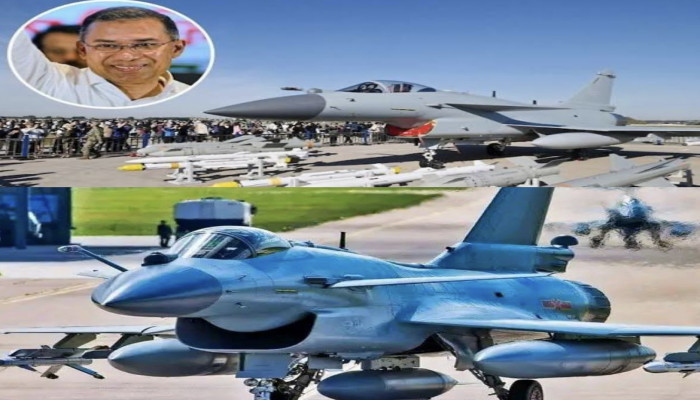
Bangladesh is moving closer to a $2.3 billion deal to buy 20 Chinese J-10CE multirole fighter jets. The proposed purchase could become one of Dhaka’s biggest defence deals in years. Bangladesh Prime Minister Tarique Rahman’s aide Zahed Ur Rahman said the claimed performance of the Chinese-made fighter during the May 2025 Operation Sindoor influenced the decision to consider the aircraft.
The government is seeking to modernise Bangladesh’s air force and strengthen its air defence capabilities. The proposed package puts the effective cost at nearly $115 million per aircraft. This is much higher than the fighter’s base price of $62.7 million. The overall package includes training, operational equipment, technical and logistical support, freight, insurance, VAT and construction work.
Bangladesh’s Armed Forces Division has estimated the total cost at Tk 28,314 crore. The calculation uses an exchange rate of Tk123 to the US dollar, Dhaka-based The Business Standard reported. The development was confirmed by Bangladesh PM’s Information and Broadcasting Adviser Zahed Ur Rahman. He said on August 25 that an inter-ministerial committee had prepared a draft agreement for negotiations on the purchase.
His comments on Operation Sindoor and France-made Rafale fighter jets drew particular attention. Zahed Ur Rahman said Bangladesh was seriously considering the J-10 after what he described as its performance against Indian aircraft during the conflict. He said, "It is now established that an Indian Rafale fighter jet was shot down by a Chinese-made J-10 fighter aircraft during the India-Pakistan war." He added, "The Rafale is regarded as a modern 4.5-generation fighter" and claimed that the "J-10CE had performed very well against it".
Pakistan had claimed that its Chinese-made J-10s shot down Indian aircraft, including Rafale jets, during the May 2025 conflict. India has rejected Pakistan’s account. Dassault Aviation CEO Eric Trappier also called the claim that three Indian Rafales had been shot down inaccurate. Indian officials have disputed Pakistan’s version of the events as well.
In August 2025, Indian Air Force Chief AP Singh said Indian forces had destroyed at least five Pakistani fighter jets and one large military aircraft during Operation Sindoor. India’s position also differs from Pakistan’s claims about the Rafale. In June this year, the Indian Air Force floated a tender seeking bridge support for all 36 Rafale fighter jets India bought from France. The move has also been cited as contradicting Pakistan’s claims.
The J-10CE is the export version of China’s J-10C. It is a single-engine, single-seat multirole fighter operated by the People’s Liberation Army Air Force. Pakistan is currently the only confirmed foreign operator of the export version. If Bangladesh completes the purchase, it would mark an important development for China’s fighter-jet export ambitions.
For Bangladesh, the proposed purchase forms part of a wider plan to replace or upgrade its ageing air force. Dhaka already operates several Chinese-origin aircraft, including F-7 fighter jets. China also remains Bangladesh’s biggest defence supplier. The J-10CE would give Bangladesh access to a more modern fighter platform as it looks to strengthen its air defence.
The procurement process began under the interim government led by Muhammad Yunus in 2025. Bangladesh initially estimated the price at around $60 million per aircraft. The Ministry of Finance later gave in-principle approval to a $2.2 billion proposal for 20 jets. The latest proposal has raised the aircraft price to $62.7 million each. The overall package has also increased to $2.302 billion.
Under the proposal, 10 of the 20 aircraft would be incorporated into Bangladesh’s Table of Organisation and Equipment. The other 10 would remain outside it. The jets are expected to be procured from China National Aero-Technology Import & Export Corporation, or CATIC, through government-to-government negotiations, according to Reuters. The agreement could be signed during Bangladesh’s 2026–27 financial year. Payments would be spread over 10 years until 2035–36.
The proposed deal comes as China expands its engagement with Bangladesh. The J-10CE purchase was discussed during Yunus’s visit to China in March 2025. An 11-member inter-ministerial committee was later formed to negotiate the deal.
The development also carries significance for India. Bangladesh and India share a long border and deep historical ties. However, relations between Dhaka and New Delhi have become more complicated after the political upheaval that removed Sheikh Hasina from power.
Tarique Rahman made his first overseas visit to Malaysia before travelling to China in June. After attending the Summer Davos Forum in Dalian, he travelled to Beijing by high-speed train. His proposed visit to India remains uncertain, with no dates confirmed so far.
China, meanwhile, has continued efforts to expand its strategic and economic presence in Bangladesh. For Dhaka, the J-10CE purchase is being presented mainly as a move to modernise its air force. However, the deal also comes amid a wider contest for influence in India’s neighbourhood. The disputed claims surrounding Rafale jets during Operation Sindoor have added another political and military dimension to Bangladesh’s consideration of the Chinese fighter.



 Loading...please wait
Comments