



Bangladesh on the edge: Student leader’s death sparks violence, media attacks, lynching of Hindu man
- In Reports
- 06:11 PM, Dec 19, 2025
- Myind Staff
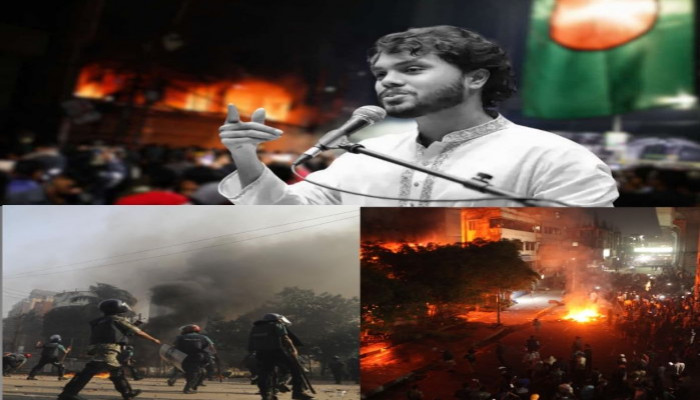
Bangladesh has been pushed into renewed turmoil following the death of Sharif Osman Hadi, a prominent youth leader linked to last year’s student-led uprising that led to the ouster of former Prime Minister Sheikh Hasina from power. His death has triggered widespread violence across the country, particularly in the capital Dhaka, where mobs attacked major media houses, journalists were trapped inside burning buildings, anti-India slogans were raised, and cultural organisations were targeted. Separately, a Hindu man was lynched over allegations of blasphemy and his body was set on fire, further deepening fear and instability.
The violence comes at a time of heightened political tension, with critics and observers alleging that the unrest is being used to create chaos and derail the electoral process, raising serious concerns about the future of elections in Bangladesh.
Sharif Osman Hadi, 32, was shot in Dhaka on December 12 by unidentified assailants. He suffered a gunshot wound to the head and was later airlifted to Singapore for emergency medical treatment. Despite efforts by doctors, Hadi succumbed to his injuries on Thursday evening.
Hadi was a key youth figure and the spokesperson of Inquilab Mancha, and had emerged as a strong voice during last year’s student uprising. He was known as a vocal critic of both India and former Prime Minister Sheikh Hasina. His death immediately sparked anger among supporters, who poured onto the streets, accusing various institutions of bias and conspiracy.
Soon after news of Hadi’s death spread, a fresh wave of violence erupted in Dhaka late Thursday night and continued into early Friday. Angry mobs targeted some of Bangladesh’s most influential media organisations.
The headquarters of Prothom Alo and The Daily Star were stormed, vandalised, and partially set on fire. According to reports, the attack on Prothom Alo’s office began around midnight on Thursday, followed shortly by a similar assault on The Daily Star. Videos circulating on social media showed mobs smashing property with sticks while fires burned on the road outside Prothom Alo’s building. Thick smoke filled the offices, creating panic inside.
Several journalists and staff members were trapped inside the buildings as the attacks unfolded. The smoke made breathing difficult and turned the situation into a life-threatening ordeal.
Zyma Islam, a senior reporter at The Daily Star, described the terrifying moments inside the building in a Facebook post. “I can’t breathe anymore. There’s too much smoke. I’m inside. You are killing me,” she wrote.
After the violence subsided, journalists returning to work were visibly shaken. Photojournalist Prabir Das broke down in tears while describing the loss of his life’s work. “My memories, the photographs I have taken over so many years of my career, four or five hard drives,” he said. “Those who set the fire may not understand the value of these things to a journalist,” he added.
According to news agency AP, editors of Prothom Alo and The Daily Star are known to be closely connected with Bangladesh’s interim leader, Muhammad Yunus. In recent weeks, protests had already taken place outside these newspaper offices. These protests were organised by Islamist groups, who accused the newspapers of being pro-India. After Hadi’s death, these accusations intensified.
Supporters of Hadi accused media outlets of biased reporting and alleged a foreign-backed conspiracy, claims that further fuelled violence against journalists and media institutions.
As unrest spread, protesters raised anti-India slogans in multiple locations. In some areas, demonstrators attempted to target Indian diplomatic interests. In the Rajshahi district, which borders India, dozens of protesters tried to march towards the office of the Assistant Indian High Commissioner. Police later stopped the march before it could reach the premises.
Bangladeshi authorities said they had identified suspects linked to Hadi’s shooting and claimed that the shooter had most likely fled to India. Following this, Dhaka summoned the Indian envoy and sought an explanation.
Amid the violence, reports said that Bangla cultural organisation Chhayanaut was also targeted during attacks in Dhaka. Members of the organisation have demanded a probe, expressing concern that cultural and intellectual spaces are increasingly coming under attack during the unrest.
In a separate and deeply disturbing incident, a Hindu man was lynched on allegations of blasphemy in Bangladesh on Thursday, highlighting a communal dimension to the ongoing chaos. Police officials speaking to BBC Bangla said the incident occurred in Bhaluka Upazila of Mymensingh district. The victim, Dipu Chandra Das, worked at a local garment factory and lived as a tenant in the Dubalia Para area.
According to police, an angry mob accused Dipu of making objectionable remarks about Prophet Muhammad. He was caught around 9 pm on Thursday, beaten to death, tied to a tree, and then set on fire. Bhaluka police station Duty Officer Ripon Mia confirmed the details. “The group of attackers had beaten the man to death. They then tied his body to a tree before they set it on fire,” he said.
He further told BBC Bangla, “An angry crowd caught him around 9 pm Thursday over allegations that he made derogatory remarks about Prophet Muhammad. They beat him to death and later set fire to the body.” Police said that individuals questioned about the incident could not recall where or how Dipu had allegedly insulted Islam.
A video claiming to show the lynching circulated on social media, showing a large crowd filming the burning body on mobile phones. Authorities said the authenticity of the video has not been verified.
The incident took place on the Dhaka–Mymensingh highway, leading to a traffic blockade for several hours. Police rushed to the scene after the crime was reported. Dipu’s body was later sent to the Mymensingh Medical College Hospital mortuary for a postmortem examination. As of now, no case has been filed, and police are trying to locate the victim’s family. “We are trying to locate his relatives. Legal action will be taken in accordance with the law once a case is filed,” a police official said.
The killing of a student leader, attacks on media houses, assaults on journalists, communal lynching, and anti-India protests have all unfolded against the backdrop of growing political uncertainty. Critics and observers have alleged that the violence is being used to create fear, instability, and chaos, potentially as an attempt to stall or cancel upcoming elections.
While authorities have said investigations are underway, the scale and coordination of the unrest have raised serious questions about whether democratic processes can continue normally amid such widespread violence.



 Loading...please wait
Comments