




Bangladesh Jamaat’s alleged letter of support to Delhi protests triggers security concerns
- In Reports
- 06:52 PM, Jul 21, 2026
- Myind Staff
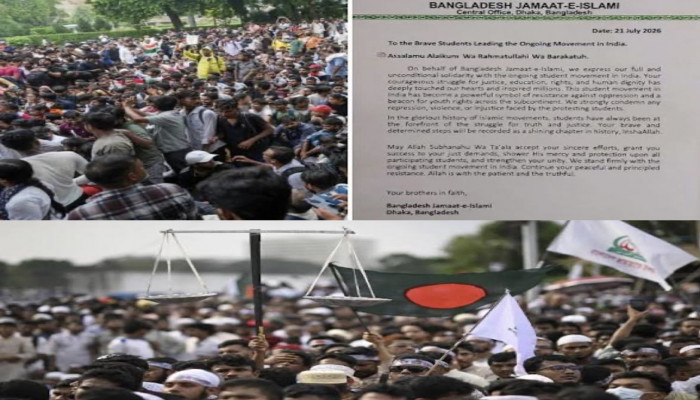
A purported letter attributed to Bangladesh’s Jamaat-e-Islami has raised security concerns after it allegedly expressed support for the ongoing student protests in Delhi. Intelligence agencies are currently verifying the authenticity of the communication. Officials have not confirmed whether the organisation actually sent the letter. However, authorities are closely examining the matter due to the possible involvement of a foreign political and ideological group in India’s internal affairs.
According to intelligence sources, the alleged letter claims that Bangladesh Jamaat-e-Islami extended solidarity to the protesting students in India. The communication, whose authenticity remains under investigation, has sparked debate over national security, sovereignty and the possibility of international attention shifting towards a domestic issue.
Agencies are verifying the authenticity of the letter attributed to the organisation, but officials underline that any involvement of foreign political or ideological groups in India’s internal affairs warrants close scrutiny.
The purported message states, “On behalf of Bangladesh Jamaat-e-Islami, we express our full and unconditional solidarity with the ongoing student movement in India. Your courageous struggle for justice, education, rights, and human dignity has deeply touched our hearts and inspired millions. This student movement in India has become a powerful symbol of resistance against oppression and a beacon for youth rights across the subcontinent. We strongly condemn any repression, violence, or injustice faced by the protesting students."
The message further says, “We stand firmly with the ongoing student movement in India. Continue your peaceful and principled resistance. Allah is with the patient and the truthful."
Security analysts said that if authorities confirm the authenticity of the letter, the development could have wider implications beyond the protests themselves. Experts believe that support from a foreign organisation with a hardline Islamist ideology could influence public perception of the movement. Critics and authorities may view the protests through the lens of external influence instead of focusing only on the students’ demands. Analysts say such a situation could affect the credibility of the movement and increase scrutiny.
Experts also noted that involvement from foreign political or religious groups in domestic movements raises concerns about national sovereignty. They said outside organisations entering internal policy debates can shift attention away from local grievances. Such interventions may change the narrative and bring larger geopolitical or ideological issues into the discussion.
Security experts pointed out that Bangladesh’s Jamaat-e-Islami has long faced allegations of holding anti-India positions. Analysts have also linked the organisation to a hardline Islamist ideology and alleged connections with extremist elements. They argue that open support from such groups could create concerns about radicalisation. Experts fear that extremist narratives could attempt to enter civil protests through such interventions.
Analysts further warned that extremist organisations have historically tried to take advantage of periods of social unrest. They often use genuine public concerns and student grievances to expand their influence. Experts said such groups may attempt to build networks and recruit young supporters during times of unrest. Public endorsement from controversial foreign organisations could also divert attention from the original demands of protesters and intensify security concerns surrounding the movement.
Authorities have not issued any official statement confirming the authenticity of the reported communication. Investigations into the matter are still ongoing. Agencies continue to examine the alleged letter while officials monitor the situation closely.



 Loading...please wait
Comments