




Azerbaijan hosts Global Khalistani Conference, marking rise of anti-India trilateral alignment
- In Reports
- 01:51 PM, Jan 22, 2026
- Myind Staff
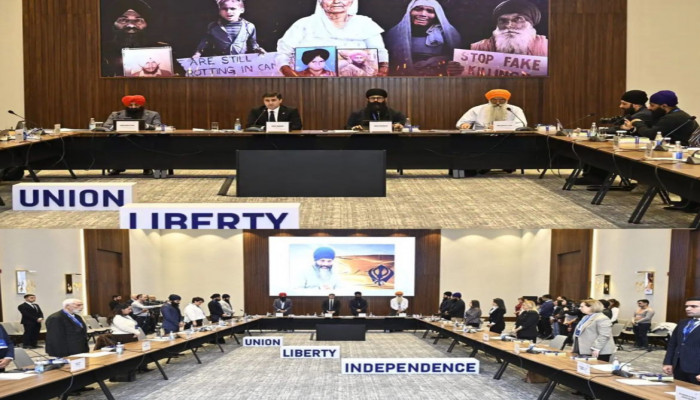
In a new geopolitical development, Azerbaijan hosted an international conference titled “Racism and Violence Against Sikhs and Other National Minorities in India: The Reality on the Ground.” The event was organised by the government-affiliated Baku Initiative Group (BIG) and is being seen as a clear attempt to internationalise the Khalistan narrative and apply pressure on India at a global level.
The conference brought together Khalistani extremist elements and Pakistani officials on a single platform, indicating a coordinated and unified approach. The participation of state-linked and foreign actors highlighted what analysts describe as a growing alignment between Azerbaijan, Pakistan, and Turkey in matters related to India.
Among the key attendees was Abbas Abbasov, Executive Director of the Baku Initiative Group. His presence underlined the official backing provided to the event by institutions linked to the Azerbaijani government. Another prominent participant was Ramesh Singh Arora, Minister for Human Rights and Minority Affairs of Pakistan’s Punjab province. His attendance gave the conference explicit state-level support from Pakistan.
Several Khalistani-linked representatives from Western countries were also present. These included Moninder Singh and Prabhjot Singh Warring from Canada, and Dabinderjit Singh Sidhu and Jaswinder Singh Khatkar from the United Kingdom. Ranveer Singh attended on behalf of the UK-based organisation “Everything’s 13.”
The event began with a minute of silence for Hardeep Singh Nijjar, a Khalistani operative who was killed in Canada in 2023. This gesture effectively projected him as a martyr of the Khalistan movement. During the conference, propaganda films and archival material were screened. These visuals aimed to portray India’s internal security actions as “systemic racism” and “genocide,” using strong language to frame India’s domestic policies in a negative light.
A major focus of the conference was a strategic shift toward global institutions. Participants discussed taking the issue beyond regional narratives and approaching international bodies, especially the United Nations. There was specific discussion on engaging the UN Human Rights Committee to investigate alleged “extrajudicial executions” in India.
A joint statement issued by the Baku Initiative Group and the Sikh Federation International argued that Sikh activism is being wrongly labelled as “extremism.” This argument reflects a long-standing Khalistani position and is intended to gain sympathy and legitimacy within Western academic institutions and non-governmental organisations.
The choice of Azerbaijan as the venue is significant and points to the growing Pakistan–Azerbaijan–Turkey alignment, often described as the “Three Brothers.” This relationship has reportedly strengthened after India supported Armenia during the Nagorno-Karabakh conflict. Since then, Azerbaijan has shown increasing alignment with Pakistan’s anti-India stance.
One visible indicator of this alignment is the language being used by Azerbaijani state media and think tanks. They have consistently adopted the term “IOJK,” meaning Indian Occupied Jammu & Kashmir, which mirrors Pakistan’s official terminology on the issue.
The Baku Initiative Group itself was originally set up in 2023 to target Western “colonialism,” particularly focusing on France. However, it is now being used as a platform to amplify the Khalistani narrative. This shift suggests a deliberate effort to repurpose the organisation as a foreign policy tool.
According to the developments highlighted during the conference, Pakistan appears to be using Azerbaijan as a neutral-looking venue to promote disinformation and provide space to Khalistani elements. This is especially significant as such groups are facing increasing scrutiny in countries like Canada and the UK.
Overall, the conference signals a coordinated attempt to globalise the Khalistan issue by leveraging international platforms, sympathetic governments, and carefully framed narratives, without altering the core positions already held by the participating actors.



 Loading...please wait
Comments