




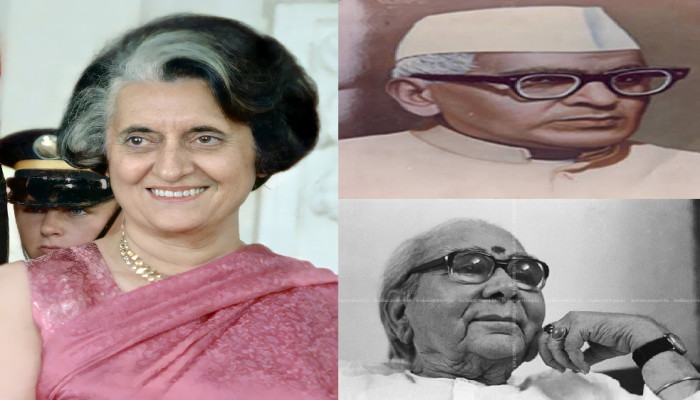
If Jawaharlal Nehru's management of UP politics was characterised by indirect manipulation and the subtle exercise of central leverage, his daughter Indira Gandhi's approach was considerably more direct. Over the course of the 1970s, Indira Gandhi completed the destruction of autonomous state-level leadership in the Congress party that her father had begun and, in doing so, she not only permanently weakened the Congress in UP but also fundamentally corrupted the state's democratic culture. The consequences of this authoritarian centralisation still play out in UP politics today.
The Syndicate Wars: Destroying Internal Democracy
Indira Gandhi's rise to the Congress presidency and the Prime Ministership is inseparable from her destruction of the Syndicate, a group of powerful state-level Congress bosses who had initially sponsored her as a pliant, manageable successor to Lal Bahadur Shastri. The Syndicate included Kamaraj Nadar of Tamil Nadu, S. Nijalingappa of Karnataka, Atulya Ghosh of West Bengal, and crucially for UP, Chandra Bhanu Gupta, the long-serving Chief Minister whose factional machine dominated the state Congress organisation.
Gupta represented exactly the independently powerful state leader that Indira Gandhi could not tolerate. He had his own mass base, his own organisational network, and his own conception of how UP should be governed a conception that did not always align with the high command's preferences. More dangerously, he was allied with other Syndicate members in opposing Indira Gandhi's increasing concentration of power and her leftward economic turn.
Indira Gandhi responded by systematically cutting Gupta down. She promoted his rival, Kamlapati Tripathi, as an alternative power centre, encouraged factional conflict within the UP Congress, and used central government patronage to build loyalty directly with UP politicians who bypassed the state organisation. The result was to transform the UP Congress from a political machine with genuine organisational depth into a collection of competing factions, all dependent on the central high command for survival—and therefore incapable of the autonomous political work needed to contest elections effectively at the grassroots level.
The 'Committed Bureaucracy' and the Erosion of Institutional Integrity
One of Indira Gandhi's most damaging contributions to UP's governance was her advocacy for a 'committed bureaucracy' — the idea that civil servants should be ideologically aligned with the ruling party rather than constitutionally neutral. This doctrine, while never formally enacted, transformed the political culture of the IAS cadre in UP in ways that persisted for decades.
District Collectors and senior state officials who demonstrated loyalty to the ruling party were rewarded with prestigious postings and rapid promotions. Those who tried to remain neutral or acted against partisan interests in discharging their duties were transferred to remote postings or sidelined entirely. The result was a progressive degradation of the IAS cadre in UP, as the incentive structure shifted from competence and integrity to political connection and personal loyalty.
The consequences for governance were severe and immediate. Political patronage networks captured development programs. Law enforcement became a tool of partisan politics, with politicians controlling police postings and transfers and using the force to protect supporters and harass opponents. Revenue administration, which affected the daily lives of UP's vast agrarian population, became a site of systematic corruption as officials competed to extract maximum rents from their postings.
Garibi Hatao: Populism Without Governance
Indira Gandhi's 'Garibi Hatao' (Remove Poverty) campaign of 1971, which delivered a massive electoral mandate, represented the most explicit formulation of the political approach that would dominate Congress governance in UP for the next two decades: the substitution of populist rhetoric for substantive policy, and the use of welfare promises as electoral mobilisation tools rather than as genuine development commitments.
In UP, the Garibi Hatao mandate translated into a series of centrally sponsored welfare schemes: food grain distribution, poverty alleviation programmes, and employment schemes administered through the same politically compromised bureaucratic machinery that had already failed to deliver land reform. The schemes were real; the patronage networks that captured them were, too. The rural poor of UP found themselves the nominal beneficiaries of programme after programme that, in practice, delivered a fraction of the promised support while enriching the political class and its allied contractors.
The nationalisation of banks in 1969, hailed as a pro-poor measure, had similarly perverse consequences in UP. While priority sector lending nominally increased, Congress politicians and their clients captured local bank branches, so much of the rural credit went to the well-connected rather than the genuinely needy. The Green Revolution benefits, which did reach UP's western districts through improved seeds and irrigation, went disproportionately to larger farmers, often Congress supporters, rather than to the marginal cultivators who needed them most.
The Emergency and Its UP Dimension
The Emergency of 1975-1977 represented the culmination of Indira Gandhi's authoritarian project. In UP, the Emergency was implemented with particular brutality, reflecting both the state's political importance and the Congress apparatus's anxiety about the strength of opposition building there. The Allahabad High Court judgment that had invalidated Indira Gandhi's 1971 election, delivering a verdict that would have disqualified her from Parliament, was widely celebrated in UP as evidence that the rule of law could still assert itself against political power. The Emergency was in part a response to this threat.
The suspension of civil liberties, the arbitrary detention of opposition leaders, the press censorship, and the excesses of the Sanjay Gandhi-led sterilisation and slum demolition drives — all of which were implemented with particular enthusiasm in UP — created a depth of popular resentment against the Congress that would take the party a generation to begin to overcome.
The UP dimension of the Emergency was distinctive in its targeting of both political opposition and cultural-religious organisations. RSS swayamsevaks and Jana Sangh workers were among the earliest and most systematically imprisoned. Their subsequent role as the backbone of the Janata Party opposition and their principled resistance during the Emergency became part of the political memory the BJP has successfully deployed in subsequent decades—a tangible demonstration that the RSS-BJP tradition was willing to sacrifice personal freedom in defence of democratic values.
The Long-Term Damage: A Political Culture Corrupted
The most enduring consequence of Indira Gandhi's centralisation was not any specific policy failure but the transformation of UP's political culture. By destroying internal party democracy, politicising the bureaucracy, and substituting populism for governance, she created a political ecosystem in which accountability ran upward—to the high command—rather than downward to the electorate. Leaders prospered by managing their relationship with the centre, not by delivering results to their constituents.
This political culture did not disappear when the Congress lost power. The regional parties that eventually replaced the Congress in UP — the Samajwadi Party and the Bahujan Samaj Party — inherited and in many ways amplified its pathologies. The SP under Mulayam Singh and the BSP under Mayawati both operated on a logic of centralised patronage distribution, bureaucratic politicisation, and populist mobilisation that owed more to the Congress tradition they had displaced than to any genuinely alternative model of governance.
Since 2017, the primary challenge for the Yogi Adityanath administration has been to dismantle the existing political culture, substitute patronage with governance, restore institutional integrity, and re-establish accountability to the voters. The profound advancements made in this pursuit, alongside the fulfilment of commitments concerning culture and development, signify a truly monumental shift. A deep dive into the dysfunctions that were overcome necessitates an appreciation for Indira Gandhi's centralised governance and its extended influence on the political trajectory of Uttar Pradesh.
Ideological Foundations: The Emergence of the Bharatiya Jana Sangh in Uttar Pradesh Part 4
Disclaimer: The opinions expressed within this article are the personal opinions of the author. MyIndMakers is not responsible for the accuracy, completeness, suitability, or validity of any information on this article. All information is provided on an as-is basis. The information, facts or opinions appearing in the article do not reflect the views of MyindMakers and it does not assume any responsibility or liability for the same.



 Loading...please wait
Comments