




Australian PM Albanese faces Israeli pressure after Bondi Beach terror attack
- In Reports
- 11:54 PM, Dec 15, 2025
- Myind Staff
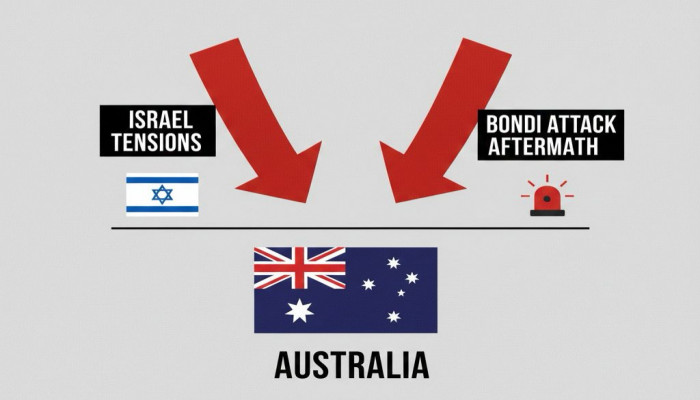
ustralian Prime Minister Anthony Albanese is facing mounting domestic and international pressure following a deadly terrorist attack at Sydney’s iconic Bondi Beach during a Jewish holiday celebration. The incident has not only shaken the nation but also worsened diplomatic tensions between Australia and Israel, while reigniting debate at home over how effectively the government has addressed rising anti-Semitism.
The attack, which took place during a Jewish festival at Bondi Beach, claimed multiple lives and has been described by authorities as a terrorist act. The tragedy has sparked anger and fear within Australia’s Jewish community and prompted strong reactions from Israeli leaders, opposition politicians, and senior officials across Australia.
The fallout from the attack has added strain to already tense relations between Australia and Israel. Israeli Prime Minister Benjamin Netanyahu publicly criticised Albanese, accusing him of failing to act against anti-Semitism, which Netanyahu said has been on the rise since 2023.
In response, Albanese called for unity and said his government was prepared to take “whatever action is necessary” to combat hatred and protect communities. Speaking on Monday, the Australian Prime Minister sought to reassure the public that his government remained committed to fighting anti-Semitism and violence.
The comments came as diplomatic ties between the two countries were already under pressure due to disagreements over Middle East policy, including Australia’s stance on Palestine and criticism of Israel’s actions in Gaza.
In the hours following the attack, Jewish leaders expressed deep concern and frustration, saying the violence reflected a broader failure to confront anti-Semitism in Australia. Levi Wolff, lead rabbi of Sydney’s Central Synagogue, spoke to Reuters at Bondi Beach, where he said one of his friends was killed in the attack. “There has been a shocking level of anti-Semitism that has been rearing its head in this country as it has in other countries,” Wolff said. He warned that unchecked hatred could have deadly consequences. “When anti-Semitism goes unchecked from the top, these are the things that happen,” he added.
His remarks echoed concerns raised by several Jewish organisations, which say that threats, abuse, and attacks targeting Jewish people and institutions have become more frequent in recent years. Facing criticism, Prime Minister Albanese defended his government’s actions at a press briefing. He outlined a series of measures already taken to address hate crimes and anti-Semitism, including new laws and security funding.
Albanese said the government had criminalised hate speech and incitement to violence, and had introduced a ban on the Nazi salute, measures aimed at curbing extremist behaviour. He also pledged that funding for physical security for Jewish community organisations would be extended, ensuring greater protection for synagogues, schools, and other institutions. In addition, Albanese pointed to the need for tougher gun laws, even though Australia already has some of the strictest firearm regulations in the world.
Despite these measures, Jillian Segal, a special envoy appointed by the government last year to address anti-Semitism, said the attack did not come as a surprise.
Segal was appointed following a series of graffiti attacks and arson incidents targeting synagogues and Jewish businesses across Australia. Speaking in a radio interview with the Australian Broadcasting Corporation (ABC) on Monday, she said the signs had been clear.
“The writing has been on the wall,” Segal said. She added that more action was needed to prevent such attacks in the future, suggesting that existing measures had not gone far enough.
Australia’s conservative opposition seized on the attack to criticise the ruling Labour government. Sussan Ley, leader of the Liberal Party, said the government had allowed anti-Semitism to grow unchecked. “Everything must change from today in how governments respond,” Ley told a press conference. She urged Albanese to immediately implement all recommendations from a report issued by Segal in July. That report called for stronger action across multiple areas, including a focus on anti-Semitism at university campuses, which have seen heated protests and political activism related to the Israel-Gaza conflict. When the report was released in July, Albanese stood alongside Segal and strongly condemned anti-Semitism. He described it as an “evil scourge” and announced that the government would spend $25 million to boost security at Jewish community sites, including schools.
Albanese has repeatedly stressed the importance of distinguishing anti-Semitism from legitimate criticism of the Israeli government. Speaking in July, he said Australians must be free to express their views on international events, including Israel’s actions. “You should be able to express your view here in Australia about events overseas,” Albanese said. However, he made clear that targeting individuals because of their religion or identity crossed a line. “Where the line has been crossed is in blaming and identifying people because they happen to be Jewish,” he added. This distinction has been central to the government’s response, particularly as protests related to Gaza continue across the country.
Segal’s recommendations include tougher screening of visa applicants for anti-Semitic views and closer scrutiny of universities, cultural institutions, and broadcasters. However, these proposals have not gone unchallenged. Australia’s Race Discrimination Commissioner, Giridharan Sivaraman, was among those who raised concerns, warning that some measures could conflict with human rights protections.
Sivaraman emphasised that all forms of racism must be addressed, not just anti-Semitism. According to the 2021 census, around 116,967 Australians identify as Jewish. This represents 0.46% of Australia’s population of about 25 million. Most Jewish Australians live in inner Sydney and Melbourne, areas that have also been the focus of recent protests and security concerns.
The Labour government has sought to balance its response amid Australia’s diverse and multicultural society. This includes a large and politically significant Lebanese-Australian community. Since 2023, New South Wales police have allowed weekly protest marches against Israel’s war in Gaza through central Sydney. While authorities have said the protests are lawful, critics argue they have contributed to rising tensions.
Australia’s relationship with Israel has been strained since August, when Israel revoked the visas of Australian diplomats working in the occupied Palestinian territories. At the time, Australia’s Foreign Minister Penny Wong described the move as an “unjustified reaction”, following Australia’s decision to recognise Palestine.
That same month, Australia expelled Iran’s ambassador after intelligence agencies linked at least two anti-Semitic arson attacks to Iran’s Revolutionary Guard.
The Bondi attack has also fuelled debate over immigration and border policy. Australia’s conservative parties had been preparing to announce a new immigration policy before Christmas, amid growing pressure from the populist One Nation party, which has surged in opinion polls.
One Nation Senator Pauline Hanson blamed what she called weak border controls for the attack. “We have to take a strong stand on who we bring into the country,” Hanson told 4BC radio on Monday. However, Immigration Minister Tony Burke rejected that argument, stating that the alleged 24-year-old gunman was born in Australia. He added that the gunman’s father, who was also a suspected shooter and died in the attack, had arrived in Australia as a resident in 1998. Burke also highlighted the actions of a bystander who helped stop the attack.
Local media have identified the man as Ahmed al Ahmed, a Syrian Muslim, who is credited with disarming one of the attackers. ‘Very Difficult to Prevent’ Lone Attacks. Former Prime Minister Malcolm Turnbull, who once represented Bondi’s large Jewish community in parliament, said preventing such attacks is extremely challenging.
“It is very difficult to prevent single acts of terror,” Turnbull told the ABC. As Australia continues to grieve, the Bondi Beach attack has become a turning point in national conversations about anti-Semitism, terrorism, free speech, and social cohesion. With pressure mounting from Jewish leaders, opposition parties, and international allies, the Albanese government now faces urgent calls to turn words into stronger action, as the country seeks to ensure such a tragedy is never repeated.



 Loading...please wait
Comments