




Australia–Japan seal $7 billion contracts for supply of advanced warships
- In Reports
- 05:42 PM, Apr 18, 2026
- Myind Staff
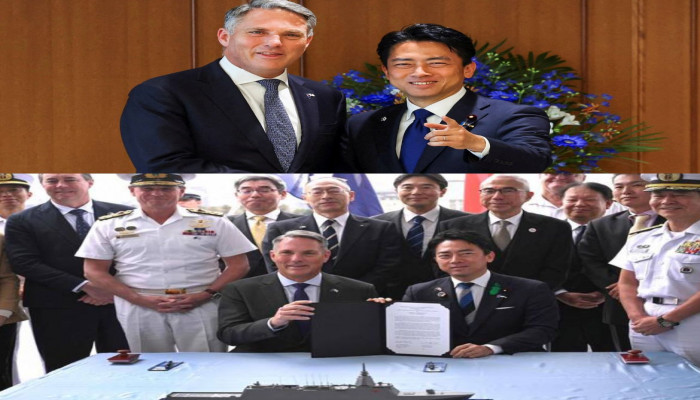
Australia and Japan have formally moved ahead with a major defence agreement worth A$10 billion ($7 billion), signing contracts to begin the supply of advanced warships. The deal represents Japan’s most significant military export since it lifted its long-standing ban on defence exports in 2014. It also signals a deepening of strategic ties between the two countries at a time of growing security concerns in the Indo-Pacific region.
The agreement was signed on Saturday by Australia’s Defence Minister Richard Marles and Japan’s Defence Minister Shinjiro Koizumi. Both leaders endorsed a memorandum that highlights their shared commitment to ensuring the successful execution of the project. Marles, in an official statement, said the memorandum was aimed at “reaffirming the Australian and Japanese governments' shared commitment to the successful delivery” of the warships.
This deal, originally struck in August, is a key step in Japan’s evolving defence policy. For decades, Japan maintained a pacifist stance following World War II. However, recent geopolitical developments have pushed Tokyo to expand its security partnerships beyond its traditional alliance with the United States. Strengthening ties with Australia is part of a broader effort to balance China’s increasing military presence in the region.
Under the agreement, Mitsubishi Heavy Industries will build and supply three upgraded Mogami-class multi-role frigates for the Royal Australian Navy. These ships will be constructed in Japan and are expected to be delivered starting in 2029. In addition to these initial vessels, eight more frigates will be built in Australia, marking a significant transfer of defence manufacturing capability.
Japan’s Defence Ministry also confirmed the development through a post on X. It stated that Koizumi and Marles welcomed the “conclusion of contracts for General Purpose Frigates, and confirmed to further strengthen bilateral defence ties” during the signing ceremony held in Melbourne. The statement reflects the broader strategic importance both nations attach to the agreement.
The construction process will begin in Japan, where the first three frigates will be built. After that, production will shift to Australia. Marles noted that there would be a “transition to an onshore build” at the Henderson shipyard near Perth in Western Australia. This transition is expected to boost Australia’s domestic shipbuilding industry while ensuring long-term maintenance and operational readiness.
The frigates being developed under this deal are designed for multiple roles. They will have the capability to track and hunt submarines, engage enemy surface vessels, and provide air defence. These features make them highly versatile assets for modern naval operations. Australia plans to deploy these ships to protect its critical maritime trade routes and safeguard its northern approaches.
The strategic importance of these deployments cannot be overstated. The Indian and Pacific Oceans are key regions for global trade, and maintaining security in these waters is a priority for Australia. At the same time, China’s expanding military footprint in these areas has raised concerns among regional powers. This deal is therefore seen as part of a broader effort to maintain balance and ensure stability.
Overall, the Australia–Japan warship agreement is not just a defence procurement deal. It represents a shift in regional alliances and reflects changing security dynamics in the Indo-Pacific. By combining Japan’s advanced shipbuilding expertise with Australia’s strategic needs, the partnership is set to play a significant role in shaping the region’s defence landscape in the coming years.



 Loading...please wait
Comments