



Attack on Iran’s supreme leader would mean all-out war, Tehran warns
- In Reports
- 12:27 PM, Jan 19, 2026
- Myind Staff
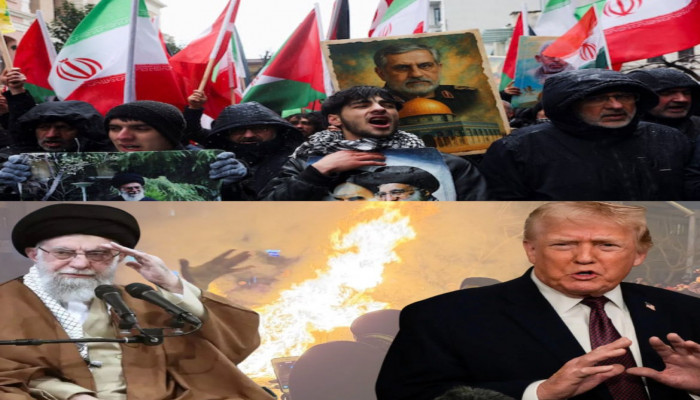
Iran has issued a strong warning to the United States, saying that any attack on Supreme Leader Ayatollah Ali Khamenei would lead to an all-out war, as the death toll from nationwide unrest has crossed 5,000. The warning comes amid rising tensions between Tehran and Washington, growing protests inside Iran, and reports that executions linked to the unrest may resume.
Iranian President Masoud Pezeshkian, in a post on X, said Iran’s response “to any unjust aggression will be harsh and regrettable.” He added that any strike on Supreme Leader Ayatollah Ali Khamenei would be “tantamount to an all-out war against the Iranian nation.” His remarks clearly signalled Iran’s firm stance against any external intervention targeting its top leadership.
The statement was made as tensions escalated following comments by US President Donald Trump. Trump has repeatedly warned that the United States could intervene if protesters in Iran continued to be killed or executed. In an interview with Politico on Saturday, Trump said, “It’s time to look for new leadership in Iran.”
President Pezeshkian also blamed the United States and its allies for Iran’s economic problems. In a social media post, he said that long-standing hostility and what he described as inhumane sanctions were a major reason behind the difficulties faced by the Iranian people. According to him, external pressure has played a key role in worsening Iran’s internal situation.
Despite the sharp exchange of words, there were mixed signals from Washington. On Friday, President Trump thanked Iran’s leaders in a social media post, saying they had halted scheduled executions of 800 detainees. While the US has moved military assets into the region, Trump has not clearly explained what specific steps Washington may take next.
Iran’s leadership, however, responded strongly a day later. Supreme Leader Ayatollah Ali Khamenei branded Trump a “criminal” and acknowledged “several thousand deaths” during the unrest. He blamed the violence on what he called US and Israel-backed terrorists and rioters, once again rejecting claims that the protests were purely domestic in nature.
The protests first erupted last month in Tehran’s Grand Bazaar. Initially driven by economic grievances, the demonstrations quickly turned political and spread to other parts of the country. Shopkeepers, students, men, and women from different income groups joined the protests. In many places, crowds openly called for an end to clerical rule, marking one of the most serious challenges to Iran’s leadership in recent years.
As the protests grew, authorities responded with strict measures. Internet access was cut across large parts of the country, and security forces were deployed heavily on the streets. Although demonstrations eased last week after a violent crackdown, reports of deaths, arrests, and abuses have continued to emerge.
An Iranian official told Reuters that at least 5,000 people have been killed during the unrest. The same official said the verified death toll was unlikely to “increase sharply.” Once again, Iran accused “Israel and armed groups abroad” of supporting the protesters, a claim that Iran’s clerical leadership has repeated many times while responding to internal unrest.
Iran has also signalled that executions linked to the protests could still take place. On Sunday, Iran’s judiciary said that some cases connected to the unrest had been classified under severe charges. Judiciary spokesperson Asghar Jahangir said certain acts had been labelled as “Mohareb,” an Islamic legal term that means waging war against God and carries the death penalty under Iranian law. “A series of actions have been identified as Mohareb, which is among the most severe Islamic punishments,” Jahangir said, as quoted by Reuters.
Internet monitoring group NetBlocks reported that brief internet access restored on Saturday was later cut again, indicating continued restrictions on communication as authorities attempt to control the situation.
According to an Iranian official, some of the heaviest fighting and highest death tolls were reported in Kurdish regions in north-western Iran. These areas have witnessed repeated unrest in the past. Earlier this month, three sources told Reuters that armed Kurdish separatist groups had attempted to cross into Iran from neighbouring Iraq, adding to tensions in the region.
As protests, international pressure, and strong warnings continue, Iran has made it clear that any direct threat to its Supreme Leader would cross a red line, with consequences that, according to Tehran, would amount to an all-out war.



 Loading...please wait
Comments