




Assam Assembly Polls 2021: BJP’s Mission 100+ Versus a Congress-led Mahajot and the Jatiyotabadis
- In Politics
- 11:46 AM, Mar 15, 2021
- Ankita Dutta
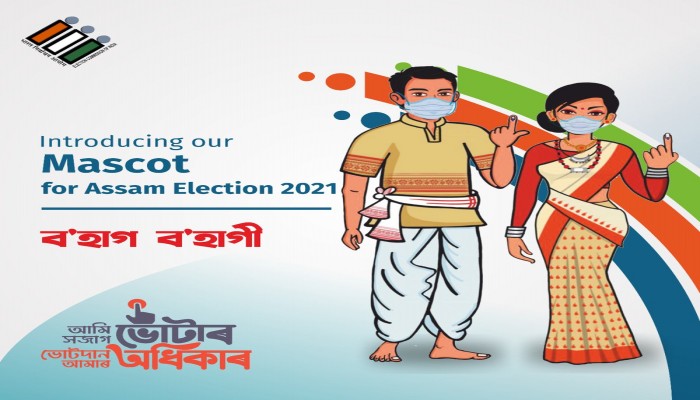
With the announcement of the dates (March 27, April 1, and April 6) for the three-phase polls to the 126-member Assam Legislative Assembly, the various contending parties seem to have begun their preparations for the upcoming battle on a war footing. The Election Commission of India recently unveiled its mascots Bohag and Bohagi and also released a theme song for the elections. In the words of the ECI – “The Assembly Election 2021 will be held during the most loved season of the Assamese calendar, i.e., ‘Bohag’ – the season of Rongali Bihu. Bohag-Bohagi is aimed to motivate people to come forward and exercise their right to vote and celebrate it with gaiety this Bohag Bihu whilst they participate in building a stronger, free, fair and safe democracy.” Undoubtedly, the ambience is gradually heating up. Interesting political developments are unfolding almost every day in the already volatile political scenario of a state that has burned and suffered for several years in the past.
The crucial phase of the Assam Movement against illegal foreigners (1979-1985) witnessed some of the worst nightmares of communal hatred and violence. The Khoirabari massacre (1981) and the Nellie massacre (1983) are just two important cases in point. The Asom Gana Parishad (AGP) registered a thumping victory in the assembly elections of 1985, only to be thrown out of power in 1991 by the Congress Party led by Hiteshwar Saikia. Although the AGP climbed back to the echelons of power in Dispur again in the year 1996 led by former CM Prafulla Kumar Mahanta, this second term of the AGP government in Assam was marked by complete political chaos and misrule. From the now-banned militant outfit United Liberation Front of Assam (ULFA) unleashing mindless havoc on the established state machinery to secret killings, the period from 1996-2001 was the darkest chapter in the political history of the state.
In one of the most gruesome massacres that took place in the year 2004 in Dhemaji district of Upper Assam, a huge bomb explosion during the Independence Day celebrations on August 15 had resulted in the death of 18 people, mostly school children. The sight of the dead bodies of those little kids was horrific! The ULFA claimed full responsibility for this attack on innocent civilians. It was especially after this brutal incident that the common Assamese people feared stepping out of their homes every year on August 15 and January 26 for several years thereafter.
Much of the chaos stabilised and Assam entered into a new phase of progress and development, thanks to the laudable efforts of former CM and Congress stalwart Tarun Gogoi. A popular mass leader with his own unique wit and charisma, the death of Tarun Gogoi has created a vacuum in the Congress Party ahead of the elections this year. It looks like a sinking ship populated on the one hand by weary and aged leaders who know nothing else except complaining against the BJP and Narendra Modi, and a few “youth leaders” who seem to be a confused lot, having no idea whatsoever of the ways and means of rescuing the ship. It still remains clueless about how to counter the BJP’s rolling juggernaut in the region for the past several years. In the meantime, the BJP has been craftily laying the groundwork for the elections, especially among the tea-garden voters, where its presence was almost negligible till a few years back. Despite being in power, the BJP has taken its chances with new leaders and new faces. The Congress, on the other hand, has mostly played it safe.
The dominance of the BJP has further been bolstered by repeated visits to Assam of party bigwigs and star campaigners from Delhi, especially PM Narendra Modi and Home Minister Amit Shah. It was just a few weeks back that PM Narendra Modi had inaugurated and laid the foundations of the Dhemaji Engineering College and the Sualkuchi Engineering College, respectively. Home Minister Amit Shah too, during his poll-related tour of Nagaon district, had assured the people at Batadrava constituency (Batadrava is the birthplace of Mahapurusa Srimanta Sankardeva who led the Vaishnava renaissance in Assam) that the BJP is firmly committed to its mission of making Assam free from floods, illegal infiltration, corruption and andolans (agitations) in the next five years. He also inaugurated a project to beautify the Batadrava Thaan in a function held at Batadrava, besides participating in the Guru Pujan of the Pran-Pratishtha ceremony of the phenomenal Mahamrityunjay Mandir in Puranigudam, Nagaon. It is world-renowned for the record of constructing the 126 feet tall Shiva Linga, touted as the largest Shiva Linga in the world.
State-level senior leaders of the BJP have also held a number of election rallies and meetings at different places that were seen to draw large crowds. Upbeat over their dominant performance in the last Assembly and Lok Sabha polls, the ruling BJP-AGP combine is exuding confidence and targeting a win in a hundred seats of the 126-member House. Leading campaigners of the state BJP such as CM Sarbananda Sonowal and Finance Minister Himanta Biswa Sarma have already made forays into the interiors of the state to boost the morale of their party workers and candidates, along with the candidates of their allies. The ruling coalition undoubtedly has a clear-cut edge over the Congress-led ‘Grand Alliance’ or what they have termed as Mahajot. It comprises of the Congress, Maulana Badruddin Ajmal’s All India United Democratic Front (AIUDF), Communist Party of India (Marxist), Communist Party of India (Marxist-Leninist), and Anchalik Gana Morcha led by “noted intellectual” and a prominent ULFA ideologue from Assam Ajit Kumar Bhuyan.
New entrants to the Mahajot include Hagrama Mohiliary’s Bodoland People’s Front (BPF) and Tejashwi Yadav-led Rashtriya Janata Dal (RJD). It may be noted here that the BPF still commands a significant influence in the Bodo-inhabited areas of Kokrajhar, Baksa, Chirang, and Udalguri in Lower Assam, while the RJD is eyeing on weaning away at least a section of the substantial Hindi-speaking voters (largely Biharis and Marwaris) from voting for the BJP. The fall in the popularity of its alliance partner, i.e., the AGP, in the recent times is going to be a tough contest to the ruling BJP. The other contenders in the fray include the two newly-formed regional parties born out of the anti-CAA agitation, i.e. the All Assam Students’ Union (AASU)-backed Assam Jatiya Parishad (AJP) led by ex-“student leader” Lurinjyoti Gogoi, and Raijor Dal (RD) backed by the Krishak Mukti Sangram Samiti of the imprisoned “peasant leader” Akhil Gogoi.
The Opposition parties have failed to put up a convincing, united front that goes beyond the same old childish rant of repealing the CAA. They think that the most effective antidote to the BJP’s poll prospects in Assam is to garner all the anti-CAA forces under one common banner and expose the BJP’s double-speak. But this is not going to materialise, given the fact that such a strategy has only exposed their narrow, one-sided policy of appeasement of the Muslims. All the hullabalo of the Opposition parties over the recent ban on government-funded madrasas aptly proved their intentions right. Moreover, the rift in the so-called ‘Grand Alliance’ has become apparent in the matter of fielding candidates, eroding the Opposition’s credibility further. As a matter of fact, as many as 21 executive members of Morigaon District Congress Committee had recently quit the party protesting against the granting of ticket to one Munin Mahanta of the CPI. The agitated members have said that the party high command did not discuss anything with the local leaders and cadres about the seat-sharing arrangement with the CPI in Morigaon.
Almost every day, the ruling BJP alliance is scaling up its attacks on the Congress-AIUDF alliance as an unholy nexus of anti-Assam forces out to destroy its language and culture. The Congress is also equally hitting out at the BJP by trying to reclaim its lost space and influence among the tea workers, unemployed youth and farmers. On the other hand, are the Jatiyotabadis led by Lurinjyoti Gogoi. They are desperately trying to fill in the vacuum of the Congress, riding high on their claims to protect the “secular” fabric of Assam and repeal of the Citizenship Amendment Act, 2019. It was just a few days back that one booth-level President of the BJP named Debananda Gogoi of Bordumsa in Tinsukia district of Upper Assam was killed by Joychandra Gogoi, a resident of the same village and member of the newly formed AJP. As per reports, the accused was swiftly arrested under the initiative of the Tinsukia Police. This is the very first incident of pre-poll violence that was reported from Assam on the night of March 12, 2021. Does Jatiyotabad (translated as regionalism in Assamese) imply violence towards one’s political opponents? The silence of Lurinjyoti Gogoi on the heinous crime raises serious doubts on the brand of politics espoused by him and his party, cleverly camouflaged in the grand idea of “regionalism”.
Campaigning has gained a fresh momentum in the state as most of the political parties have already declared their candidates for the first and second phases of the three-phase elections. But, the prospects of each would become clearer only after the two mind-boggling tasks of seat adjustment and candidate selection are finally completed. It is seen that most of the parties have gone for a mix of the old and the young. But a number of sitting MLAs have not been re-nominated by their parties. Many such deprived candidates have decided to contest the polls defying the will of their parties. In some way or the other, these independent candidates are going to alter the permutation and combination of the contending parties in several constituencies. As is often the case post the filing of nomination papers, discontentment is slowly brewing among the failed party ticket aspirants. This holds especially true for a few senior leaders of the major parties who have been denied candidature at the eleventh hour. E.g., AGP stalwarts Prafulla Kumar Mahanta and Brindaban Goswami have been given a cold shoulder this time. Also, among the ignored are senior Congress leaders Tanka Bahadur Rai and Prithvi Majhi.
Internal bickering has hit all the parties across the spectrum following the announcement of the candidatures. But, how far this trend is going to affect their electoral fortunes remains to be seen. This time, a largely triangular contest is expected to take place in Assam, unlike a bipolar one (Congress versus BJP) as the state witnessed in the 2016 state Assembly polls. The tug of war in most of the constituencies across Lower Assam, Upper Assam, and the Barak Valley (comprising of the districts of Cachar, Karimganj, and Hailakandi) too, is going to take place between the two major adversaries – the BJP-led ruling coalition with its partners (AGP, United People’s Party Liberal (UPPL), and Gana Suraksha Party (GSP) of MP Naba Sarania), and the newly-formed grand alliance of the Congress-AIUDF-Left parties. Several senior and influential leaders of the contending political fronts have been dishing out freebies and monetary benefits to woo the voters, and also making tall promises of the same if they come to control the reins of power.
E.g., during the launch of its second leg of the election campaign, the Congress Party announced its ‘Congressor 5 Guarantee’ under which it has launched a website www.congressor5guarantee.in for online employment registration for unemployed youth of the state. It has also said that if voted to power, its government will generate 5 lakh jobs in the public sector and take initiatives for creating 25 lakh jobs in the private sector in the state during the next 5 years.
Schemes like Orunudoi and Swami Vivekananda Assam Youth Empowerment Yojana (SVAYEM) launched by the BJP government for women and unemployed youth of the state respectively, have been accorded a red-carpet welcome. While the long-term impact of such interventions either on the lives of the beneficiaries or on the economy are still questionable, but they have certainly appealed to the targeted segment of voters. If on the one hand, the BJP is vouching for securing its much-treasured ‘100-plus’ seats, the Congress and its coalition too, have equally taken the bull by the horns. Yet, several ground-level reports have suggested that the popularity of the BJP continues to remain as strong as ever since 2016. The sporadic tussles for power and the lack of a strong leading face in the Congress still remains a matter of serious concern for India’s Grand Old Party. The major challenge for both the AGP and the BJP in the way of finalising their seats and candidates for the third phase of the polls scheduled on April 6, has also now been resolved. Besides the candidature of state unit party president Ranjeet Kumar Dass from Patacharkuchi and NEDA convenor Himanta Biswa Sarma from Jalukbari, the BJP had not formally declared the names of candidates for the third phase of the polls for 40 constituencies, including Gauhati (East), Gauhati (West), and Dispur.
The prestigious Gauhati (East) seat has been retained by State Minister Siddhartha Bhattacharya, while Jayanta Malla Baruah is the BJP’s candidate in Nalbari which is one of the strongest bastions of the RSS in Lower Assam. The BJP is finally contesting on 92 seats, while its alliance partners will field their candidates from the remaining seats in the 126-member Assembly. The third and the final list of candidates of the AGP comprises of candidates for 13 constituencies.
It has been reported that the BJP, in an attempt to reduce its dependence on any other party/alliance partner for gaining an upper hand during the formation of the next government, has preferred to field its own candidates in those segments for which the internal surveys have predicted a sure win for the ruling combine. The AGP leadership is perceptively worried about a likely erosion of its support base after the formation of the Assam Jatiya Parishad and the Raijor Dal. Both these fronts have already forged a pre-poll alliance, and are definitely going to put up candidates in all those seats from where the AGP won in 2016. This is one of the most important reasons behind the AGP seeking to field its candidates in more assembly seats in the upcoming polls. The State Finance Minister Himanta Biswa Sarma, while commenting on the AGP’s demand for 40 seats from the ruling BJP, was of the view that if the regional party insisted on getting 40 seats, there may be a friendly contest between the two in a number of constituencies.
It wouldn’t be an exaggeration to say that if today the illegal infiltration problem of Assam still awaits a credible solution, the stark failure of the AGP to fulfil the objectives and ideals upon which it was founded is largely to be blamed for. Time and again, its leaders have betrayed the innocent hopes of the voters through their tall claims, which today stand exposed. But, one of the major success areas of the ruling BJP in the last five years has been the import of latest Israeli technology to guard more than 40 kms of the international riverine border with Bangladesh in Dhubri district of Lower Assam. The same technology would now be used for guarding the riverine border in the Barak Valley. The riverine borders were considered the most vulnerable earlier as there was no physical barrier. Moreover, fencing along the Assam-Bangladesh border is almost complete and the Centre has also undertaken several commendable steps to put up “Smart fencings” in a few vulnerable locations. These are really important developments from the point of view of India’s national security, but which the popular media, both print and electronic, has often deliberately left ignored.
The fact that the ruling BJP is the most potent and viable force in terms of a well-knit grassroot-level presence and a cohesive organisational network in the political space of the state at present, can hardly be contested. In fact, a robust organisational base and an efficient machinery of reaching out to the masses far and wide, have been the BJP’s strongest points. These two factors have also often helped it compensate serious flaws in its governance many times. This was clearly manifest in its stunning performance in the 2016 Assembly elections and then again during the 2019 Lok Sabha polls. The BJP was almost a near non-entity in Assam in the 2011 Assembly elections when it won a mere five out of 120 seats contested with its vote share being 11.47%. But it succeeded in increasing its tally to 60 seats in the 2016 Assembly elections, blessed as it was by a wave of anti-incumbency against the Congress Party. It was also smart enough in having decided to enter into a strategic pre-poll alliance with the AGP, BPF, and other regional groups of various janajati communities such as the Rabhas, Tiwas, and Misings. The AGP too, gained from the alliance when its tally of seats increased to 14 in 2016 from a mere 10 in 2011.
The voting pattern of the Muslim-dominated areas in several districts of Lower Assam is going to be an interesting one this time. Being a national party, the Congress Party’s open alliance with Maulana Ajmal could eventually prove to be more useful for the Muslims in order to counter the BJP’s rise. What worries the Muslims here in particular is the fact that perfume-baron Badruddin Ajmal might never want to provoke the BJP-led central government in Delhi, for that would imply a direct threat to his massive business interests both within and outside of the state and in the Gulf too. Hence, in 2016, there were sporadic reports that some of the AIUDF voters in Lower Assam were going back to the Congress (Sethi and Shubhrastha, 2017). At that time, the Congress Party had not entered into an alliance with the AIUDF unlike this year’s elections. A strategic shift of the Muslim votes to the Congress had taken place at the very last moment in 2016. If we take a leaf out of it, then this time the Muslims, in all probabilities, would vote en-masse for the Congress-AIUDF alliance. This would significantly damage the BJP’s chances in several Muslim-dominated areas of districts like Dhubri, Barpeta, Nalbari, and Goalpara in Lower Assam.
Because of a huge demographic change over the years, Lower Assam has always been the BJP’s weakest link. Unlike the 2016 elections when the Congress was on the defensive and the BJP alliance was holding its sway, this time, its alliance with the AIUDF has given it the much-needed confidence to take the BJP head on. As such, there has been a big scramble for party tickets among the Congress leaders, both old and young alike for the ensuing polls. The Muslims will eventually take the call after the Friday prayers a week ahead of the polls. It is important to remember that the Muslims in any area vote both strategically and tactically, keeping in mind the religion and party affiliation of all the contesting candidates in a particular constituency and also the long-term consequences of their vote. This holds true irrespective of whether they are in a majority or in a minority in the said area. The AIUDF’s recently released list of candidates from 16 different constituencies of the state encompassing Lower Assam, Barak Valley, and Nagaon is a much well-calculated move.
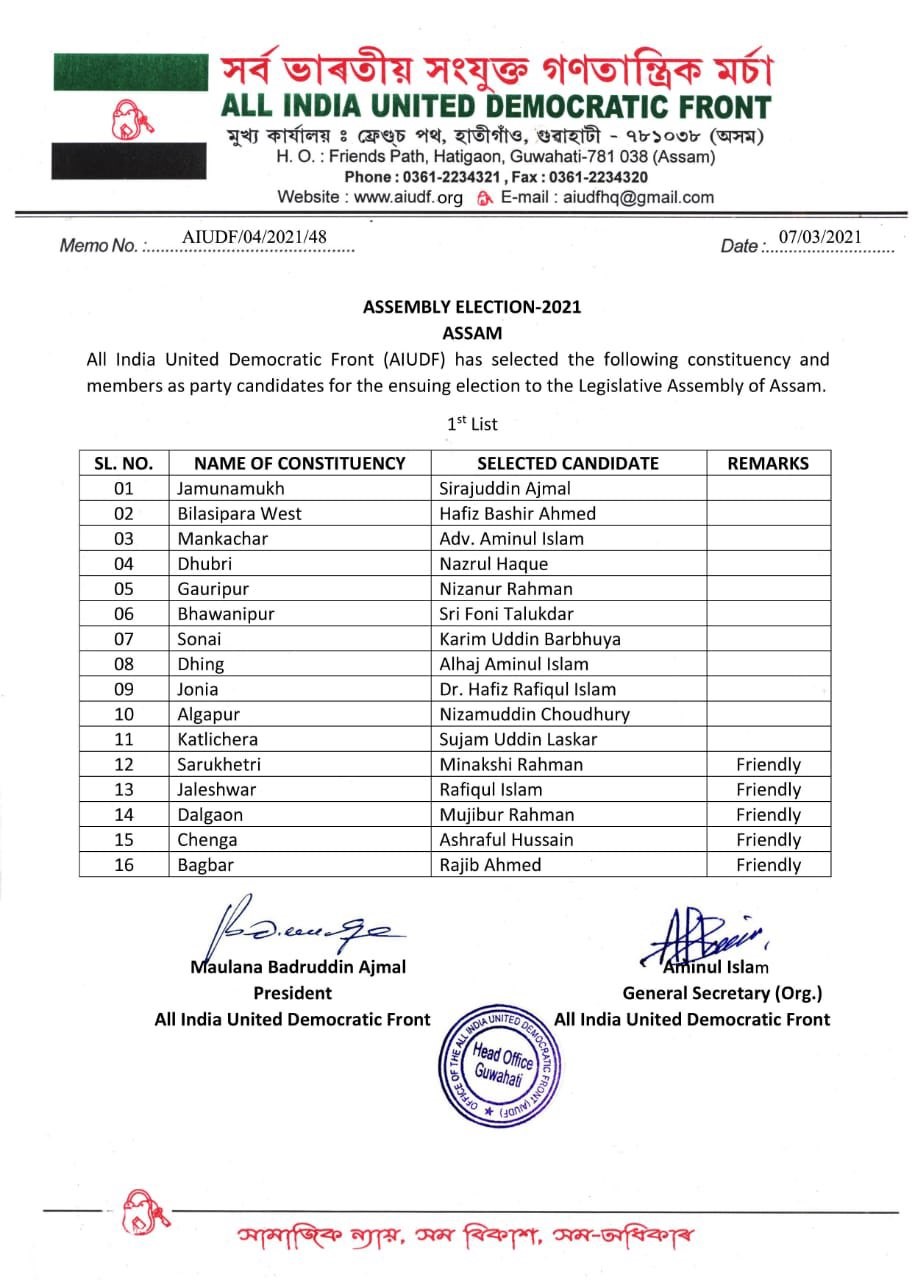
With an eye on making their presence felt in Lower Assam, it was only a few days back that the All Assam Minority Students’ Union (AAMSU) led by their influential adviser Azizur Rahman had joined the Raijor Dal as an alliance partner. This development has come amid speculations of a widening political rift between the Assam Jatiya Parishad and the Raijor Dal after both the regional allies fielded candidates in the same constituencies in some of the BJP strongholds of Upper and Northern Assam. Nonetheless, the entry of Azizur Rahman in the field with Raijor Dal has given a major boost to the latter’s prospects in the Muslim-dominated seats of Lower Assam. A ‘friendly contest’ between the Congress and the AIUDF in five constituencies of Lower Assam, viz. Sarukhetri, Jaleshwar, Dalgaon, Chenga, and Bagbar, and the fear of losing grip over the grassroot-level workers of the two grand alliance partners because of seat exchange, has the possibility of leading to a division of the Muslim votes. If such a situation happens, then Akhil Gogoi’s Raijor Dal will no doubt, emerge as the ultimate beneficiary. It is also because of the fact that the Raijor Dal already enjoys a considerable support base in districts like Goalpara and Barpeta.
One of the constituents of the Raijor Dal, i.e., the Krishak Mukti Sangram Samiti (KMSS), and its student wing, the Satra Mukti Sangram Samiti (SMSS), have been quite proactive among the Muslims of these regions for several years now. A ‘friendly contest’ between the Congress and the AIUDF is also taking place in Katlicherra constituency of Hailakandi in the Barak Valley. Katlicherra too, has a very high concentration of Muslims who have traditionally backed non-BJP parties. Azizur Rahman has been named as the Raijor Dal’s candidate from Naoboisa, a Muslim stronghold in the north bank of the Brahmaputra from where the AIUDF won the last Assembly polls. As a part of the seat-sharing arrangement in the grand alliance, Naoboisa has gone to the Congress Party this time. This pre-poll understanding between the Congress and the AIUDF holds good enough possibilities of eventually turning out to be an advantageous one for the Raijor Dal. Former Minister in the Tarun Gogoi government, Bharat Narah, has been shifted out of his home turf in Lakhimpur’s Dhakuakhana to Naoboisa where local youth Azizur has become a popular face due to his vocal stand in favour of safeguarding the rights of those who have been excluded from the National Register of Citizens (NRC).
The AIUDF’s decision to opt for a ‘friendly contest’ with its alliance partner Congress in some seats for the forthcoming Assembly elections is actually a ‘tactical move’. It is because both the parties will try to make certain that the BJP-led coalition of parties does not benefit from a division of the opposition votes in such constituencies. It has smartly factored in various relevant aspects like demographic pattern of the concerned seats, results of the previous elections, cadre strength and organisational base of both the parties, among other things, before arriving at the decision to have a friendly fight with the Congress in these selected constituencies. The dissatisfaction is already brewing among some sections of the AIUDF workers regarding seat-sharing arrangements with the Congress Party. In those seats where the Muslims constitute 70% or more of the total electorate, the chances of a BJP or an AGP candidate managing to win is very slim even in the case of a division of votes between the AIUDF and the Congress. But, Sarukhetri could prove to be a bit problematic for the alliance. The AIUDF understands this very well. Hence, they are undertaking various mass outreach programmes in Sarukhetri to make sure that the AGP, which is going to be in the fray from the constituency on behalf of the BJP, is not able to wrest the seat this time.
The Congress Party had fought the electoral battle in 2016 on its own terms, and eventually bagged 26 seats. The AIUDF too, also fought it alone and was able to clinch a mere 13 seats against 18, which it had bagged in the 2011 Assembly polls. It was largely attributed to the Maulana’s long absence from the political scene of the state, which adversely came to impact his clout in the Muslim-dominated regions of Lower Assam. Being the businessman that he is, Ajmal mostly remains busy in managing his business interests abroad. The all-pervasive work done by his NGO Markazul Ma’arif in several areas of Nagaon district and Lower Assam has, however, not been enough to compensate for the time that Ajmal has failed to spend among his core constituents. It would be definitely wrong to project the AIUDF as the only undisputed political party of the Muslims in Assam. There are far radical Islamist groups like Ahle Sunnat and Nadiya Tu Tamir that are quite strong and influential among the Muslims of the Barak Valley. They have always been in a continuous opposition to Maulana Ajmal’s AIUDF since its inception in 2005 after the repeal of the Illegal Migrants (Determination by Tribunals) Act.
The Congress was the traditional security provider to the Muslims in Assam; however, with the emergence of the BJP and especially after the scrapping of the IM (DT) Act in 2005, the Muslims more or less abandoned the Congress and switched their loyalty to the AIUDF. Although the Congress tried its level best to woo the Muslims by bringing the Foreigners (Tribunal for Assam) order of 2006, but that did not prove good enough to placate the Muslim community. There are 40 assembly constituencies, spread over 9 parliamentary seats, where Muslim voters constitute 35% to 90% of the total population. These parliamentary seats are Karimganj, Silchar, Dhubri, Kokrajhar, Barpeta, Guwahati, Mangaldoi, Nagaon, and Kaliabor.
It needs to be recalled here that the controversial IM (DT) Act was a major hurdle in the way of undertaking the work of 3ds – detection, de-franchising, and deportation of the East Bengal origin illegal immigrants in Assam. What therefore worries the Assamese Hindus (including the janajati communities designated as “Scheduled Tribes”) the most is that if the grand alliance/Mahajot is voted to power, its constituent AIUDF will work for the interests of the suspected Bangladeshi infiltrators. Considering the fact that the AIUDF had won 13 seats in the 2016 Assam Assembly elections, it will undoubtedly seek to increase its tally this time in order to get into a better bargaining position, in the event of the Mahajot forming the next government at Dispur. It goes without saying that giving in to the AIUDF’s wish of grabbing more seats will add more fuel to the fire of apprehension and insecurity that has been raging deep inside the people of Assam for many years now. This apprehension stems from a genuine fear of becoming a minority in their own land, and this crucial situation of demographic change cannot be interpreted through fancy academic jargons such as xenophobia!
Moreover, several party bigwigs inside the Congress have already expressed their resentment over their party’s reaching a pre-poll understanding with the AIUDF. In such a case, there is also the possibility of a revolt within the Congress if it tries to go too far in placating the AIUDF. The Mahajot, or more correctly a non-BJP alliance under the Congress and the AIUDF, had recently faced a debacle in the Bodoland Territorial Region (BTR) elections with many top faces of both the parties unsure about the fate of the alliance itself. Quite predictably, the issue of D-Voters and the National Register of Citizens (NRC) are among the major poll planks of the AIUDF.
The Legal Rights Observatory (LRO) had recently released a sensational video clip in Twitter of Badruddin Ajmal at an election rally in Barpeta district of Lower Assam, which showed the highest growth rate of Muslim population of 12% between the two Census years – 2001 and 2011. In the video, Ajmal can be seen saying that the Mughals ruled India for 800 years, the British for 200 years and now the Congress-AIUDF alliance will create an Islamic state in Assam. Ajmal is then heard saying that Narendra Modi should also not dream of converting India into a Hindu Rashtra. Notably, LRO is the same NGO that had raised allegations of terror funding against Ajmal’s AIUDF right on the eve of the BTR elections. Ajmal had not only termed these charges as ‘baseless and without facts’ but also categorically denied committing any violation of the Foreign Contribution Regulation Act (FCRA) rules or receiving funds from overseas NGOs having links with Islamic terrorist organisations. This time too, Ajmal referred to the LRO video as an ‘adulterated’ one and showed what he claimed to be the full video of the event. He also labelled the LRO as a fake NGO with no address and authentic identity of the persons associated with it.
With campaigning and sloganeering reaching a crescendo in the heated atmosphere of the state, the wait is now for May 2, 2021!
References:
- BJP-AGP seat-sharing talks remain deadlocked. The Assam Tribune. March 05, 2021.
- Cong promises 30 lakh jobs in State: ‘Congressor 5 Guarantee’ 2nd leg launched. The Assam Tribune. March 05, 2021. pp. 1, 6.
- Dwaipayan. Hectic Assembly Poll Activities in Assam. The Assam Tribune. March 04, 2021.
- Nani Gopal Mahanta. (2014). Lok Sabha Elections in Assam: Shifting of Traditional Vote Bases to BJP. Economic and Political Weekly. Vol. XLIX, No. 35, pp. 19-22.
- Rajat Sethi & Shubhrastha. (2017). The Last Battle of Saraighat – The Story of the BJP’s Rise in the North-East. pp. 81-85.
- https://www.organiser.org/Encyc/2020/12/4/Ajmal-Foundation-of-AIUDF-chief-accused-of-massive-loot-LRO-lists-its-Isamist-donors.html
- https://www.google.com/amp/s/www.firstpost.com/india/assam-assembly-election-2021-prafulla-kumar-mahanta-a-mediocre-politician-and-student-leader-par-excellence-9400101.html/amp
- https://www.google.com/amp/s/www.sentinelassam.com/amp/editorial/some-musings-on-assam-assembly-elections-2021-528243
Image Source: Twitter



 Loading...please wait
Comments