



Anti-India remarks intensify in Bangladesh ahead of 1971 war Victory Day anniversary
- In Reports
- 06:32 PM, Dec 16, 2025
- Myind Staff
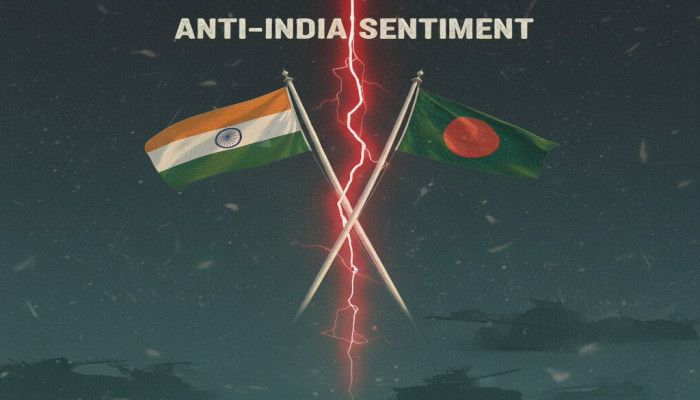
As Bangladesh marked the 55th anniversary of its Victory Day, a series of provocative anti-India remarks from political platforms in the country have raised concerns in New Delhi. The statements, including threats directed at India’s northeastern states, come at a time of political uncertainty in Bangladesh and the growing influence of radical Islamist elements.
The latest remarks were made by Hasnat Abdullah, a leader of the student-led National Citizen Party (NCP), who warned that Bangladesh could provide shelter to forces hostile to India and assist in separating India’s northeastern region, commonly known as the “seven sisters,” from the rest of the country. His comments were made during a protest rally organised by Inqilab Mancha, coinciding with Bangladesh’s Victory Day celebrations on Monday.
On the occasion of Victory Day, Chief Adviser Professor Muhammad Yunus paid tributes to the martyrs of the 1971 Liberation War by placing a wreath at the National Memorial in Savar, on the outskirts of Dhaka. The day commemorates Bangladesh’s independence following the end of the 1971 war.
The same date is observed in India as Vijay Diwas, marking the victory of the Indian armed forces and Bangladesh’s Mukti Bahini over Pakistan. The conflict ended with the surrender of 93,000 Pakistani soldiers, leading to the birth of Bangladesh as an independent nation.
However, this year’s solemn remembrance took place against the backdrop of political flux in Bangladesh, with critics pointing to rising radical Islamic influence and attempts to weaken the legacy of the 1971 war and Bangladesh’s historical ties with India.
At the protest rally, NCP leader Hasnat Abdullah made a direct and provocative statement regarding India’s northeastern states. He said, “Seven Sisters will be separated from India,” a remark that triggered immediate concern due to its implications for regional stability.
Abdullah further alleged that individuals accused in the attack on Osman Hadi were being supported by India, a claim that was dismissed by New Delhi. His remarks came amid a broader narrative pushed by certain political elements in Bangladesh that seek to blame India for the country’s internal political developments. India strongly rejected the allegations made by Bangladeshi leaders.
Responding to the comments, the Ministry of External Affairs stated, “We expect that the interim government of Bangladesh will take all necessary measures for ensuring internal law and order, including for the purpose of holding peaceful elections.” India has consistently maintained that it respects Bangladesh’s sovereignty and democratic processes and has urged Dhaka to prevent the spread of inflammatory rhetoric that could destabilise bilateral relations.
Professor Muhammad Yunus, a Nobel Laureate, is widely seen as maintaining close ties with the National Citizen Party, which emerged from the violent protests in August last year that led to the ouster of former Prime Minister Sheikh Hasina.
Under Yunus’ leadership, critics say Bangladesh is witnessing a push for closer ties with Pakistan, while distancing itself from India. This shift has raised alarm, especially given Pakistan’s role during the 1971 Liberation War, when its forces were responsible for the torture, rape, and killing of lakhs of Bangladeshis.
Radical Islamic elements within the NCP have continued to make anti-India statements, reflecting a broader ideological shift among certain political groups seeking to redefine Bangladesh’s historical narrative. Observers and critics argue that since the Yunus-led interim administration took charge, there has been a concerted effort to erase the legacy of the Liberation War and downplay India’s role in the creation of Bangladesh.
The 1971 war remains a defining moment in South Asian history, symbolising cooperation between India and the people of East Pakistan, who fought together for freedom. Attempts to undermine this legacy have been viewed as deeply troubling by historians and policymakers alike.
Hasnat Abdullah escalated his rhetoric by issuing a warning to India. He said, “I want to say clearly to India that if you shelter forces who do not respect Bangladesh's sovereignty, potential, voting rights and human rights, Bangladesh will respond.” He further added, “If Bangladesh is destabilised, the fire of resistance will spread beyond borders.” These statements, analysts say, indicate an attempt to project India as an external threat while deflecting attention from Bangladesh’s internal challenges.
Abdullah’s remarks are not seen as isolated incidents. They are part of a larger pattern in which anti-India rhetoric is increasingly used to influence domestic politics in Bangladesh. Political groups backed by radical Islamist elements are attempting to discredit India while advocating stronger engagement with Pakistan. Such groups, critics point out, had supported Pakistan during the Liberation War and are now gaining influence under the current political climate.
Alongside the rise in anti-India rhetoric, there have been growing concerns about attacks on minorities in Bangladesh. Reports indicate that not only Hindus, but also Sufis and Ahmadiyyas, have faced increasing incidents of violence and intimidation. Human rights observers warn that the emboldening of radical elements poses serious risks to social harmony and democratic values in the country.
As Bangladesh marks one of the most significant moments in its history, the resurgence of anti-India statements during Victory Day has added to regional unease. India continues to closely monitor developments, particularly statements that threaten territorial integrity and regional peace.
The situation underscores the fragile nature of South Asian geopolitics at a time when historical memory, domestic politics, and regional relationships are increasingly intersecting.



 Loading...please wait
Comments