




An Analysis of the Nominal GDP Per Capita of Indian States, 2025-26
- In Economics
- 12:03 AM, Mar 13, 2026
- Mukul Asher
This column analyses the nominal GDP per person of the states in India in 2025-26 in USD. The data are for the old GDP series with a base of 2011-12, and not from the recently introduced new series based on 2022-23.
The World Bank classifies countries as low, lower-middle, upper-middle, and high—based on the previous year’s gross national income. The thresholds for FY2026 are: Low (USD 1,135 or less), Lower-middle (USD 1,136–$4,495), Upper-middle (USD 4,496–$13,935), and High (>USD 13,935).
India’s per capita GDP in USD in 2025-26 is expected to be about USD 3000, which is the lower-middle income category. The data in Figure 1 suggest that no Indian state is currently in the high-income category. Only one state, Bihar, is in the low-income category. With a more Vikas-oriented government being formed in Bihar, which is aligned with the government at the Centre, prospects are favourable for Bihar to move to the lower-middle income category in the next several years. Data in Figure 2 suggests that between FY 2020 and 2025, Bihar was among the ten fastest-growing states in the country. This positive record is expected to accelerate under the new state government.
There are, however, nine states, from all parts of the country, some, such as Maharashtra (population of 130 million), Tamil Nadu (population of 85 million), and Gujarat (population of 75 million), having populations larger than many countries, which are in the upper-middle income category. The rest of the states are in the lower-middle-income category. Uttarakhand, with a per capita income of USD 4,230, has realistic prospects of moving to the upper middle income category in the next few years. Given India’s population of over 1400 million persons, these variations among the states require a nuanced and cautious interpretation of India’s per capita GDP. Overgeneralisation in discussing India’s per capita income should be avoided.
The data in Figure 1 shows wide variations in nominal per capita GDP among the states, ranging from a low of USD 998 in Bihar to USD 10,281 in Goa, a difference of over 10 times. To attain the goal of Viksit Bharat in 2047, such large gaps need to be narrowed by policies that raise, particularly the incomes of states at the lower end, and of those not growing at a satisfactory rate because of poor policies, governance, and insufficient priority given to vikas (growth). At the same time, deepening innovation-led growth in all sectors, including the agricultural sector, should also be a priority.
Anuj Gupta has noted that “India’s economic transformation is not unfolding through a single reform or headline policy. It is the product of several structural shifts happening simultaneously, across social policy, state capacity, industrial strategy, and political competition.”1
Figure 1: Nominal Per Capita GDP in USD of States in India, 2025-26
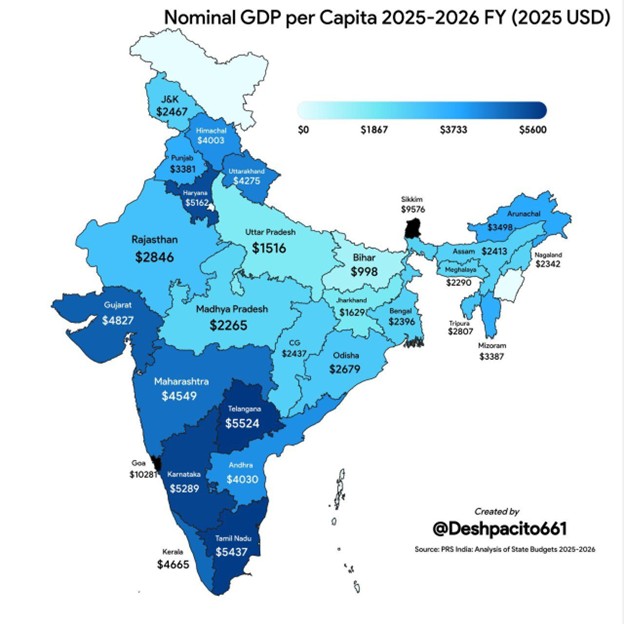
Gujarat (USD 4,827 per capita income) and Maharashtra (USD 4,549 per capita income), the two western states, have exhibited prudent fiscal management and solid commitment to drivers of growth, such as infrastructure development, and willingness to increase growth nodes within the state. They have also focused on leveraging new emerging technologies. Their prospects for improving their relative ranking are widely regarded as very promising.
Three Indian states in the southern part of the country are closely clustered in per capita income. Telangana (USD 5,524), Tamil Nadu (USD 5,437), and Karnataka (USD 5,289). Their governance quality, fiscal management, and extent of focus on Vikas will impact whether they continue to sustain much above average per capita income and maintain their relative ranking in the group.
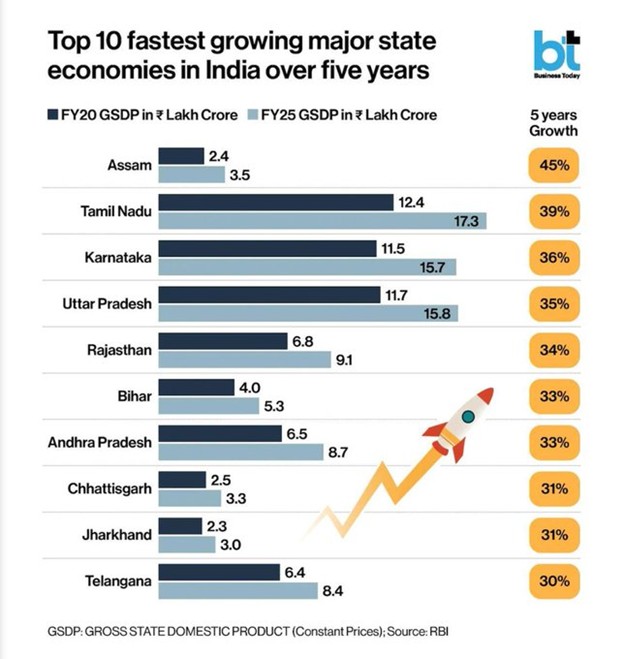
Data in Figure 2 suggests that all three are among the top ten states in the growth of state gross domestic product between FY 2020 and FY 2025. Telangana, however, grew at a much lower rate (30 per cent) compared to the other two states.
There are also serious concerns about Telangana’s fiscal management. Niti Aayog study concludes that “Telangana’s debt is predictably on an unsustainable path. Due to a high primary deficit to GSDP (between 2.0 and 2.5 per cent), its debt to GSDP ratio in the baseline scenario is predicted to increase by nearly 8 percentage points in the next five years. It also has a very high magnitude of outstanding contingent liabilities; absorbing these is predicted to put the State’s debt on an even more dire trajectory”2.
In Keralam’s per capita income of USD 4,665, remittances by its workers and professionals have played a significant role. They are mainly concentrated in the Gulf region. Given the ongoing war between Israel and the US on the one hand and Iran on the other, with the Gulf region experiencing significant collateral damage, Keralam residents will need to become capable of moving to higher value-added activities and diversify geographically, especially towards high-income countries, to sustain the relative importance of the remittances.
Keralam will also need to have a conducive political economy to fully realise the potential of the Vizhinjam International Transhipment Deepwater Multipurpose Seaport. It aims to reduce reliance on foreign ports like Colombo for handling large container vessels. In 2015, Adani Ports & SEZ (APSEZ) signed a 40-year agreement with the Keralam government to build and maintain the port.
Figure 2: Ten Fastest Growing Indian States in GSDP between FY 2020 and FY 2025
The case of two neighbouring states in the North, Haryana and Punjab, is instructive. Better polices and greater focus of the policymakers and the population towards growth have resulted in Haryana attaining a per capita income of (USD 5,162), over 52 per cent higher than Punjab (USD 3,381). Punjab is classified as in the lower-middle-income category, while Haryana is in the upper-middle-income category. The current prospects are for this gap to widen further.
Punjab ranked last among India’s 18 major states in the 2026 edition of the Fiscal Health Index of the NITI Aayog. This restricts its Policies to improve its relative economic performance3.
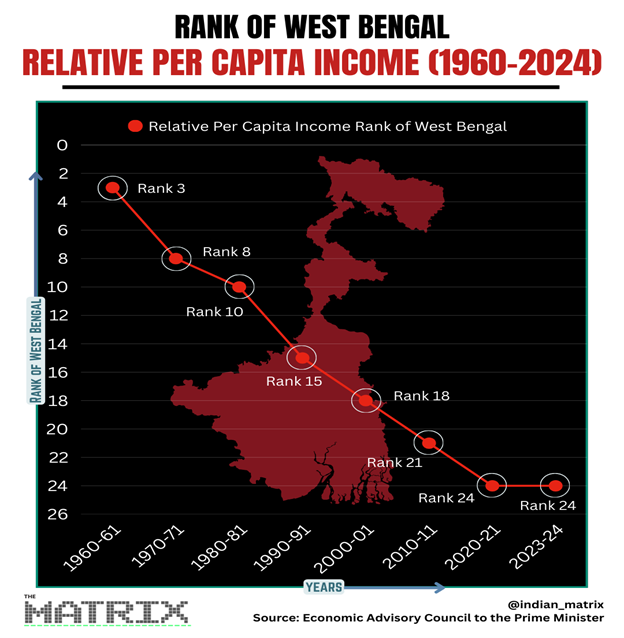
The case of three states in the eastern part of the country illustrates the outcome of good governance and growth focus, and cooperative mindset in Odisha (USD 2,679 per capita income), and Assam (USD 2,413 per capita Income) on the one hand and West Bengal (USD 2,398 per capita income on the other. As Figure 2 suggests, between FY 2020 and FY 2025, Assam’s GSDP grew at the highest rate (49 per cent) in the country. In sharp contrast, Figure 3 indicates that West Bengal’s rank in per capita income continuously fell from 3rd in 196-61 to 24th in 2023-24.
West Bengal, therefore, needs to change the leadership mid-set towards governance, cooperation with the Centre and other states, and overall economic management competence before it can improve its position and begin to positively contribute towards the Viksit Bharat goals.
Figure 3: Ranking of West Bengal State in Per Capita Income, 1960-61 to 2023-24
To conclude, as India progresses towards the goals of Viksit Bharat by 2047, not just the accelerated per capita GDP income growth among most states will be essential, but special focused efforts to narrow the gap in per capita income among the states will be necessary. The Central government’s policies are already consistent with the above, but the laggard states will have to play their part as well through much greater political accountability and by nurturing a positive attitude towards growth and wealth accumulation.
References
- https://swarajyamag.com/commentary/indias-quiet-revolution-loud-ambition- (Accessed on 10 March 2026)
- https://niti.gov.in/sites/default/files/2025-03/Macro-and-Fiscal-Landscape-of-the-State-of-Telangana.pdf (Accessed on 11 March 2026)
- https://niti.gov.in/sites/default/files/2026-03/Fiscal-Health-Index-2026.pdf (Accessed on 11 March 2026)
Disclaimer: The opinions expressed within this article are the personal opinions of the author. MyIndMakers is not responsible for the accuracy, completeness, suitability, or validity of any information on this article. All information is provided on an as-is basis. The information, facts or opinions appearing in the article do not reflect the views of MyindMakers and it does not assume any responsibility or liability for the same.


 Loading...please wait
Comments