



Amit Shah introduces Delimitation Bill in Lok Sabha amid intense protests by opposition
- In Reports
- 06:04 PM, Apr 16, 2026
- Myind Staff
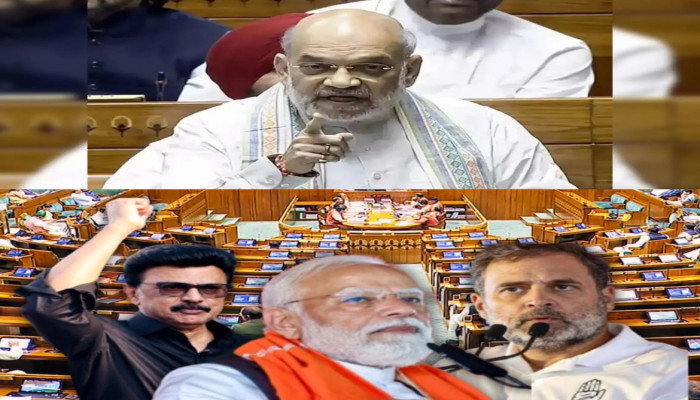
Union Home Minister Amit Shah on Thursday introduced the Delimitation Bill, 2026, in the Lok Sabha, setting off a sharp political confrontation both inside and outside Parliament. The move triggered strong opposition, especially from southern states, which accused the Centre of attempting to redraw India’s electoral boundaries in a way that could favour more populous northern regions.
The introduction of the Bill came amid intense protests, particularly in Chennai, where Tamil Nadu Chief Minister M. K. Stalin led a dramatic protest. Stalin publicly burned a copy of the proposed legislation and hoisted a black flag, calling for a statewide agitation. He described the Bill as a “black law” that would reduce the political voice of Tamil Nadu and undermine its representation in Parliament.
Inside the Lok Sabha, the situation turned tense as Congress MP K. C. Venugopal strongly opposed the Bill during its introduction. He termed it a “fundamental attack on the Indian federal structure,” which led to heated exchanges between the Opposition and the Treasury benches. Venugopal raised objections not only to the Delimitation Bill but also to the Constitution (One Hundred and Thirty-First Amendment) Bill, 2026, questioning the government’s intent, especially when Parliament had already passed the women’s reservation law.
Responding firmly, Shah said that at the stage of introduction, members could only raise technical objections and not debate the merits of the legislation. He assured that the government would give a “strong reply” during the discussion phase, pushing back against the Opposition’s criticism.
The legislative move is part of a broader package that includes three Bills: the Constitution (One Hundred and Thirty-First Amendment) Bill, 2026, the Delimitation Bill, 2026, and the Union Territories Laws (Amendment) Bill, 2026. Union Law Minister Arjun Ram Meghwal introduced the first two Bills, while Shah presented the third. In a rare procedural step, the government has also proposed suspending a provision under Rule 66 of the Lok Sabha rules to treat all three Bills as a single package. This means the latter two Bills depend on the passage of the constitutional amendment.
Meanwhile, protests continued to grow stronger in Tamil Nadu. Stalin, dressed in black, urged citizens to join the agitation by displaying black flags. He framed the protest as a larger fight to protect state rights and maintain the balance of federalism. He also drew parallels with past anti-Hindi agitations, signalling the seriousness of the resistance.
The unrest has been building for weeks but intensified after the Centre moved to operationalise provisions linked to the Nari Shakti Vandan Adhiniyam. This includes a proposed constitutional amendment that aims to delink the delimitation exercise from the next Census cycle. Opposition leaders have also raised concerns about the timing of the special Parliament session, which began on April 16 and will continue till April 18. They alleged that the government is rushing the process without proper consultation.
The strongest resistance has come from southern states, especially Tamil Nadu. Ministers and leaders from the DMK have echoed Stalin’s concerns, arguing that the proposed changes could reduce the state’s share of parliamentary representation despite its success in controlling population growth. Black flags were raised across several locations, including outside the residence of state minister Anbil Mahesh Poyyamozhi, showing a coordinated political mobilisation.
State leaders have warned that the Centre’s plan to increase Lok Sabha seats, possibly up to 850, could significantly shift political power towards northern states such as Uttar Pradesh and Bihar, where population growth has been higher. “We see this as an act of taking away state rights,” Poyyamozhi said, adding that federalism was being turned into a “conflict” rather than a consultative process.
Leaders from the South have also pointed out that while their states may see a slight increase in the number of seats, their overall share in the Lok Sabha could decline. This has raised concerns that states which successfully implemented population control measures might be politically disadvantaged, even though they contribute significantly to the country’s economy.
Delimitation refers to the process of redrawing the boundaries of parliamentary and assembly constituencies based on population changes to ensure equal representation. As per Articles 82 and 170 of the Constitution, this process is carried out by a Delimitation Commission after every Census.
However, this exercise has been frozen since 1976 through a constitutional amendment aimed at encouraging population control. The freeze was later extended until 2026. The upcoming delimitation exercise is expected to be the first major revision in decades and could significantly alter the balance of political power across states.
The core issue lies in the population-based formula used for delimitation. States with higher population growth are likely to gain more seats, while those with lower growth may see their relative influence decline. Southern states argue that this approach ignores their demographic achievements and goes against the principles of cooperative federalism.
The matter becomes even more complex because delimitation is linked to the implementation of women’s reservation and the restructuring of SC/ST reserved constituencies. This makes the issue not just administrative but deeply political, with long-term implications for representation and governance in India.



 Loading...please wait
Comments