




America’s Strategic Pause: Lessons from a Turbulent US-Israel, Iran War
- In Military & Strategic Affairs
- 08:27 PM, Apr 08, 2026
- Dr. Siddhartha Dave
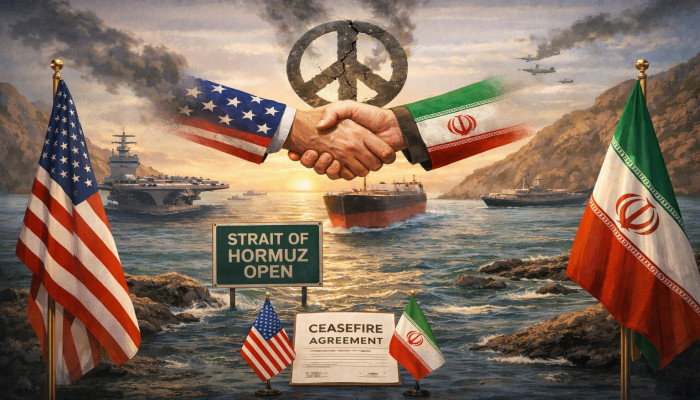
In the complex theatre of contemporary geopolitics, wars are no longer decided solely on battlefields. They are shaped equally by narratives, negotiations, and the ability of nations to manage escalation without losing strategic credibility. The recent developments surrounding the United States, Iran, and the broader West Asian conflict present a compelling case study of this evolving reality.
At first glance, the announcement of a temporary ceasefire and the suspension of strikes by the United States may appear as a routine tactical decision. However, a deeper examination suggests that this moment reflects something more profound—a recalibration of American strategy under pressure, and a shift in the balance of perception in the region.
Reports indicate that U.S. President Donald Trump acknowledged halting military actions following diplomatic engagements that involved multiple actors, including Pakistan. While such mediation claims must always be scrutinised carefully, the very fact that Washington chose to step back from an escalatory path points to a critical reality: the United States, despite its military superiority, is no longer operating in an uncontested strategic environment.
For decades, American interventions were characterised by overwhelming force followed by unilateral outcomes. From Iraq to Libya, the template was clear—military dominance translated into political leverage. However, West Asia today is a far more fragmented and contested space. Regional actors have acquired greater resilience, and global powers are increasingly constrained by economic costs, domestic political pressures, and the risk of wider escalation.
In this context, the current pause in hostilities must be understood not merely as a ceasefire, but as a strategic pause.
Iran, for its part, has sought to project the situation as a victory—arguing that it compelled the United States to accept negotiations and consider its framework of proposals. Whether these claims hold substantive truth is secondary to the larger point: in modern conflicts, perception often carries as much weight as reality. By surviving the initial wave of pressure and entering a negotiation phase, Tehran has positioned itself as a resilient actor rather than a defeated one.
This is not to suggest that Iran has achieved a decisive victory. The internal dynamics within Iran, the pressures on its economy, and the continuing vulnerabilities of its regional network remain significant. Yet, in the realm of narrative warfare, it has avoided the image of capitulation—an outcome that holds immense value in West Asian political culture.
Within the United States itself, voices have begun to question the strategic returns of such engagements. Concerns over financial costs, military casualties, and the absence of a clear end-state have resurfaced. This internal debate is crucial, as it reflects a broader fatigue with prolonged external interventions—something that has shaped American policy decisions in recent years.
The situation also highlights the limitations of coercive diplomacy when not backed by a sustainable long-term strategy. Military action, without a clearly defined political objective, risks devolving into cycles of escalation and de-escalation without meaningful resolution. The two-week ceasefire, therefore, appears less like a resolution and more like a window—an opportunity for all sides to reassess their positions.
Perhaps the most significant takeaway from this episode is the changing nature of power itself. The United States retains unmatched military capabilities, yet its ability to translate that power into uncontested outcomes has diminished. Conversely, regional actors like Iran may lack comparable conventional strength, but they compensate through asymmetric strategies, narrative building, and strategic patience.
This evolving dynamic underscores a larger transition in global politics—from unipolar dominance to a more contested and fluid order.
For Bharat, these developments carry important lessons. India’s consistent emphasis on dialogue, restraint, and strategic autonomy appears increasingly relevant in a world marked by overlapping crises. The principle articulated by Prime Minister Narendra Modi—that “this is not the time for war”—resonates strongly in such contexts. It reflects not only a moral position but also a pragmatic understanding of the interconnected nature of today’s global challenges.
Energy security, trade routes, and diaspora safety are all directly influenced by stability in West Asia. Any prolonged conflict in the region has immediate implications for Bharat’s economic and strategic interests. Therefore, a balanced approach—engaging all sides while avoiding entanglement—remains the most prudent course.
In conclusion, the current situation in West Asia should not be viewed through the simplistic lens of victory or defeat. It is, instead, a reminder that modern geopolitics operates in shades of grey. The United States has not suffered a conventional defeat, but neither has it achieved decisive dominance. Iran has not secured an outright victory, but it has avoided strategic collapse.
What we are witnessing is not the end of a conflict, but the evolution of a new phase—where power is negotiated, narratives are contested, and outcomes remain uncertain.
In such a world, the ability to balance strength with restraint, and ambition with prudence, will define the true winners.
Disclaimer: The opinions expressed within this article are the personal opinions of the author. MyIndMakers is not responsible for the accuracy, completeness, suitability, or validity of any information on this article. All information is provided on an as-is basis. The information, facts or opinions appearing in the article do not reflect the views of MyindMakers and it does not assume any responsibility or liability for the same.



 Loading...please wait
Comments