




American Midterm Elections Results: A Political and Seminal Geopolitical Analysis
- In Politics
- 10:35 PM, Nov 05, 2026
- Viren S Doshi
Political Analysis of the Midterm Results
Now that the dust is settling about the American Midterm Elections, here are some noteworthy and remarkable points.
In the US, the votes are counted, reported and certified by local, county-level and state-level officials and authorities; at times including elected persons of parties, as there is no national federal single uniform authority and system to do so.
In many places, particularly Leftist Socialist Globalist Woke Jihadi Democratic Party-ruled states, they do not ask for voter identity cards mandatorily.
Mail-in ballots are also cast, and there are possibilities of vote stealing in this system.
Then delimitation, which is known as redistricting, is also frequent, leading to gerrymandering by the leftist-ruled states wherein they do delimitation to increase their winnability.
Then there is the vicious, relentless and often paid war of fake narratives by the leftists, wokes and Jihadis of the Democratic Party and their global masters. They also use bot accounts and media houses for this "toxic chemical mind-polluting" war.
Add voter mobilisation. As in many other democracies, leftist voters vote en bloc and vote more compared to conservative or nationalist voters who are often more likely not to vote or are likely to cross-vote if the candidates or leaders are to their liking or they get misguided due to fake narratives.
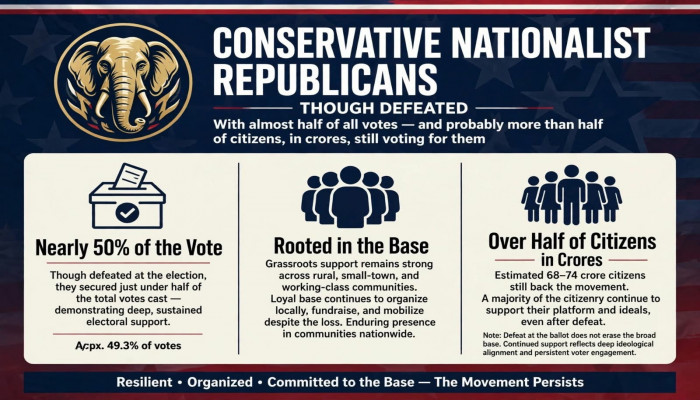
Given all this, in the midterms, it is estimated that almost 49% of voting had happened for various races, around 12 crore votes were cast out of an eligible 25 crore votes approximately.
In any of the cases and races, though seat loss is more, the Republicans have got around 45% votes on average or more.
Crores of Americans, and generally they are expected to be real citizens and rightful voters, have voted for the nationalist conservative Republican Party even amid this debacle in seat counts.
A swing of 5% vote from Republicans to Democrats generates a difference of 10%, and that is the difference.
I think the war on the jihadi regime in Iran is not the real reason, but the war of fake narratives and fake votes is the real reason for the defeat of the Republicans.
There is no SIR (Special Intensive Revision) of voter rolls, neither there is empowered national election commission leading to loopholes making the American democracy more vulnerable.
Unfortunately, when there was majority in the House and Senate in last two years, the Republican legislators, particularly senators, didn't realise the importance of passing SAVE (Safeguard American Voter Eligibility) Act, often shortened to SAVE America Act, for electoral reforms and electoral roll sanctity.
They couldn't pass it, as some of them did not want to cooperate with President Donald Trump. Several Senate Republicans (notably Susan Collins of Maine, Lisa Murkowski of Alaska, Mitch McConnell of Kentucky, and Thom Tillis of North Carolina) joined Democrats in blocking key procedural votes or amendments. Now all of them will have to sit in the opposition.
Overall, at this juncture, with crores voting for the party, it would be nothing more than a political narrative to write off the nationalist conservative Republicans from American politics. The day the nationalists get written off would be a black day for the American Dream and American Vision and American Democracy.
American Democracy is vulnerable to irregularities, just like, though in different ways, Israeli democracy is as seen in recent elections there.
Geopolitical Seminal Analysis
Suicidal Democracies and the Paradox of Tolerance
In the current geopolitical landscape, a transnational Communist Leftist Socialist Globalist Woke Jihadi Axis operates with ruthless asymmetry. In open democracies, it advances through street violence, narrative control, electoral mathematics skewed by demographics and media, and institutional capture. In return, democracies face severe constraints: they cannot interfere in the internal affairs of Communist or Jihadi dictatorial powers except in limited cases such as the war on the Ayatollah regime in Iran and still the regime is so ruthless and repressive that it could not be removed.
There is a profound lack of a level playing field. Democracies struggle against undemocratic forces that feel no reciprocal obligation to openness, elections, or tolerance.
Even major military efforts have underscored this imbalance. Despite war and intensive campaigns, the United States could not achieve regime change in the Jihadi Ayatollah regime and the Islamic Revolutionary Guard Corps (IRGC)-captured Iran. The Jihadi system and its security apparatus proved deeply embedded across institutions, society, and power structures, surviving external pressure in forms that preserved core authoritarian control rather than yielding to democratic transformation. Of course, it gets external overt and covert support from the Global Communist Leftist Socialist Globalist Woke Jihadi Axis led by Chinese Communist Party and North Korean Communist Regime. This stands in stark contrast to the ease with which the Axis exploits democratic openness from within in even apparently strong democracies, oldest democracies and largest democracies like those of Brazil, Israel, the US and India along with many European, Latin American and other democracies.
The Outcome
Israel, Brazil, and the United States risk following the trajectory of France and the United Kingdom. India is not immune. Too much unguarded democracy can kill democracy. This is the classic problem known as the paradox of tolerance.
The paradox of tolerance, articulated by philosopher Karl Popper, holds that if a free society extends unlimited tolerance to the intolerant, the intolerant will eventually seize or destroy that society’s capacity for tolerance. Unlimited openness becomes a suicide pact when the other side exploits democratic rules without ever intending to abide by them once in power. Communist, Leftist, Socialist, Globalist, Woke, and Jihadi actors show no shame or remorse in practising dictatorship when it suits them. Multilateral institutions have often been subdued or neutralised by the same axis.
Years ago, Columnist Thomas L. Friedman wrote on related dangers to democratic systems. Drawing from his experience covering Lebanon’s civil war, he observed roughly that democracies perish when everything becomes politics, when a critical mass of actors put party or faction before country, when extremists go all the way while moderates simply go away, and when the pillars of truth and trust erode—warning that the system can and will break under such conditions. His analysis of polarisation, rule-bending, and the vulnerability of open societies to internal fracture remains resonant amid today’s vicious external transnational pressures relentlessly working on the internal fault lines.
Democracy and Wars
Consider the contrasting records on elections during wartime. Ukrainian President Volodymyr Zelenskyy, frequently associated with progressive and left-leaning international networks, postponed elections citing the ongoing war with Russia and martial law. The democratic processes were suspended for years with relatively muted criticism from the global left. By contrast, Israeli Prime Minister Benjamin Netanyahu and American President Donald Trump went into elections amid conflict—Netanyahu facing the aftermath of the October 7 Hamas attack and subsequent multi-front wars, Trump operating in a highly infected domestic environment. They faced intense opposition; the same networks that excused delayed elections elsewhere readily labelled them authoritarians and kings.
The irony is stark: the “rightist, nationalist, patriotic” leaders who submitted to the ballot amid crisis are painted as dictatorial, while those who suspend democracy endlessly are often given a pass.
This is the paradox of democracy in action—suicidal openness, vulnerable open societies.
Ukraine War went on for years; nobody blamed leftist Democrats for the ensuing hardships, but the war on Ayatollah is being readily blamed on the nationalist Republicans. It is not the actual war. It is the narrative war that impinges on democracy. Even after decimating the enemy and winning the actual war, the narrative war has been lost by the nationalists, leading to losses in elections.
Systemic Vulnerabilities
Electoral systems themselves reveal structural vulnerabilities. The United States federal election apparatus lacks the centralised powers entrusted to the Election Commission of India. Delimitation of constituencies in the United States is largely handled by state legislatures as stated in the beginning. Blue states controlled by left-leaning forces have used this authority assertively to entrench advantages.
In India too, the ruling coalition and Parliament have struggled to advance comprehensive delimitation reform.
Democracy without robust guardrails for electoral sanctity—independent oversight, fair boundary drawing, resistance to demographic engineering and narrative dominance—is inherently fragile. Beware, India.
Complexity at its Climax
Some post-election analyses on the American right have gone further, arguing that leftist Democratic victories sometimes benefited from the left’s willingness to absorb or ignore extreme elements while the right fractured under internal purity tests involving figures associated with the “far left,” certain online subcultures, or controversial commentators. So-called white racist and most probably a leftist mole, Nick Fuentes, did a complete about-face leading into the 2026 U.S. midterm elections after adequate racist narrative shooting, actively urging his followers to sit out or "vote Democrat". This sudden shift—or "somersault"—came after the far-right white nationalist streamer fiercely broke away and revealed his real colours.
Whether fully accurate or not, the observation underscores a tactical asymmetry: one side consolidates power; the other is encouraged to implode, through such “moles”.
Way Ahead
Yet Israel and India, despite their vulnerabilities as open societies, are not standing still. These are relatively more coherent despite fault lines. Their conservative, nationalist leaders are actively planning to move forward with partners such as the United Arab Emirates and broader Abraham Accords frameworks—with or despite a potentially leftist, woke, or Jihadi-influenced United States, which is far too open though far more mighty. Survival and the capacity to fight require pragmatic coalitions grounded in shared interests against common threats.
Prime Minister Benjamin Netanyahu has been explicit on this point during campaigns and public addresses. He has repeatedly highlighted the strategic depth of ties with democracies like India. In the Knesset and elsewhere he has spoken of building an “iron alliance” of nations that believe in moderation, progress, human dignity, and mutual respect against the threat of extremist Islam and the jihadist communist axis of evil. He has described India as a huge power of 1.4 billion people offering “tremendous support,” called Prime Minister Narendra Modi a personal friend and “brother,” and noted the overwhelming backing Israel receives in India even as it faces delegitimization campaigns elsewhere. He has invested heavily in the relationship, elevated it to a special strategic partnership covering defense, technology, artificial intelligence, critical minerals, and more, and linked it to the India-Middle East-Europe Economic Corridor. Netanyahu has also underscored the resilience of Abraham Accords ties with the United Arab Emirates, noting that a million Israelis have visited the UAE, that cooperation continued through wars, and that security and economic partnerships with Emirati leadership remain vital.
These moves reflect clear-eyed realism. CCP occupied China, Iran occupying Jihadi regime (still dominated by the Ayatollah system and IRGC influence despite external military pressure), and various Jihadi networks do not play by democratic rules. They suppress dissent, export influence operations, and exploit open societies’ freedoms. Israel and India, as democracies under pressure from both external adversaries and internal ideological capture risks, cannot wait for perfect Western alignment. Deepening defense, technology, energy, and diplomatic ties with the United Arab Emirates and like-minded partners creates alternative centres of gravity. It multiplies capabilities against the axis while reducing over-dependence on any single capital that may itself be contested by woke or globalist currents. US, in light of this, ought to put guardrails in the next two years of Conservative Rule under President Donald Trump.
Let us hope democracies learn from each other and strengthen each other, and stand united.
Conclusion
The path forward demands more than alliances. It requires democracies to recover the paradox of tolerance’s practical implication: a society that wishes to remain free and tolerant must retain the right—and the will—to refuse tolerance to those who would destroy it. This means protecting electoral integrity with strong independent institutions, resisting demographic and narrative engineering, enforcing borders and citizenship norms, and treating ideological capture of media, academia, and bureaucracy as the strategic threat it is. It means distinguishing between legitimate political opposition and coordinated efforts to hollow out the democratic order from within.
India’s Election Commission model offers a stronger central guardrail than the fragmented American system; strengthening rather than weakening such institutions is essential. Israel’s experience under relentless multi-front pressure shows both the costs of openness and the necessity of decisive self-defense. Both nations demonstrate that conservative leadership can pursue national interest, forge non-Western partnerships, and reject the false choice between isolation and submission to a transnational axis that despises their existence as sovereign democratic civilizations.
The free world faces a lurking existential threat precisely because multilaterals and parts of the Western establishment have been subdued or neutralized.
Armchair strategists, executives, and policymakers must confront the asymmetry honestly—including the hard lesson that even sustained war failed to dislodge the Ayatollah-IRGC structure in Iran.
Unlimited tolerance is not virtue when the other side views it as weakness to be exploited. Israel and India are already acting on that recognition by building resilient partnerships with the United Arab Emirates and each other. The alternative is to watch open societies gradually become unrecognizable—or cease to be open at all.
The time for clear-eyed action is now.
Disclaimer: The opinions expressed within this article are the personal opinions of the author. MyIndMakers is not responsible for the accuracy, completeness, suitability, or validity of any information on this article. All information is provided on an as-is basis. The information, facts or opinions appearing in the article do not reflect the views of MyindMakers and it does not assume any responsibility or liability for the same.


 Loading...please wait
Comments