




Am I Healthy? An Ancient Yogic Checklist for a Timeless Question
- In Health & Wellbeing
- 12:14 PM, Jun 19, 2026
- Swami Pranaka
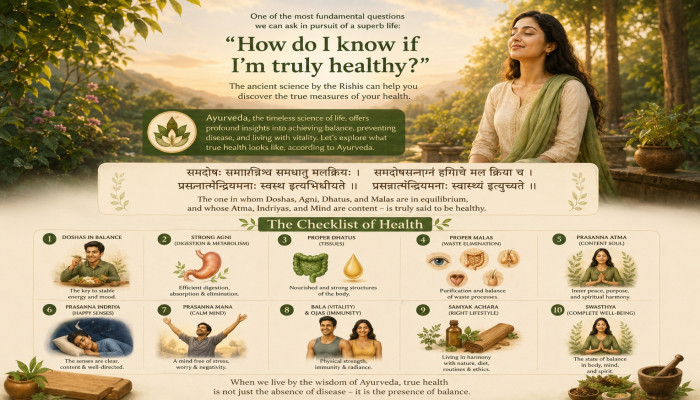
One of the most basic questions we carry, quietly and persistently, is this: “How do I know if I am truly healthy?”
Today, we check our weight, track our steps, monitor our sleep, count calories, test blood markers, and measure many functions of the body. All of this is useful. Yet, for many people, something deeper remains unanswered.
Thousands of years ago, Kashyapa Maharishi offered a simple and profound way to look at health. Not through complicated instruments, but through a Sutra, a compact statement that holds many layers of meaning.
This wisdom comes from the Kashyapa Samhita, one of the important classical texts of Ayurveda. Kashyapa is revered in the yogic and Ayurvedic traditions for his deep understanding of life, health, and human constitution.
This particular Sutra gives us a practical way to observe health through appetite, digestion, elimination, lightness, clarity of the senses, sleep, strength, and the state of the mind.
The Sutra
अन्नाभिलाषो भुक्तस्य परिपाको सुखेन च।
सृष्टविण्मूत्रवातत्वं शरीरस्य च लाघवम्।
सुप्रसन्नेन्द्रियत्वं च सुखस्वप्नप्रबोधनम्।
बलवर्णायुषोलाभः सौमनस्यं समाऽग्निता।
विद्यादारोग्य लिङ्गानि विपरितैर्विपर्ययम् ॥
In simple terms, the verse says that health can be recognised through natural hunger, easy digestion, proper elimination, lightness in the body, clear senses, restful sleep, fresh waking, good strength, a pleasant mind, and balanced digestion. When these signs are absent, the body is asking for attention.
A Simple Health Checklist
Rate each point honestly.
4: Always | 3: Often | 2: Sometimes | 1: Rarely | 0: Never
1. Hunger Arises Naturally
I feel the desire to eat only after my previous meal has been digested. I eat when I am truly hungry.
This is Annābhilāṣa, the natural arising of appetite. In Ayurveda, true hunger shows that Agni, the digestive fire, is functioning well.
Your score: ____
2. Lightness After Meals
I feel light and comfortable after eating.
Not heavy, bloated, sleepy, or dull. This is Sukhena Paripāka, comfortable digestion.
Your score: ____
3. Natural Elimination
I empty my bladder and bowel easily after waking, without strain or external support.
This is Sr̥ṣṭaviṇmūtravātatva, the free and natural movement of waste and wind. A healthy body eliminates what it does not need with ease.
Your score: ____
4. Bright and Clear Senses
This is Suprasannēndriyatva, clarity and brightness of the senses. Observe each sense carefully.
4.1 Skin: Clear complexion, without frequent acne, rashes, or unusual dullness.
Your score: ____
4.2 Vision: Clear and steady sight.
Your score: ____
4.3 Hearing: No difficulty hearing, ringing, or constant internal noise.
Your score: ____
4.4 Taste: Clean tongue and a good sense of flavour.
Your score: ____
4.5 Smell: A clear and discerning sense of smell.
Your score: ____
5. Deep Sleep
I get deep, restful sleep at night.
This is Sukhasvapna, pleasant and settled sleep. It is not only about the number of hours slept, but about the depth of rest.
Your score: ____
6. Fresh Awakening
I wake up feeling fresh and ready for the day.
This is Prabōdhana, the quality of waking. A healthy person rises with clarity and quiet readiness, not with heaviness and resistance.
Your score: ____
7. Strength Appropriate to Your Age
My physical strength feels appropriate for my age and stage of life.
This is Bala, strength. It does not mean extreme fitness. It means having the natural vitality needed for your age.
Your score: ____
8. Calm Mind and Natural Enthusiasm
I experience calmness of mind and a natural enthusiasm for life.
This is Saumanasya, a pleasant and balanced state of mind. It is not forced positivity. It is a steady, warm engagement with life.
Your score: ____
Your Score
Add your scores from all the points above. Maximum score: 48
44 to 48: Excellent. Maintain your yogic wellness and inspire others.
36 to 43: Very good health. Continue refining your lifestyle and inner balance.
25 to 35: Your body and mind need more care. Begin paying attention now.
18 to 24: Your health needs serious attention. Return to the basics: food, sleep, movement, and balance.
Below 18: Make health your first priority. Start with simple, steady changes and seek appropriate guidance.
Kashyapa Meets Modern Medicine
What is striking is how closely this ancient checklist resembles what a modern whole-person health assessment would examine today.
Natural hunger after digestion points to gut motility, digestive readiness, and metabolic balance. Lightness after meals reflects enzyme function, food tolerance, and the absence of significant bloating or inflammation. Natural elimination relates to bowel regularity, hydration, gut health, and autonomic nervous system balance.
Clear senses may reflect neurological health, circulation, inflammation, and vitality. Deep sleep connects with sleep quality, stress regulation, hormonal rhythm, and nervous system recovery. Fresh awakening points to circadian rhythm, sleep depth, energy regulation, and morning cortisol patterns.
Age-appropriate strength reflects muscle mass, mitochondrial health, physical activity, and resilience. Calmness and enthusiasm relate to stress response, emotional regulation, mental health, and vagal tone.
In modern language, Kashyapa was describing health not merely as the absence of disease, but as the smooth functioning of the whole system.
What Is Functional Medicine?
Functional medicine asks not only, “What is wrong?” but also, “Why is this happening?”
Rather than looking at symptoms in isolation, it studies the whole person: digestion, sleep, energy, stress, food, environment, movement, and lifestyle. Its aim is to understand patterns of imbalance early, before they become disease.
This is where the Kashyapa Samhita feels surprisingly relevant. Gut function, elimination, sleep quality, strength, sensory clarity, and mental steadiness are not abstract ideas. They are daily signs of how well the body and mind are working together.
A Final Word
The genius of this Sutra is its simplicity.
It does not first ask for a blood test, scan, app, or device. It asks something more immediate: How are you functioning as a living being?
Are you hungry at the right time? Do you digest with ease? Do you eliminate naturally? Are your senses clear? Do you sleep deeply? Do you wake fresh? Do you have strength? Is your mind steady and pleasant?
When these signs are present, the body, breath, and mind are moving in harmony. When they are absent, the body is not punishing us. It is speaking to us.
The final word of the verse is Viparitairviparyayam. When the opposite signs appear, they indicate ill health.
The body speaks quietly at first. The question is whether we are listening.
Based on the Ārogya Liṅgāni verse from the Kashyapa Samhita. This checklist is meant for self-reflection and lifestyle awareness, not as a substitute for medical diagnosis or treatment.
Disclaimer: The opinions expressed within this article are the personal opinions of the author. MyIndMakers is not responsible for the accuracy, completeness, suitability, or validity of any information on this article. All information is provided on an as-is basis. The information, facts or opinions appearing in the article do not reflect the views of MyindMakers and it does not assume any responsibility or liability for the same.


 Loading...please wait
Comments