




Allahabad High Court says public land cannot be claimed for namaz as a right
- In Reports
- 01:24 PM, May 02, 2026
- Myind Staff
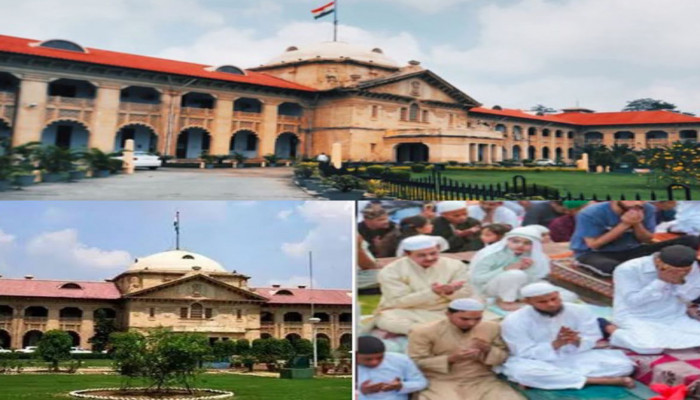
The Allahabad High Court has ruled that offering namaz on public land cannot be claimed as a fundamental right. The court made it clear that the right to religious freedom is not absolute and is subject to public order as well as the rights of others. The judgment came while dismissing a plea that sought permission to offer prayers on a piece of land in a village in Uttar Pradesh’s Sambhal district.
The case was heard by a division bench of Justices Garima Prasad and Saral Srivastava. The plea was filed by an individual named Aseen, who claimed ownership of the land in Ikona village. He approached the court seeking protection from authorities, alleging that he was being stopped from offering namaz on what he described as his private property.
According to the petitioner, he had received the land through a registered gift deed dated June 16, 2023. He argued that since the land belonged to him, he had the right to offer prayers there without requiring prior permission. He further claimed that preventing him from doing so amounted to a violation of his constitutional right to practice religion freely.
However, the Uttar Pradesh government opposed the plea and questioned the petitioner’s claim of ownership. The state argued that the land in question was recorded in official revenue records as “Abadi land,” which is meant for public use. It also pointed out that the gift deed presented by the petitioner did not contain clear land identifiers and relied only on general boundary descriptions. Because of this, the government maintained that the petitioner had failed to establish legal ownership of the land.
The state also informed the court that namaz had traditionally been offered at the site only during Eid. It clarified that there had been no restrictions on such customary practices. At the same time, the government alleged that the petitioner was now attempting to start regular congregational prayers at the site by inviting people from both within and outside the village. It argued that such gatherings could disturb the local social balance and create issues related to public order.
While examining the matter, the High Court emphasised that the Constitution guarantees religious freedom but clearly places it within certain limits. It noted that this freedom is subject to public order, morality, and health. The bench stated that public land is meant for common use and cannot be taken over for recurring religious activities, especially if such use affects movement, access, or civic order.
The court also made an important distinction between private and public religious practices. It observed that personal prayer carried out within a home or in a limited private setting remains protected under the Constitution. However, when such practices turn into organised gatherings involving larger groups, they take on a public nature. In such cases, the state has the authority to regulate them to ensure that public order is maintained.
Another key point highlighted by the court was the role of authorities in preventing possible disturbances. The bench stated that officials do not have to wait for an actual disruption to occur. They are empowered to take preventive action if there is a likelihood that an activity could affect public order or communal harmony. This observation underlined the importance of maintaining peace and balance in shared public spaces.
In its final decision, the court noted that the petitioner had failed to prove ownership of the land. Since the land continued to be classified as public land in official records, the plea could not be sustained. Based on these findings, the High Court dismissed the petition.
The ruling sends a clear message about the limits of religious freedom when it comes to the use of public spaces. It reinforces that while individuals are free to practice their religion, such practices must not interfere with public order or the rights of others. The judgment also highlights the responsibility of authorities to act in advance to prevent potential conflicts, ensuring that public spaces remain accessible and peaceful for everyone.



 Loading...please wait
Comments