




Allahabad High Court rules Muslim personal law can’t override child marriage law, POCSO
- In Reports
- 06:43 PM, Jul 08, 2026
- Myind Staff
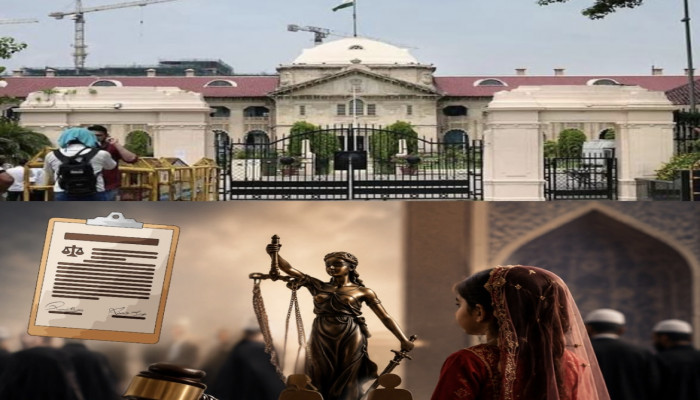
The Allahabad High Court has ruled that no personal law, including Muslim personal law, can override the provisions of the Prohibition of Child Marriage Act, 2006 (PCMA), or the Protection of Children from Sexual Offences Act, 2012 (POCSO Act). The Court made this observation while refusing to quash a First Information Report (FIR) filed against 19 people accused of stopping police and Child Line officials from preventing the marriage of a 16-year-old Muslim girl in Uttar Pradesh.
A Bench of Justices JJ Munir and Achal Sachdev delivered the judgment on July 1 in the case of Rubi vs State of UP. The Court examined the argument that Muslim personal law allows a girl to marry after attaining puberty, which is generally considered to be around 15 years of age. However, the Bench held that this view cannot prevail over the laws passed by Parliament that prohibit child marriage and protect minors from sexual offences.
The Court said, "The Shariat Law providing for puberty as the competent age under the law permissible for a girl to marry or be married, runs clearly in the teeth of the PCMA as well as the POCSO Act."
The Bench noted that different High Courts have expressed conflicting views on this issue. However, it agreed with a 2024 judgment of the Kerala High Court, which held that the Prohibition of Child Marriage Act (PCMA) applies equally to every citizen, regardless of religion. The Court also pointed out that the matter had reached the Supreme Court earlier. However, the apex court did not give a final and authoritative ruling on the issue. It further observed that the Supreme Court had, in 2024, acknowledged the uncertainty over whether personal laws could override the Prohibition of Child Marriage Act.
The High Court also referred to the proposed Prohibition of Child Marriage (Amendment) Bill, 2021. The Bill sought to give the PCMA an overriding effect over all personal laws. The Court observed that the Bill appears to have lapsed after the dissolution of the 17th Lok Sabha.
The case arose from a petition seeking to quash an FIR registered at Kakor police station in Bulandshahr on February 15, 2026. According to the prosecution, the police and Child Line officials received information about the planned marriage of a minor girl. They reached her house to stop the marriage and to produce the girl before the Child Welfare Committee. During the operation, the petitioners and several others allegedly abused and threatened the officials. They also allegedly used force to take the girl away from the custody of a Child Line team member.
The petitioners argued that Muslim personal law recognises the marriage of a girl after she attains puberty. They claimed that the Prohibition of Child Marriage Act does not affect their personal law governing marriage.
The High Court rejected this argument. It held that the minimum legal age of marriage under the Prohibition of Child Marriage Act applies to every citizen, irrespective of religion. The Bench further observed that allowing the marriage of a person below the age of 18 would likely lead to a violation of the POCSO Act, as sexual relations are generally inseparable from marriage.
The Court said, "The PCMA and the POCSO Act are statutes that are based on public health and national policy in this regard. They have a scientific understanding to them, legislatively translated into prohibitory statutes and there can be no escape from it for anyone."
The Bench also ruled that the Prohibition of Child Marriage Act and the POCSO Act would prevail over earlier exceptions available under personal laws while deciding the legal age of marriage. It held that Parliament enacted these laws for all citizens and they carry greater legal authority in such matters.
The Court observed, "A later statute, which is all-encompassing, that is, for all citizens, would prevail over the exception made in the Majority Act, 1875. It may also be noted that the marriage performed in violation of the PCMA may be voidable and not void, but the act of performing such a marriage by different parties is punishable by law."
While examining the facts of the case, the Bench found that the police and Child Line officials had acted according to their legal duties. They had reached the spot to prevent the marriage of a minor and to stop a possible violation of the law.
"The Police as well as the Child Line Team were conscious of their duties under the PCMA and also acting to prevent a possible violation of the POCSO Act," the Court observed.
The High Court further held that the allegations made against the petitioners showed a prima facie case of obstructing public servants while they were performing their official duties. It said that the allegations required a proper investigation. The Court therefore refused to interfere at the initial stage and declined to quash the FIR.
Advocate Pooja appeared for the petitioners in the matter. Additional Government Advocate-I Ghanshyam Kumar and Additional Government Advocate Shashi Shekhar Tiwari represented the State.



 Loading...please wait
Comments