




Afghan Taliban to send dossiers to global powers on Pakistan over terrorism, human rights violations
- In Reports
- 06:59 PM, Dec 13, 2025
- Myind Staff
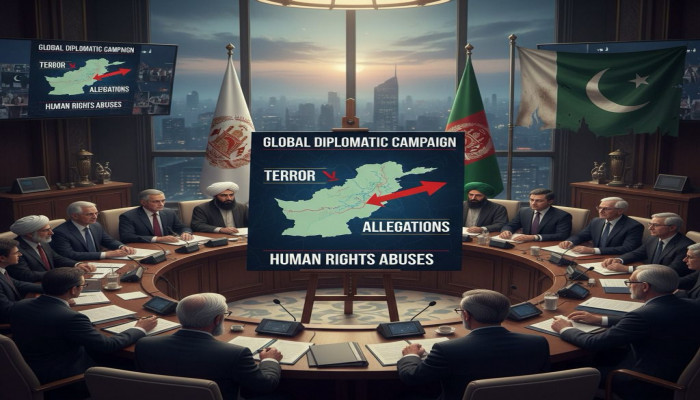
The Afghan Taliban administration is preparing to launch a wide-ranging diplomatic campaign against Pakistan by submitting a detailed dossier to major global and regional powers, accusing Islamabad of supporting terrorism, exerting economic pressure on Afghanistan, and committing serious human rights violations against Afghan citizens and refugees. Senior sources in Kabul confirmed that the move marks a significant escalation in tensions between the two neighbouring countries.
According to officials familiar with the matter, the dossier has been jointly prepared by Afghanistan’s foreign ministry and interior ministry. It is currently awaiting final approval from Taliban supreme leader Mullah Hibatullah Akhundzada. Once cleared, the document is expected to be formally shared with international organisations and key global capitals.
The dossier alleges that Pakistan has turned into what it describes as a “facilitation centre for terrorists.” Afghan authorities claim Islamabad is nurturing and supporting elements of the Islamic State (ISIS), particularly in Pakistan’s Balochistan province, and using them to destabilise neighbouring countries, including Afghanistan, India and Iran. Kabul has asserted that it possesses “solid evidence” to support these claims.
According to the document, Pakistan’s intelligence agencies, the Inter-Services Intelligence (ISI) and Military Intelligence (MI), are accused of providing financial assistance, logistical backing and operational support to ISIS and other militant groups. These groups, the dossier claims, are responsible for a sharp rise in militancy and insecurity across the region in recent months.
Despite the serious nature of the allegations, the Taliban-led government has stated that it remains open to cooperation with Pakistan on security-related mechanisms and broader bilateral engagement. However, it has strongly criticised Pakistan’s current demands and conditions, describing them as “illegal, illegitimate and unfeasible,” according to Afghan officials.
Beyond security concerns, the dossier places significant emphasis on Pakistan’s treatment of Afghan citizens and refugees. Kabul has accused Islamabad of engaging in what it calls “inhumane” behaviour, including the arbitrary closure of border crossings and the suspension of Afghan transit trade for nearly two months without clear justification. Afghan authorities argue that these measures have severely harmed the country’s already fragile economy.
The document further alleges that Pakistan has consistently blocked Afghanistan’s transit trade with India, despite Afghanistan being a landlocked nation with internationally recognised transit rights. Citing the 1965 Convention on Transit Trade of Land-Locked Countries, the Taliban government maintains that Afghanistan is entitled to free and unrestricted transit through neighbouring countries such as Pakistan and Iran. Kabul claims Pakistan’s actions amount to an undeclared economic embargo.
The dossier also accuses Pakistan of cancelling medical and student visas for Afghan nationals, subjecting refugees and Pakhtuns to harassment, torture and humiliation, and carrying out mass deportations without prior notice. These actions, Afghan officials say, have taken place at a particularly vulnerable time, as Afghanistan continues to face a severe humanitarian crisis while recovering from two recent earthquakes that caused widespread damage to infrastructure and displaced thousands.
According to the document, Pakistan’s deportation of Afghan refugees violates several United Nations conventions and humanitarian agreements, especially given Afghanistan’s ongoing rehabilitation phase. The Taliban administration has urged the international community to intervene and pressure Pakistan to comply with international law, humanitarian obligations and democratic norms. Once approved, Afghan officials say the dossier will be submitted to the United Nations and its affiliated bodies, as well as to the United States, the United Kingdom, the European Union, Russia, China, Iran, India, Qatar, Turkey, Saudi Arabia, the United Arab Emirates, Arab nations, Central Asian republics and other Muslim-majority countries.
While the dossier contains strong accusations, Afghan officials emphasise that Kabul’s objective is to draw international attention to what it views as sustained pressure and interference by Pakistan. The Taliban government hopes that global engagement will lead to diplomatic pressure on Islamabad to change its policies and restore stable bilateral relations.
So far, Pakistan has not officially responded to the reported contents of the dossier. The development, however, signals a deepening rift between Kabul and Islamabad and highlights growing regional tensions over security, trade, refugee treatment and cross-border relations in South and Central Asia.



 Loading...please wait
Comments