



Adani-Hindenburg report: SC panel finds ‘no coherent pattern of abusive trading’
- In Reports
- 12:32 PM, May 20, 2023
- Myind Staff
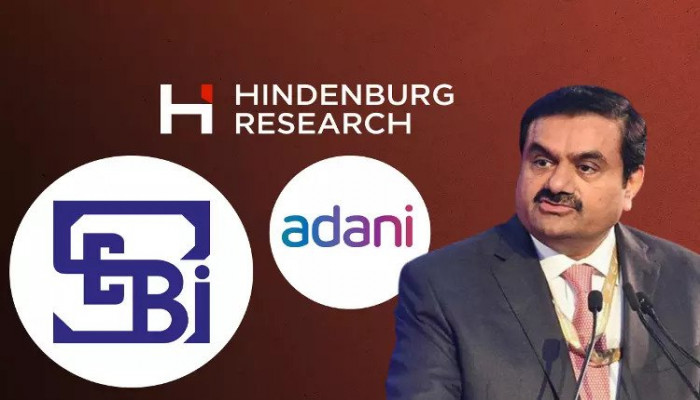
An expert committee appointed by the Supreme Court to investigate Hindenburg Research’s claims against the Adani Group said that there was no evidence of a “regulatory failure” on the part of the markets regulator Securities and Exchange Board of India (SEBI).
The committee headed by retired judge A.M. Sapre was constituted to provide an overall assessment of the situation as well as suggest measures to strengthen investor awareness, the statutory architecture, and secure compliance with the existing framework.
The market regulator, SEBI, has drawn a blank in its probe regarding the group’s entities' ownership, the court committee said in the report.
The report said that the committee could not find any pattern of artificial trading among the same parties multiple times.
"In one of the patches where the price rose, the foreign portfolio investors (FPIs) under investigation were net sellers. One investing entity that had purchased across the patches had purchased far more of other securities. In a nutshell, there was no coherent pattern of abusive trading that has come to light," it said.
The committee said SEBI has also found that some entities have taken short positions prior to the publication of the Hindenburg report and have profited from squaring off their positions after the price crashed upon publication of the report. "All the parties are still under investigation and thus the committee therefore does not express any opinion on merits," the report added.
The committee noted that it was submitted by SEBI that while the price of shares of Adani Enterprises Ltd. (AEL) rose, no evident pattern of manipulative contribution to the price rise could be attributed to any single entity or group of connected entities. The committee said it is apparent that SEBI was actively engaged with developments and price movements in the market.
"It would not be possible to return a finding of regulatory failure...since SEBI has an active and working surveillance framework to take notice of high price and volume movements and has applied itself to the data generated by such surveillance, applying objective criteria, to consider if the integrity of the natural price discovery process has been manipulated," noted the committee.
The panel also observed intense volatility after the publication of the report on January 24 was largely restricted to the Adani stocks and the market as a whole was not unduly affected. It said the market had re-priced and re-assessed the Adani stocks.
“While they may not have returned to the pre-January 24 levels, they are stable at the newly re-priced level,” it said, adding that the measures taken by Adani Group, including the move to pare its debt, had helped rebuild investor confidence.
On MPS compliance, the panel has said if the outcome of SEBI’s investigation is able to establish that foreign portfolio investors (FPIs) that have invested in Adani-listed firms are linked to the promoters then it would mean that the companies are not compliant with the MPS requirement.
In the context of RPTs, the report has noted SEBI has identified 13 specific transactions and is investigating if they were fraudulent in nature. The panel recommended these investigations must be completed in a time-bound manner.
The committee reached out to a host of foreign banks such as JP Morgan, Goldman Sachs, Citibank, Bank of Merill Lynch, and Morgan Stanley. It has been pointed out that none of the international securities firms and banks was desirous of engaging with the matter. A few of them cited conflict of interest owing to their commercial relationship with Adani Group.
The expert committee has prescribed measures to SEBI to improve its regulatory functioning and for increasing investor awareness.
Image source: Live law



 Loading...please wait
Comments