




A Decade of Breaches: The Administrative Anatomy of India's Recurring Examination Leaks Part-3
- In Current Affairs
- 01:31 PM, Jul 31, 2026
- YagnaSri
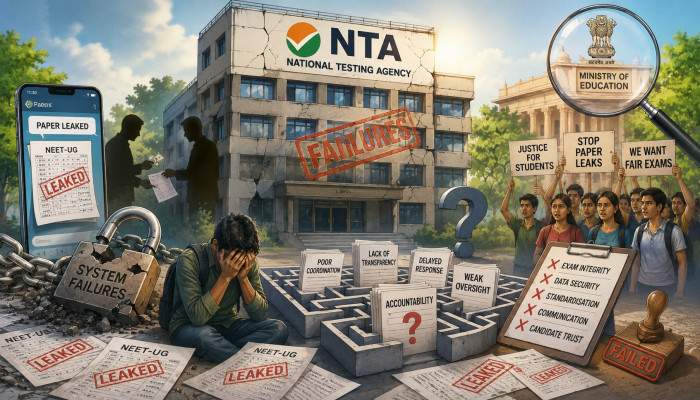
Paper leaks in India’s national entrance examinations are not a phenomenon confined to any single year or any single examining authority. Examined administratively rather than anecdotally, the record shows a recurring set of structural vulnerabilities under CBSE’s administration of AIPMT is inherited rather than resolved after the NTA took charge. Different investigations, years apart, have identified them in strikingly similar terms.
The 2015 AIPMT Precedent
Before NEET or the NTA existed in their present form, the Supreme Court cancelled the 2015 AIPMT examination conducted by CBSE after evidence emerged of a large-scale, technology-enabled cheating operation involving miniature wireless devices (Bluetooth earpieces) used to transmit answers to candidates from external solvers. Over six lakh candidates were affected, and the Court ordered a full re-examination, the first confirmed instance in independent India’s history of an entire national medical entrance test being cancelled and re-conducted. The episode is instructive because the vulnerability exploited was not a supply-chain breach but a candidate-side communication breach, a reminder that examination security is a multi-layered problem, of which physical question-paper custody is only one dimension.
Recurring Vulnerabilities Identified Across the 2015-2025 Decade
Reviewing bodies including the CBI, the K. Radhakrishnan expert committee, and successive reports of Parliament’s Standing Committee on Education have, over this period, converged on a consistent diagnosis of structural gaps rather than one-off criminal aberrations. Five recur across nearly every documented incident:
1. A multi-tier physical supply chain with numerous unsupervised handover points. Printing tens of lakhs of question-paper booklets weeks ahead of a single national exam date requires a chain running from secure printing presses to regional bank vaults or treasuries, to local transport, to the individual examination centre. Each handover printer to vault, vault to local police or district custody, district custody to the school or college functioning as a centre is a discrete point at which sealed material can be accessed, and investigations into multiple past leaks have found instances where sealed trunks held at temporary or school-level custody were opened hours before the scheduled start time.
2. Heavy reliance on private, lowest-bid vendors for security-critical functions. Because logistics, invigilation support, biometric verification and venue management have routinely been contracted out through L1 (lowest-cost) tendering, the individuals with physical proximity to question papers at the most vulnerable points in the chain have frequently been temporary or third-party personnel outside direct government service, with correspondingly weaker vetting, supervision and accountability than permanent government officials would carry.
3. Unvetted private venues. Reliance on private engineering colleges and schools rather than permanent, government-owned testing infrastructure as examination centres has repeatedly been flagged as a weak link, since such institutions typically lack secure perimeters, tamper-evident CCTV networks free of local interference, and staff under direct government accountability, making local functionaries more susceptible to coercion or inducement.
4. Organised commercial exploitation of extreme demand-supply mismatches. With over 20 lakh candidates competing annually for roughly 1,00,000 to 1,08,000 MBBS seats nationwide (of which only about 55,000 are in government colleges), the financial incentive for organised syndicates — sometimes referred to in investigative reporting as “solver hubs” — to intercept and monetise a leaked paper is extremely high, with sums reportedly running into tens of lakhs of rupees per candidate in past cases.
5. Instant digital dissemination once a physical breach occurs. Where an earlier generation of leaks might have remained localised, the ubiquity of encrypted messaging platforms means that a single photographed page can now reach a very large number of candidates within minutes, converting an isolated physical breach into a nationwide integrity crisis before authorities can respond.
A further structural feature amplifies the consequences of any breach in NEET-UG specifically: because the examination is conducted as a single national paper on a single day, in a single shift — unlike the multi-session, multi-question-set architecture used for JEE (Main) — the compromise of one master question paper places the entire national examination at risk, with no readily available fallback paper or statistical mechanism to isolate and discard only the affected sitting.
Specific Documented Episodes
The years 2024 and 2026 saw the most consequential manifestations of these vulnerabilities for NEET specifically, though incidents recur across the wider NTA examination portfolio:
- NEET-UG 2024 was the subject of extensive litigation before the Supreme Court over alleged paper leaks centred on Hazaribagh and Patna in Bihar, and a separate controversy over compensatory “grace marks” awarded to a set of candidates, which the Court ultimately directed be withdrawn for 1,563 candidates while declining to annul the examination nationally, holding that the evidence did not establish a systemic breach affecting the exam’s overall integrity. The CBI’s first chargesheet in the matter, filed on 1 August 2024, named thirteen individuals.
- UGC-NET June 2024 was cancelled in its entirety after its question paper was found to have been compromised and circulated on the darknet — the episode that, together with the NEET-UG 2024 controversy, directly triggered the constitution of the Radhakrishnan expert committee.
- JEE (Main), despite its computer-based, multi-session architecture, has not been free of administrative lapses: reviewing bodies have recorded instances of faulty questions being withdrawn from final answer keys after they had already been used to compute scores, and controversy in some sessions over the statistical normalisation methodology used to compare scores across differently timed shifts.
- CUET (UG/PG) has faced its own recurring criticism, principally over severe delays in result publication that reviewing committees found disrupted the wider academic admissions calendar.
What the Record Shows, and Doesn't Show
It is important, in an administrative account, to be precise about what the accumulated record across a decade actually establishes. It does not establish that every allegation of a “leak” in every year was substantiated; courts and investigating agencies have, in several instances, found evidence insufficient to establish a systemic breach, as the Supreme Court held in respect of NEET-UG 2024. What the record does establish, with considerable consistency across independent investigators and independent expert and parliamentary reviews conducted years apart, is a stable set of structural conditions: an outsourced, deputation-dependent workforce; unvetted private venues; a fragmented, multi-handover physical supply chain; and a single-shift examination architecture with no statistical fallback that recur as the operative vulnerability whenever a breach is in fact confirmed. The remainder of this series traces how an expert committee formally diagnosed these structural conditions in 2024, how far that diagnosis was acted upon before May 2026, and what occurred when the same vulnerabilities were exploited again in the NEET-UG 2026 examination cycle.
National Testing Agency: Mandate, Structure and the Roots of Institutional Fragility Part 2
https://myind.net/Home/viewArticle/national-testing-agency-mandate-structure-and-the-roots-of-institutional-fragility



 Loading...please wait
Comments